Showing posts with label drugs in film. Show all posts

29.1.14

No Mothafucka Tells Me When I Can Split: Super Fly (1972)

Well it has officially been the longest amount of time I have spent away from the blog since its inception.  Usually, I have some reason for a two to three day split that is tied to being out of town or simply not having a film with which I feel passionate enough to devote a few paragraph to at any great length.  This most recent stepping away though is wholly due to the notable shift in my life priorities, ones that have led to me spending a very very large amount of time at school (four graduate school courses proving time consuming).  I am also working on a few film related conference presentations as yet another work for publication!  As such, this blog which has always served as a sort of space of reflection will serve, at least for the next few months, as a space where I might occasionally reflect on a film or two, as I will be dumping almost all of my time into research (whispers that it might involve Godzilla are abound).  Furthermore, while it is still in the early, early planning stages there is also a plan for me to become involved with a podcast, one that will invariably help me to gain exposure to the world of film review and criticism that will be a welcome alternative to my enjoyable, but, nonetheless, taxing work in academic film writing.  With that in mind, I am still catching up with as many films as possible, quite a few I had hoped to share on the blog, but am only now coming back to review Super Fly a film that I had been quite hoping to watch some time ago.  Stuck inside because Columbia, SC has managed to actually receive snow, it is the only thing I am aware of that is cooler than the temperatures outside and is quite indicative of everything that has made the blaxploitation sub-genre, not a thing to mock and dismiss, but something that is wholly embrace by cinephiles.  Taking on filmmaking in a way that is both noticeably amateur, but also quite in tune with neo-realist filmmaking practices, Super Fly is nothing, if not a fantastic character study and time capsule of a moment in black urban thought.  Edited frenetically and pushed forward with a poised pace, the film would be quite respectable on its own.  Adding the superb soundtrack of Curtis Mayfield only makes it something extraordinary.


Super Fly focuses on the struggles of characters in black urban New York City as they exist involved to varying degrees in the trafficking, selling and using of cocaine.  At the center of this entire trade is Priest (Ron O'Neal) a cocaine dealer himself, who occasionally takes a sample from his own stash.  Yet, tired of being nothing more than a pusher man for the higher ups in distribution, Priest gets a wild idea and believes that with the help of his partner and fellow cocaine distributor Eddie (Carl Lee) that they can make one swoop of success over cocaine sales that will help the two remain rich for years to come.  After pushing and prodding their former drug source Scatter (Julius Harris) the two are able to get in contact with the biggest cocaine distributor in the city of New York, one who no surprise has ties to the mob.  When Priest puts his foot down as to both his own legitimacy as a dealer, as well as his own assertion that he will take no degradation on the part of a white man, he is provided with a large amount of drugs and sets about dealing them to the community.  Showing no shame in his actions, he eventually has a run in with the police, who instead of arresting him decide that they want to be in on the profits, allowing them to continue in their distribution as long as they pay a hefty fine to the boys in blue.  Scatter who finally sees this shift in the selling dynamics as his means to escape the city, borrows money from Priest and hopes to flee.  In his exit, however, he is stopped by the police and is forced into a heroin overdose in the back of his own Rolls Royce.  Providing a moment of clarity for Priest, he decides to take his half of the profits and split, using his guile to extract his money from Eddie's home without even the slightest of suspicious on the part of the police.  However, when the chief of police attempts to use firepower as a means to suppress Priest, the empowered ex-drug dealer blackmails him and escapes from the situation unscathed, looking with much hope into his future with money, love and perhaps a lot less cocaine use.


Super Fly might well be the most wholly realized of all the works the complete the blaxploitation cannon, excluding post-genre items that are often looking back on the era with love and admiration, but more importantly a far bigger budget.  As such, gleaning any singular theoretical idea from the films of this era are somewhat of a challenge, because frankly they were engaged in as many social messages as possible in condensed narrative spaces.  Super Fly while it may be about a drug dealer, is certainly also a prophetic warning against the dangers that drugs present not only to the African-American community as a whole, but to all individuals, regardless of race, creed or religion.  Indeed, Priest and those who surround his drug trafficking are aware of the terrible world within which they exist, but their respective decisions are predicated on addiction, survival and feelings of entrapment.  Painting the narrative as something that manifests itself out of white, hegemonic power structures, the presence of the corrupt members of the New York Police Department, take Super Fly from simply being a hip crime thriller, to something with the most profound of Foucaldian implications.  Whether it be the bizarre layers of self-regulation at work when the tenants of the dilapidated slums simply cower in the corner as opposed to mounting a revolution, or Scatter flees from the game only to be killed via forced overdose, the narrative shows the way in which law and its assumed protective status cause people to self-regulate in wild and oppressive ways.  Priest, whose name thus takes on more layers, serves as a counter to this authority and finds means to look back at the authoritative gaze, questioning the grounding of their power and whether or not the figures in charge need to undertake their own self-reguation.  Of course, Super Fly is not a film entirely void of its own problems, most pertaining to its complete lack of positive female characters throughout, aside from those who have direct ties to Priest's worldview.  It is in this narrative structuring that Super Fly becomes a hyper-masculine text, one that is afforded a bit of balance when juxtaposed with pretty much any film involving the headstrong Pam Grier.

Key Scene:  The drug trafficking montage is cinematic in surprising ways.

The DVD for this is quite cheap and well worth grabbing.  Hell the soundtrack is also worth your time.

4.1.14

You're So Stressed Out, Do You Want Some Pot?: Crank (2006)

I know that whoever might come across this blog would seem to find my taking the time to even blog about Crank a bit curious.  A film that appears to be a completely action oriented film starring Jason Statham that could very well have been shot entirely as a result of a couple of guys drinking way too much Red Bull before doing an equal amount of cocaine.  Crank is a movie that on paper would be everything I despise about the movie industry, because it appears to be filtering out normative fare about cool white guys running amuck in a city with little or no consequence to their own bodies or those around them.  Crank, however, proves almost immediately to be the singular exception to this rule, becoming something much more in lines with Tom Twyker's Run Lola Run or the maddening cinematic sporadical nature of a Terry Gilliam film.  Crank emerges off of the screen as some sort of larvae that had been festering in the open wounds of the post-modern cinematic structure, wherein the likes of referential filmmaking and only the most moderate of attempts to merge new filming technologies with narrative were being explored.  Here, in the frantic pace of 88 minutes the directorial team of Neveldine/Taylor offer up a cocktail of special effects, music and every other possible element that is as lethal to the eye sockets of the viewer as the drug with which the film borrows its title.  It is not to say that this sort of execution should be the singular approach to action filmmaking, because if done so with even the slightest of a misstep it becomes nauseating, foolish and frankly a bit grating.  Crank, however, manages to take the concept of the frenetic filmic possibilities of post-modernism and move the camera within the diegetic space in clever ways, both breaking the fourth wall and the very understanding of temporal progress in cinema to result in something that is far more enticing that it is disconcerting.  Crank has the feel of being a rather fun experimental film project that has been stretched to its absolute limitations, always at the point of cracking, but never losing its tension.  Indeed, if there is anything to find fault in with Crank it is the fanboys who have appropriated the film as their point of reference without doubly understanding the moral implications at play in the film or how the function as part of a larger commentary on the nature of dilmmic language and action cinema.  Crank is a gift, one that is both acknowledged by a large audience, but also quite overlooked by many for its layered critical possibilities.


Crank focuses on the character of Chev Chelios (Jason Statham) a hired hand for various criminal organizations in Los Angeles who happens to awake one morning to find himself in a dizzied frenzy and barely able to walk.  It is not until he approaches his television and discovers a DVD explaining his situation that things become much clearer.  Chev's former boss has exacted one of his henchmen, Verona (Jose Pablo Cantillo) to see to Chev's death, but given the warped sense of how to go about murdering a hired hand, Verona chooses to inject him with a cocktail of various drugs that put his body into a state of slow nerve and arterial arrest.  Panicking, the maniacal Chev attempts to contact his girlfriend Eve (Amy Smart) with no success, leading to his turning to his 'doctor' and medicinal advisor Doc Miles (Dwight Yoakam).  It is explained that the drug's affects can be slightly altered if Chev is capable of keeping up his heart rate and adrenaline to their highest points, as it will keep him functioning and prevent his body from shutting down.  At first completely concerned with sustaining his own well-being Chev begins a rampage about Los Angeles that includes him obtaining and snorting crack on a bathroom floor before getting into a fistfight and even driving through a packed mall in order to evade police in pursuit.  In between, all of this Chev continues to load himself up with various drugs and sources of caffeine, all the while attempting to contact Eve, while also obtaining information regarding Verona and his lackey through his friend and informant Kaylo (Efren Ramirez).  When Chev is finally able to catch up to Eve, her generally blasaie attitude, paired with her constant pot smoking lead her to be rather oblivious to the going-ons, although when she sees Chev's body falling apart she is willing to sacrifice both mind and body (in a very obvious way) to assure his safety.  Eventually, Doc Miles is able to meet with Chev and help control the substance running rampant through his body, but it proves only a means to slow down the decay, thus causing Chev to execute in his last hours alive the most wild and aggressive of revenge acts, all culminating with him falling as his body slows to its final beats.


This movie is a lot of things in a matter of very little narrative space.  It is rather clear that the filmmakers had a great time creating the film and by extension Statham seems to clearly enjoy the general off-the-wall nature of his characters' rampaging.  What is lost in the visceral styling of the film and the latent coolness of such a unchecked push through rage is a larger look at the male power figure in the action film and the ways in which he too is capable of going on rampages in the name of his own self-interests, even if not quite as intense as is on display in Crank.  This male action figure as body that can overcome all obstacles has its most classic connection to the iconic works in the James Bond franchise, primarily those tied to Sean Connery.  What makes Crank so absolutely scathing in this regard is the noted emphasis on Chev's own survival being predicated on filling his body with chemically vile materials, all the while breaking and plowing through everything in his path in rode to save himself.  Indeed, his relations to the other characters around him are also stretched by his own fight or flight mentally, here drawn out to a very literal level.  In a way, Chev is a Bond or, in fact, another Statham action character, but here the sense of good versus evil becomes far murkier, when indeed his only willingness not to flee for his safety and the though of taking Eve with him is challenged by the realization that even if he continues to rampage and destroy accordingly he will only do so in a futile sense.  This awakening all plays back on his ultimate decision not to go through with an assassination, which led to his being injected with the Crank in the first place.  Wherein a previous masculine action hero is playing into the execution of military orders or the saving of his daughter from an unseen kidnapper, Chev is solely doing things for his own fruition, taking and giving to others as it enables him to further on his desires.  This would all make for a great film, but what takes the film to the next level is the moment when Chev must encounter his own mortality in the death bed of a patient at the hospital.  The existential implications in this, one of two paused and slowed down moments in the film is highly evocative, as it is not until he is plummeting to his own death where the futility of his own actions and the larger masculine hero as harbinger of unchecked power crash to the ground, here very literally.

Key Scene:  It is tough to pick out of something that is so heavily invested in a strung out narrative, but one can see many of the elements at work well in the mall chase scene through its entire fruition.  Also the subtitles scene is pretty great.

Crank is rather easy to come by on bluray and must be seen in HD.  I was glad to become aware of this film through a blog some time ago of underrated bluray releases.  I cannot emphasize the deserved place of this film on that list.

9.8.13

I'm An Australian, And I'm Looking For A Friend: Stoner (1974)

Sometimes movies emerge into the world without any rational explanation or justification, and their very existence defines what the collective of moviegoers know to be absurdism.  The thing with this is these movies often tend to present themselves as such, focusing on the non-normative in cinema or completely rejecting constructs to allow for their desired message to emerge.  In other cases, the films simply manifest themselves because it is clear that nobody told the people involved not to do so and the result is one part baffling and another part profoundly transcendent.  At least I keep telling myself that is what is going on with the wild film that is Stoner, also known as the The Shrine of Ultimate Bliss.  I want to say that it is a film that is so terrible that it exists as being good, but it would be misguided to call it such, as it is rather clear that everyone knows what is going on and no sense of over-enthusiasm emerges.  Indeed, if any such zealousness were to come forth on the set of this film it is quite likely that it was devoured by the gross mustache that George Lazenby rocks for most of the film.  Stoner, bearing one of the worst conceived titles in the history of cinema, exists almost as two separate films that have a feeling of being paired together rather hap hazardously and even when the two protagonists meet up in the closing twenty minutes of the film it is rather hard to concede to it being anything but forced.  Indeed, where other blaxploitation and kung-fu films of the era would work because of their navigation and reconsideration of race relations in the venue of film, Stoner fails simply because it suggests that a fish-out-of-water film can work with a character who is a white Australian male.  It is no small bit of irony that it is George Lazenby who is cast in the role of Stoner, as he was himself James Bond, albeit for only one film, a white figure who moves through spaces he is deemed non-normative with the assumption that he is indeed still in a possession of power.  Stoner extends this commentary by making it work within the context of a kung fu flick, where in a hulking white guy beats down a ton of Asian bodies in the name of a vague narcotics bust.  It could have worked, were the film a little bit more self-aware about its absurdity, but Stoner fails by taking itself way to seriously, existing not as a accidental statement on a cultural issue turned into cinematic magic, as is the case with Reefer Madness, but one of a condemnation of a particular social pandemic that is so on-the-nose and poorly executed as to fall flatter than the obnoxiously awful Birdemic.


The bizarre world of Stoner focuses on the title character played by George Lazenby, an Australian narcotics officer who has been sent to China to explore the production and disbursement of a controversial drug known as "the happy pill."  The name suggestive of an antidepressant, actually appears to have more in common with modern day Viagra and other performance enhancement drugs, although this particular version works for both men and women and seems more indicative of an aphrodisiac.  Assumedly doing this task because the drug is highly addictive Stoner, moves about the streets of what is assumedly Hong Kong fighting of henchmen and mobsters who seem him as a threat, while moving through the various brothels and bars that have become the hotspots for the drug trafficking.  Meanwhile the film also focuses on Li Shou-Hua (Angela Mao) a Taiwanese detective who has also been tasked with breaking up the drug cartel, although she, as opposed to Stoner, finds herself with more access to the inner circles of the trafficking, particularly sources directly tied to Chin (Joji Takagi) the drug kingpin and maniacal leader who is credited with creating the happy pill.  The two separately navigate China, Stoner using brute force and a wicked mustache to get what he needs in various situations, while Li must be more crafty, relying on disguises as a salesgirl to infiltrate the inner circles of the mob.  Eventually, both Stoner and Li get to Chin's headquarters, simultaneously, and instantly befriending one another when they realize they have both arrived to take down Chin.  When they meet, however, Li is dressed in masculine clothing, therefore, Stoner assumes her to be a young man.  Eventually, the two are capture and it is revealed that Li is indeed a girl, at which point Stoner takes a clear sexual interest in Li, an act that is further problematic when considering that Chin injects Stoner with the happy pill juice to drive him to be sexually rampant.  Locking the two in a cell together, Li finds herself in a constant state of evasion from Stoner's unconscious, bumbling sexual advances.  When he awakes the next day to discover that not only has Li blocked of his attacks, she has also freed them both from their restraints, the two take it upon themselves to duke it out with Chin and his men, ending his production of the drug, while also coming into a ton of money, an amount that is immediately decided should go towards fighting narcotics traffic in Hong Kong.  Nothing is said about the future of either Stoner or Li, aside from showing a plane flying into the air, assumedly carrying Stoner back to Australia, whether Li joins him remains decidedly uncertain.


Transnationalism?  The dangers of addiction?  Passing as a different gender?  These could be possible things to talk about with a film like Stoner, but I just cannot get over the idea that it is a film in which George Lazenby, who played James Bond in On Her Majesty's Secret Service, moves about Hong Kong as a huge white guy beating up guys and sleeping with women, much like his British cinematic counterpart.  It is as good a time as any to mention that I am on the way to having an article published in a book regarding this very theme in James Bond films.  I cannot give details at the moment, but it is nice to be able to make the connection to a non-Bond film that happens still to include a James Bond actor, particularly since I do not include On Her Majesty's Secret Service in my paper.  Much as he does in On Her Majesty's Secret Service, Lazenby, as Stoner, arrives in Hong Kong and assumedly takes control of the situation demanding what he needs and desires with little concern for others around him.  Indeed, nobody seems to have asked the Australian to come, but it holds a sort of colonizing expectation that he can simply emerge and take what is his, doubly problematic given the relationship between Britain and China historically.  What makes Stoner starkly different from its Bondian siblings though is that the character of Li is not the submissive Bond girl, but instead a bad ass woman all her own, one that can pass as a man or woman as she sees fit, while also avoiding the very intense advances of Stoner.  In the Bond films he always gets the woman, even if she professes to be a lesbian, Bond finds a way to woo, often by force.  Angela Mao, does not allow a character such as hers to be taken by force, her prowess and skill evading and denying the oppression that comes from the lurking colonial figure.  True his wild chases are spurred by a heavy dose of drugs, but that does not mean they are any less problematic, particularly since the drugs were injected in him by another male figure.  Interestingly, Li is the only character who does not consume the drug and rejects it, adding a layer of sexual politics that suggest the "happy pill" to be a fabrication intended to justify male sexual prowess and dominance.  I know this is speaking in a lot of generalities, but I do not want to draw on anything that might show up in my publication.  When it becomes available publicly I will certainly refer back to this post with a more drawn out discussion.

Key Scene:  No scene, just Lazenby's mustache that inexplicably disappears by the film's third act.

I would avoid this film, there are much better Golden Harvest kung fu films to watch and in terms of George Lazenby, I would just check out his criminally underrated turn as Bond in On Her Majesty's Secret Service.

9.5.13

It's Easier To Pull The Trigger Than Play Guitar: Desperado (1995)

It is only fitting to include this hyper neo-western on my viewing docket for the month, because, after all it is a complete embracing and rejection of the traditional western that preoccupies itself with white, male issues and often passively incorporates Mexican characters as a means to create narrative cohesion, usually in an exploitative manner, reflect on my recent discussion of Rio Bravo for an example.  While the character of Carlos is certainly not out-and-out exploitative, one cannot help but question his relevance to a plot aside from filling a narrative gap.  What one is provided with in Desperado is a complete and highly visceral consideration of the experiences of, next to Native American persons, the most othered bodies within the traditional western, the Mexican/South American identity.  Robert Rodriguez's pseudo-sequel to El Mariachi (A film I absolutely adore) Desperado is in some ways better than its predecessor, while also lacking a considerable amount of its gritty low-budget honesty.  Robert Rodriguez, much like his filmic compatriot, Quentin Tarantino creates films that are so heavily invested in multiple genres and references as to almost not be any specific style, yet the nature of Desperado is, if anything, wholly a western that also happens to be a film about the drug trade.  Desperado stands as an excellent reminder that Tarantino, while a rebel and provacateur of a filmmaker, does not exist on a spectrum all his own, and very much exists in the same world as Rodriguez.  In fact, I know this will seem sacrilege to fans of this style of film, but in many years in which the two have released films in the same relative space, I would contest that Rodriguez has offered the better product.  Rodriguez, unlike Tarantino, manages to continually surprise, such was the case with Machete, a film I dismissed only to find it absolutely engaging and appropriately excessive.  Desperado is a cinematic fiesta that is tightly paced, while being slow and introspective when necessary, borrowing from a melodramatic tradition integral to Spanish cinema, while also embracing the b-movie world where Rodriguez clearly learned his film language.  Many genres formulate, instersect and explode on the screen in one of the globe's most criminally underrated auteurs work.  I would call Desperado a minor Rodriguez film, but even that makes it stand far above its counterparts.


Desperado preemptively follows the character of El Mariachi (Antonio Banderas), I say preemptively because he is introduced through a tale told by barfly and "brother" of El Mariachi Buscemi (Steve Buscemi) who informs a local bar, that is a knowing front for corruption and drug trafficking about his presence and killing at another bar, particularly his unusual means for carrying weapons via a guitar case.  El Mariachi is introduced within the context of a performance, one that is excellent, but goes unappreciated by the mostly white patrons.  As a result, El Mariachi goes on a quest to end the evil reign of Bucho (Joaquim de Almeida) whose evil ways have led to a border town turning into anything but habitable.  El Mariachi moves about the town, almost like a shadow, searching for Bucho and destroying all those who seem to get in his way, yet viewers are also provided a glimpse into the world of Bucho as he ruthlessly exploits everyone around him, regardle
ss of loyalty or family ties.  When El Mariachi finally discovers the bar which much of the trafficking takes place it results in an intense shootout with countless deaths.  During his retreat from battle El Mariachi is chased by one of Bucho's men and shot, only to be rescued and nursed back to health by bookstore owner Carolina (Salma Hayek) who sees El Mariachi as a hero her town desperately needs.  After engaging in a fiery night of passion El Mariachi uses information provided by Carolina to hunt down Bucho, only to discover that he has implemented every single member of the community into his drug ring, including children and even Carolina, using a back room of her bookstore to hide drugs.  Initially furious at the discovery, El Mariachi attempts to take on Bucho's men alone, a task that proves troublesome at first, especially when he is simultaneously attacked by the elusive and seemingly non-partisan Navajas (Danny Trejo).  Eventually, El Mariachi gets Bucho in his scope with a chance to kill him, which leads to the realization that Bucho is his brother, causing him to hesitate in his attack, much to the anger of Carolina.  After stepping over his fraternal boundary issues, El Mariachi recruits the help of his band, whose instrument cases also double as weapons, to take on Bucho's men and eventually Bucho, which is yet another bloody affair, although both El Mariachi and Carolina survive, and even if it is tumultuous the closing scenes suggest that their relationship will do the same.


Desperado, as noted in the opening paragraph, is a film that not only rejects white patriarchy and its power within the western genre, but turns it inside out, in fact, reversing the entire notion of who controls the space of the western, especially in a post-colonial world.  While Rodriguez's films would certainly evolve to consider the issues of navigating a border in a post-9/11 world, Desperado does not have the same concern, because its presence right in the middle of the 90's proved to be a culturally diverse and open to exploration.  Rodriguez however is not idyllic or optimistic about this sort of movement between borders, because as he sees it through the narrative of Desperado, the movement is only that of white tourists coming in and invading the cultural spaces of Mexico.  Think of the particularly frustrating scene involving a few American tourists critiquing Cheech Marin's character and his methods of bartending.  Granted, he is a terrible bartender, but their dismissal is based entirely on their constructions of American service industries.  Similarly, Rodriguez dismisses the carefree evasive attitudes of spring break college kids who move into Mexico expecting it to instantly become a party palace for their every whim and completely void of the violence and despair present in many border cities.  I know that it might seem as though such a set up would absolutely undermine the possibility for any tropes being discussed, but that is far from the case.  The idea of the "stranger" is quite prevalent in the western genre, however, it usually involves a dark, mysterious individual coming into a town and while El Mariachi certainly serves as the first example of this within Desperado, he is also not the stranger, especially since he is the person with whom viewers are to share with experientially.  Instead, Rodriguez has the moments of white invasion serve as a sort of example of how the stranger really exists within contemporary Mexico, especially when they double as a former colonizer.  The white bodies, including Buscemi to a degree, move through the space as though it is their own, while also fearing every alley.  In fact, I would say that the entire opening scene to this film sets up Rodriguez's idea of what non-Mexican bodies represent to the Mexican cultural community and, trust me, it is far from endearing.

Key Scene:  The big bar shootout is action scene magic

This is a cheap film to obtain and probably less recognized than it should be.  I would suggest picking up the bluray double pack paired with Rodriguez's earlier film El Mariachi.

29.4.13

My Head Is Made Of The Same Material As The Sun: Upstream Color (2013)

It seems as though calling a film transcendentalist would be a bit of an oxymoron considering the philosophical movements decided rejection of all things institutional, yet when one considers Shane Carruth's most recent work Upstream Color, one can find few proper terms to describe its unique, cinematic and absolutely mesmerizing quality and considering that it was written, directed, and, more importantly, produced by Carruth therefore allowing to exist about as outside of the institutional elements of filmmaking as possible, much as was the case with this now cult classic sic-fi enigma Primer.  If it were not enough alone that the film were outside of the system, as one would put it, thematically it draws upon a push from the absolute heights of technology and indoctrination back towards something in the natural world, almost bestial and intangible.  Of course, the film also makes heavy use of Henry David Thoreu's Walden which, undoubtedly, helps my case, although it is not in the "on the nose" pretentious manner that seems far more indicative of a terrible mumblecorp than the absolutely realized and visually haunting Upstream Color.  I would comfortably compare this film to the work of Terrence Malick with far less whispering and considerably higher amount of rejection regarding humanity as being inherently good.  One could also easily draw some connections to the work of Brian Eno, wherein he takes the most basic of musical elements and extends them to their grandest and most realized potential, finding the ambient enjoyment in minimalism.  While Upstream Color certainly uses visual elements in varied and intense manners, it still seems to have an ambient element about it, nonetheless, one that moves through itself and beyond itself, occasionally tapping into the most basic of human desires and experiences, only to make grand statements about the universe moments later.  Upstream Color is an early 2013 release and will likely become forgotten by the time awards season rolls around, however, it is such an engaging and challenging cinematic experience that I am convinced that it will do very well come the end of the year when I reflect on my favorite film experiences of the year.


Upstream Color certainly has a narrative, however, much like Primer it is so intertwined, cyclical and non-linear as to make navigating it with any degree of certainty, nearly impossible.  What does exist is a series of characters and ideas which seem to result in some identifiable narrative moments.  The main character of the narrative appears to be Kris (Amy Seimetz) a graphic designer whose run in with a drug dealer known only as The Thief (Thiago Martins) results in her losing all her assets, and her job, when the drug, created by some hybrid of plant, liquid and insect causes her to be hypnotized into following every order of The Thief.  This portion, however, is followed by Kris, now possessing much shorter hair and her attempts to rekindle a relationship with her estranged husband Jeff (Shane Carruth) whose own illicit behavior as an off the books broker for a set of motels leads to a certain degree of paranoia.  These interactions, as well as brief other occurences, are monitored by The Sampler (Andrew Sensenig) who appears to be an experimental musician with an expressed interest in capturing and altering the noises of nature into ambient, polyphonic musicscapes.  However, considering the location of much of The Sampler's work it is also quite possible that he is a pig farmer, who has music as a very secondary hobby.  When the traumas of the past and Jeff's own problematic present state lead to a falling out the couple almost split ways, only to decide to give their relationship one more shot, this time with a greater degree of success, although there arises on issue as to their shared understanding of past events,  particularly Jeff's assurance that what Kris assumes to be her past is indeed his own.  However, their memories seem to collide together in poetic certainty when the two arrive at The Sampler's pig farm and find themselves magnetically drawn to the animals, an act that has a certain degree of connection based on Kris and her previous run-in with The Thief, however, the involvement of other previously unidentified bodies makes the experience both incredibly personal to Kris and seemingly universal to all those involved, including Jeff and The Sampler, and, indirectly, The Thief.


It is the very indistinguishable line between the personal and the universal that seems to draw the narrative ideas of the movie together.  It is no accident that the film borrowed heavily from Thoreau's Walden exists in a similar thematic space, although to be fair that is very much the nature of transcendentalism.  It first involves a person finding themselves in relation to the institutionalized state they live in, then rejecting it and in the process of rediscovery finding a larger meaning.  One of the best moments of this within Walden involves Thoreau innocently looking into a frozen like at the habitat below leading to his own personal identity crisis, followed by a profound reflection on his relationship with a higher entity, in his case God.  Upstream Color is not so much oriented towards the higher deity aspect, although Kris and her vision of a sun-headed man, could certainly glean such a response, instead; it seems concerned with a push towards a healthy non-institutionalized way of living.  In fact, even the very drugs that exist within the narrative are completely detached from an sort of chemical-pharmeaceutical hands.  They appear to come from the earth, eerily manifesting themselves out of nothingness.  Interestingly enough, while Kris is going through the process of rejecting all her "earthly possession" as it were, her diet consists solely of water and ice, a veritable cleansing that goes along with her move towards a transcendent lifestyle.  One could certainly argue that the tension in her relationship with Jeff is a result of his continued attachment to the institutionalized world, even though his existence is entirely detached on paper.  Furthermore, the irony of them moving through hotels is not lost, in so much as not only is it not a home they built on their own, much as Thoreau did, it is further a space that even as it is intended to be a place of safe space and rest is not one of possession.  As such they must return to the dirt of the earth for the answers, and Carruth is clever to make it the most disgusting of places, a pigsty, perhaps suggesting that life is eternally attached to the most grotesque and it is in this realization that others can begin to share in the beauty of the world, at least the closing montages suggest such a possibility.

Key Scene:  The sun-head scene involving Kris and The Thief is cinematic magic.  I am almost scared as to look up how it was done, as it would inevitably spoil some of its awe.

This is a stellar work, it is well worth obtaining on bluray to view once, twice or even three times.  I imagine it even exists as a wonderful sort of backdrop when muted.

21.4.13

Depression Is The Inability To Construct A Future: Side Effects (2013)

If it were not for the absolutely amazing and impeccable work being put out by Paul Thomas Anderson I would be in line to call Steven Soderbergh the best director currently working in film.  Always consistent and always pushing his limitations the rather unfortunate news that he is considering retirement is of great concern to film critics and cinephiles the world over, especially since he is making a conscience decision to move onto other non-film related endeavors.  Given his keen concern for perfection I am sure his next ventures will be met with much success, but it is still a bummer to think about, especially since films like Contagion and Bubble have received high praise and are certainly among some of my favorite films of their respective years, and I am a defendant of both The Informant! and Magic Mike as being highly underrated, yet keenly engaging films.  In fact, Soderbergh as a filmmaker represented on this blog is just short of the recently reviewed Kim Ki-duk for having the most films in which I have written full reviews.  Where Soderbergh does seem to be winning is in the area of receiving the most comparisons, scrolling through some of my past reviews it is rather clear that I associate a certain sort of deep focus minimalism with the director and deservedly so because he continually delivers a high quality product in a packaging that is clearly distinguishable as his own.  This is certainly not an exception for his most recent film Side Effects, which comprises itself of a handful of actors Soderbergh has relied on in the past and visually defines his auteur status, even if this proves to be his last film, aside of course for his highly anticipated HBO movie, Behind the Candelabra which is about, of all things, Liberace, a subject so sensitive that it could only work in the delicate surgeon-like hands of Soderbergh.  If Side Effects proves to be his final feature film then so be it, while it will certainly not stand to be his best work, it is still an exercise in excellent filmmaking and takes a plot with twists and deception and never allows viewers any moments to reside if comfort.  I was one of two people in the theater watching this movie, but when a certain, very violent scene occurred I was aware of my own gasps of astonishment, as well as those of the other person.  Unsettling would be the word to describe these moments, but considering that it is generally an absolutely bleak and stark film, one could never really define the viewing experience as welcoming.


Side Effects in all its multi-person narrative centers on two main figures, the first being Emily Taylor (Rooney Mara) a woman who is suffering from various degrees of psychotic breakdowns as a direct result of losing her illustrious and well-to-do lifestyle after the arrest of her husband Martin (Channing Tatum) after being found guilty for insider trading.  She is happy about his release from prison, but when the stress proves too much she drives herself into the wall of a parking garage, thus leading to her being hospitalized for suicidal tendencies.  It is there that she meets the doctor on duty, psychiatrist Jonathan Banks (Jude Law) whose hopes of finding success and a great future for his fiancee and her daughter have led him to take up extended shifts, as well as agreeing to more work with experimental pharmaceuticals.  However, when a combination of anti-depressents and anti-sleepwalking medicine lead to Emily violent stabbing her husband, Jonathan's involvement with the girl is put into question, especially since it appears as though he was solely responsible for the misdiagnosis and its subsequent fatal results.  In the process, Emily's former psychiatrist Victoria Siebert (Catherine Zeta-Jones) steps prominently into the picture spouting advice and opinions about Emily's past mental issues.  When it becomes evident that Victoria has her own interests at heart and that Emily is consistently attempting to undermine Jonathan's well being, he takes it upon himself to delve deeper into the case and prove that his actions were not to be blamed for Emily's terrible acts.  Of course, the added burden of this preoccupation with innocence leads to his being chastised for poor performance at work, which causes his fiancee to question his motives, only worsened when a set of compromising pictures surface, suggesting that Emily and Jonathan had a relationship that extended beyond patient/client lines.  This last form of loss leads Jonathan to throw everything at proving his innocence, an act that proves beneficial, although incredibly trying for the young doctor, however, he proves that deception is afoot and that proving one's sanity may well be more difficult than arguing for their insanity.


Much like his stellar film Contagion, or any film by Soderbergh that focuses on a specific subject, Side Effects deals with the world of prescription drugs, to be specific anti-depressants, in a near ethnographic manner.  The low key manner of his filmmaking and concern for story and character over visual flair leads one to constantly have to remind themselves that what they are watching is indeed fictional and far from full truths.  Perhaps this works exceptionally well in regards to this film, because it is decidedly concerned with the frail line between reality and illusion and to what degree one can cross those lines in the name of escapism or self-preservation.  At various points throughout the film each of the main characters engages in their various forms of deception, each with their own ulterior motives and desires, it is not a question of the ethics of the act of lying or purposefully deceiving the world, because as many Soderbergh films have done in the past, this is a relational issue.   People in the world of his films, and, to some degree, the world outside the theaters, are prone to deception as long as it assures the happiness of those around them.  I would be hard pressed to find even the most sanctimonious of people who do not lie in the face of despair or sadness to push towards the possibility of happiness.  This certainly seems to be the case for the relationship between Emily and Martin, they had an entire life of all they desired predicated upon high degrees of lying and deception and when the light is thrown upon this lie, it is hard to maintain the performance even in the most intimate of settings.  As such, Side Effects brilliantly captures the world of pharmaceuticals to great detail, but that is only the surface commentary of the film, because at a much deeper level Soderbergh seems intent on considering how we use drugs, and the chemical deception they provide to mask our delusional view of the world around us, as well as an excuse to actually go of the deep end when it proves advantageous.  To the world of Side Effects, drugs are a secondary problem to the general acceptance of lying for sanity's sake.

Key Scene:  Soderbergh goes Hitchcock via a Psycho style scene and boy was it intense to watch on the big screen.

This is a great film and considering that it could be his last theatrical release, I feel as though you owe it to yourself and the great auteur to seek it out at your local cinema.

5.4.13

I Saw Death Rising From The Earth: A Scanner Darkly (2006)

I recently stumbled upon the madness that is cultural outpour via Nerve.com, a decidedly counterculture forum.  I particularly enjoy some of their deeper delving into insanity through experimentation with over consuming various things, whether they be legal or illegal.  However, I as a cinephile and part-time film critic was particularly intrigued, and, subsequently, enraged by their various "ranked" listings, where they take it upon themselves to put things like director's films in chronological order.  It was one particular post titled Philip K. Dick Adaptations from Worst to Best that caught my attention.  I am no scholar of Dick's work and have not seen a considerable amount of the films mentioned, however, I have attested to my love of Blade Runner and quickly assumed that it would be this film that would easily steal the number one spot on the list...this was not the case.  The folks at Nerve.com went with A Scanner Darkly, a film I was familiar with, but had only seen clips of up until that point.  I was perplexed and decidedly upset by the choice, feeling as though the perfect Blade Runner had no business in any spot but first.  However, I knew that to truly affirm this statement I would need to watch A Scanner Darkly in its entirety and really synthesize it as a film before making a definitive statement.  So upon watching it I can say this, Blade Runner is still a considerably better film, but damn if A Scanner Darkly is not a menacing, dystopic piece of cinema that is deserved of high, high praise.  I am not entirely familiar with the book on which this is based, but looked it up and discovered it to be written in 1977, which is baffling, especially since watching it now, some seven years after its filmic release, I cannot help but consider how both prescient and ahead of its time the text really was and still is, particularly in its consideration of the maddening effects of drug culture on identity, self-respect and interactions between various persons consuming such psychologically altering substances.  Of course, I am aware that some of these reactions are a result of Richard Linklater's adaptation and filming, particularly his use of rotoscoping, to give it an otherworldly feel, while still touching dangerously close to reality, in fact, if one blurs or clouds their vision during the viewing, it suddenly becomes all too real and incredibly disconcerting.  The implication are heavy in this film and its stylized nature certainly attracts viewers, the message brilliant and while again not Blade Runner, certainly exists within the higher tiers of science fiction filmmaking.


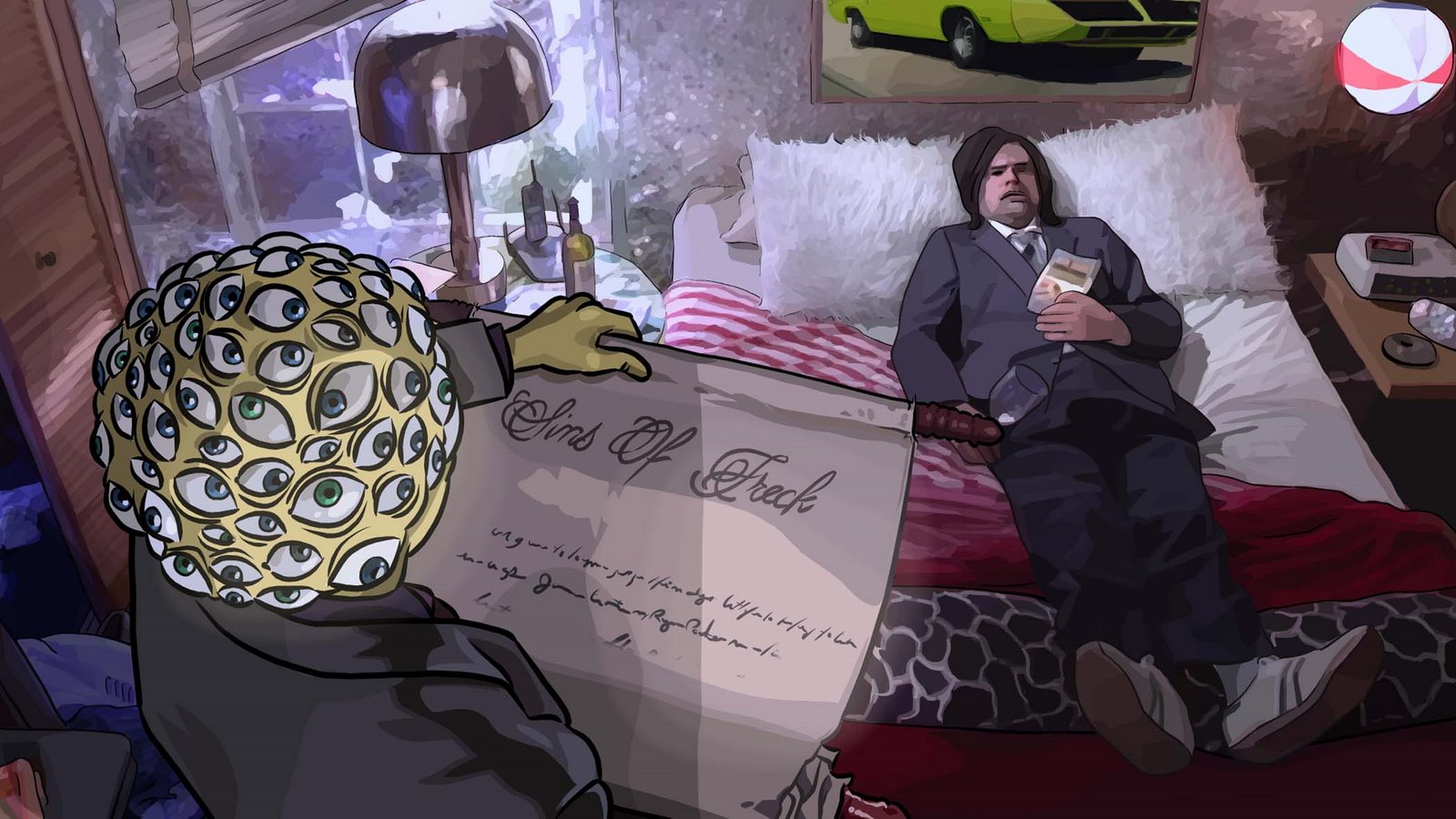
A Scanner Darkly centers on a post-drug war America that finds itself in a heavily Orwellian state, one where phone calls are traced and video recordings invade even the most intimate of actions.  However, despite these intrusive technologies, drugs, nonetheless, manage to intrude into society, via various dealers and drug circles.  One drug, in particular, Substance D proves debilatating in its psychotic alterations, leading heavy users to suffer from split brain psychosis and intense and visceral paranoia.  As such the police force for Orange County invests in methods to destroy the trafficking of the drugs, using agent Bob Arctor (Keanu Reeves) to infiltrate a high-powered Substance D ring, involving the anarchistic, yet maddeningly militaristic Barris (Robert Downey, Jr.) and his stoner-like pal Ernie Luckman (Woody Harrelson).  Perhaps the groups most troublesome individual is Charles Freck (Rory Cochrane) whose addiction to Substance D, has all but entirely destroyed his mind.  As Arctor's involvement with the group heightens, so does his burgeoning friendship with the group, particularly one with sexual implications with a come-and-go guest in the house Donna (Winona Ryder).  It is during a day at work that Arctor is informed by his superior Hank, who, like Arctor wears a "scramble suit" which is a constantly shifting identity suit that makes the identification of their creator's form so rare that it only occurs about one in every million manifestations.  Needless to say, the double duty of attempting to continue to mask his presence as Arctor while also getting "closer" to breaking up the drug ring proves far too much to handle, only worsened by his continual use of Substance D, within the confines of his work.  He begins to become the subject of tests by the police psychiatrists, only to be told that his brain has now split and is beginning to work against itself.  It is one night, after a failed attempt at romance with Donna that Arctor's insanity splits and he finds himself seeing persons present in situations they are not present, which results in him being entirely pulled of the case where he was to investigate himself.  It is during his last "talk" with Hank that he realizes his boss may well be Donna undercover, leading to the final break from sanity, leading to his being placed in rehabilitation.  It is during his rehabilitation that he is sent to a farm to aid in "growing items," which is intercut with a scene of Donna, known, out of cover as Audrey, talking with a superior about his possible memories of a drug, which will allow him to hopefully undercover the truth that the farm using addicts from Substance D, is, in fact, the same place growing and harvesting the chemical.


The film is absolutely baffling and nearly incomprehensible on first examination, after all, it is Dick's very moving text that is both a cautionary tale against drug use, as well a work created to pay homage to his friends whose lives were invariably damaged by the drugs of the era.  It is perhaps this framework that makes the narrative so complex, because Linklater's adaptation makes it clear that it neither condemns nor praises those involved in drug use.  In fact, it shows the layers of dependency and paranoia that emerge as a result of such engagements.  For example, Barris is always spouting ideas about being watched by the government and being steps away from getting narc'ed out.  This would be illogical in most film settings, but this is the entire narrative of the film, Barris is continually in contact with a friend who is essentially awaiting a moment to bust him for his use and distribution of Substance D.  Furthermore, Arctor's misery seems to stem from his concern that he is alienated from the society around him, believing that the performances he puts on are meaningless, because what results is his failure to earnestly connect with any one on an earnest level.  The irony extends itself when one considers that, as part of his job, he must wear a suit that continually alters his identity, so much so that he is never himself, but on the rarest of occasions.  Tragedy, emerges then when he does seem to have a moment of genuine connection between another person only to be denied that pleasure, when she claims to be too involved in drugs, but what proves to be the likely alternative is that she knows engaging with him could destroy the larger plan to exploit him to attack the drug producers down the line.  In fact, Arctor is even told that he is insane, leading to his questioning every action, even the moment when he does realize that Hank, is indeed Audrey/Donna he is so unstable that to question it would be to affirm his own fall into psychological instability.  The result, of all this, I would suggest is not to condemn the drug users for their eventual fall out, but instead, to critique the nature of drug trafficking, both in its indifference to those it hurts, as well as the way in which the government uses it to their advantage in one moment, only to turn their heads and condemn it in another breath.

Key Scene:  The moment when Arctor catches a glimpse of Donna in the scramble suit is so built up and delivered with such succinct certainty that it is hard not to be completely blown away by its occurrence.

The bluray is phenomenal.  Show Dick and Linklater some love and grab a copy.

30.3.13

Nothin' But Boobies. Who Needs 'Em?: Valley of the Dolls (1967)

If I want to embrace yesterdays film Foxy Brown for its absolutely brilliant use of metaphor, then I will have to come down quite hard on Mark Robson's 1967 film Valley of the Dolls, an adaptation of a Jaqueline Susann novel of the same name for being far too over the top and showy to really justify its intensity.  Sure the film is absolutely mesmerizing visually, particularly its use of psychedelic sequences to depict pill highs, and the rather innovative method for depicting musical numbers.  Yet, it must be acknowledged that the film really seems to lack a clear direction, social commentary or set of relateable characters in general.  While these are not necessarily mandatory for a film to be enjoyable, just look at anything Harmony Korine has made, when something like Valley of the Dolls attempts to reside within the cinematic and frames itself within the traditional aspects of filmmaking, it can be rather unbearable to watch it crumble under its own overly lofty ambitions.  Perhaps my real problem with the film comes not from its broad ambitions, I enjoy films with audacious hopes, but, instead; from its inability to relate its visual endeavors with the story shown.  While I have never personally read Susann's novel I cannot speak to how faithful Robson's adaptation is or is not, I, however, imagine that some of the "whiteness" of the narrative is undercut by the reality of the then tense racial climate.  The film viewers are provided with plays heavily into assumptions that everything is terrible in the world of well-to-do white people, almost entirely as a result of their large amounts of free time.  In fact, this is a film about a girl moving to the big city and attempting to find her identity, something her class and race afford her to do without question.  I know this is a rambling bit of rage and theoretically obtuse, yet, I just felt really let down by what I assumed would be a far more astute observation of sex, drugs and exploitation in the era, yet, the result was far less thrilling and certainly problematic.  In fact, if it were not for the beautiful voice of Dionne Warwick at the films opening and closing I would be inclined to dismiss the film in its entirety, and to think I almost bought a copy of the film flat out based on the cover alone.


Valley of the Dolls centers on two young girls who decide to take a shot at Broadway and all its illustrious promises.  The first girl Neely O'Hara (Patty Duke) is in possession of a powerful voice, but does not necessarily fit the look of a Broadway starlet.  The second is Anne Welles (Barbara Parkins) a young woman from New England who has travelled to the big city, completely living her somewhat provincial life and middle America lifestyle behind her, including a promising marriage proposal.  The film then becomes, ostensibly, about making the correct choices.  Another girl within the group of women attempting to hit it big on Broadway, Jennifer North (Sharon Tate) takes the approach of marrying into success, assuming that it will afford her open doors to big events and eventually huge theater deals, however, she ends up pregnant and in need of an abortion, which leads to another layer of medical expenses.  In the end Jennifer must break-down and star in European "soft core" erotic films.  On the other hand Neely, in an attempt to use duplicitous and devious behavior to her advantage, much like her idol, an aging Helen Lawson (Susan Hayward), however, in the process, Neely comes to obtain a crippling addiction to barbiturates, known, as "dolls" in the community.  Anne is also not free of the dangerous influence of "dolls," and succumbs to their influence for a considerable amount of time, yet is able to escape their addictive nature.  Neely, however, continues to spiral out of control and ends up in an asylum for a portion of the film, where she is assured that she caught sight of a former lover.  Yet, upon release Neely's addiction worsens, and when she adds alcohol to the mix things only spiral further downward.  In the end, Anne returns home to her family, realizing that, perhaps, the big allure of Broadway is far too much for her and simplicity is her best course of action.


This movie is all over the place philosophically, and seems to desire to dump the entirity of women's issues onto viewers, without properly dealing with any of them.  There is a character who is diagnose with cancer, and its relationship to the overall plot is so loose that I could not help but recall the announcement of having cancer that occurs in Tommy Wiseau's The Room.  I am, obviously, all for films dealing with issues of women's health and their social objectification, in fact, almost every paper or presentation I give concerns this, yet, I have no desire to engage with materials that only do this on a cursory level.  There is an abortion in this film, very little is made of this, despite clearly having rather dire effects of Jennifer and her self-identity.  She spirals into doing softcore pornography and the film never suggests that her inability to talk about her feelings post-abortion may have played into her choices.  Furthermore, the film uses some incredibly derogatory terms for sexual identity as it relates to one character, and while one could certainly suggest that this is due to drug induced rage, little consequence or challenge is given to these slurs and hateful diatribes.  Finally, the film manages to take hysteria and use it as a plot advancement without, simultaneously, condemning it as a illogical and societally constructed phenomena.  In fact, Neely's entire stay at the mental asylum appears to be an "expose" on how hysteria manifests itself, however, she is vilified for these behaviors, nevermind, that she is just as much caught in a love triangle with Anne and another man.  Very little seems to emerge in the way of critiquing males for their involvement in the problems "discussed" in this film and it is perhaps in this that I find the film most frustrating.  Again, I would rather have a film not discuss such dense and controversial topics, than to do so with half-hearted, nearly exploitative intentions.

Key Scene:  Again it is a visually pleasing film and the musical sequences are quite funny, I did, however, laugh out loud during the "European film" sequence.

This is a rental by all means, perhaps I am completely wrong in my opinion of this film and will certainly revisit in the future, however, as it stands I do not particularly care for its messy framework.

29.3.13

I Got A Black Belt In Barstoolin': Foxy Brown (1974)

I would have been quite foolish to have gone the entire month without including a film from the blaxploitation explosion which occurred in American film during the 1970's, particularly, since the genre is full of some rather intriguing and unusual depictions of women, in some cases quite problematic, however, on occasion the women who possess spaces in these films did so with such a degree of authority and strength that they would become symbols of power and pride for women, particularly those of color, for decades to follow, and even be remade in loving homage by Quentin Tarantino.  At least this is the case for Jack Hill's 1974 blaxploitation classic Foxy Brown, which is a funky, fresh and absolutely thrilling look at the effect on drugs and urban black populations in the seventies.  Of course, sticking it to the man and promoting a drug-free culture within the African-American community was nothing new to blaxploitation films thematically and the idea was certainly not uncommon within the political debates occurring in urban communities during the era, however, one cannot ignore the masterful and, admittedly, awesome ways in which this rather run of the mill story unfolds in the world of Foxy Brown.  Like many of the era's classics, it is rife with some terrible acting and some of the most haphazard editing techniques ever comitted to film, which have come to signify some of the more negative elements of the genre, yet, it is also a film with an excellent soundtrack, some fun over-the-top fighting scenes and enough interracial relationships to make CPAC and the American Family Association go up in arms.  These are, obviously, the things that have made these low-budget urban flicks last and remain cinematically relevant.  Foxy Brown is an exception to its counterparts, with its strong and sensual female lead who is unarguably victim to the male gaze and cinematic objectification, yet her existence and abrasive confrontational attitude stand to confront this objectification head on, making Foxy Brown a girl of revolutionary means both cinematically, socially and historically all at once.


Foxy Brown, surprisingly enough, does indeed focus on a woman named Foxy Brown (Pam Grier) a black woman who seems to have it hard enough navigating the unwelcoming world around her, especially after her boyfriend became a victim of assault for working undercover to bust drug trafficking.  Even when he returns to society, it is as a new man, undergoing plastic surgery to change his alias.  Things seem to be great between Foxy and the new version of her boyfriend, yet her wily brother Link (Antonio Fargas) finds himself tied deeply into drugs himself both as a user and a dealer and quickly becomes financially indebted to the wrong people.  Realizing that Foxy's new lover is indeed the old narcotics officer, he rats him out for his own safety, leading to his murder.  This illogical murder and death of her lover, which has now essentially occurred twice, leads Foxy into a decided mode of revenge, in which, she seeks out all those involved in the wicked trade beginning with the lowly henchmen and working her way up to the druglords.  Along the way she meets an group of terrible, mostly white, people who find her foolish attempts, at the most humorous, always standing in her way, whether it be the simultaneously suave and gross Steve Elias (Peter Brown) who takes a sexual interest in Foxy, yet cannot remove himself from his oppressive state as a higher up in the drug trafficking.  Foxy also comes into contact, multiple times, with a woman named Katherine Wall (Kathryn Loder) who sees Foxy not only as a threat to the success of her brothel/drug ring, but her own power at a sexual figure as well.  After making quick work of everyone from the drug pushers to high-end politicians, Foxy finds herself at the point in which she must destroy the drug distributors at the root, and she recruits the help of her local Neighborhood Justice Comittee to end the terrible engagements.  This, of course, involves a ton of guns and shootouts, but Foxy eventually obtains what she wants, both justice for the wrongs exacted by drug dealers, as well as revenge for the people who were directly involved in the murder of her lover.  Despite being sexually objectified, beaten and forced to take heroin, Foxy moves from the situation a bigger and more threatening, not to mention enlightened woman.


So many a critics, particularly with a feminist lens in mind, have dismissed this film, and many other of the era for their heavy use of nudity and the naked female form, for what seem to be inexplicable moments.  I get this reading, trust me it is a film far from being void of problems, however, where I want to draw the line with a film like this is its distinct use of metaphor and message.  The body of Foxy is exploited and objectified, not for the sake of male gaze in a cinematic sense, but as a very real call to attention of these issues occurring on a large scale, especially within the urban community.  The film rejects the notion of black women as being highly-sexualized, in fact, Foxy inverts this notion and uses the bigotry to her advantage, playing up on this assumed sexuality to get a politician caught in a controversial act.  Similarly, the idea that the black woman is to reside in the back ground to the black male political cause is also rejected within the film, it is Foxy who saves her brother, and while she does require the help of a group of black men to, ultimately, take down the drug dealers, it is her image of empowered black woman that ends the film, leaving no question as to where she stands in relationship to the rest of her community.  However, what I think puts many theorists up in arms, is a scene depicting Foxy fighting a group of white, lesbian women in a dive bar.  They find her presence problematic and not entirely welcome, and one might anachronistically read this as a division of women, yet, one must remember that the film was released in 1974, at this point in time the National Organization for Women was still predominantly white women, and only two years earlier when Shirley Chisholm ran for president, NOW back a white male, to avoid the fears of losing in supporting a black woman.  It is a film of layers, to read into the nudity is a necessary one, without question, however, it extends to something much larger and more revolutionary.  Foxy is a woman, one of color and she fights against the man, which evolves far beyond the simple assumptions of rich white male wealth, essentially, this is a key moment in analyzing intersectionality, far before it became socially and theoretically acceptable to do so.

Key Scene:  The bar scene is everything one could want from a blaxploitation film in all its cheesy, yet awesome glory.

This film is super cheap, I do not foresee a bluray version coming out anytime soon, therefore, a DVD copy will suffice.