The bad movie is a beloved area of movie going and cinephilia all its own. Between movies with cheesy special effects and some of the worst acting conceivable, one has a wide array of options to view, if they are prepared to completely disavow any respect for cinematic tradition. Now, these films are treated for their absurd nature with love, many receive far more care and distribution than monumental art house films whose demand simply does not match that of The Toxic Avenger or the bizarre film that is The Room. These works usually traipse the line of new director establishing themselves and being created on a shoestring budget as passion projects by a group of friends. Bad movies are bad, but notably they are not cinematic masterpieces. I would have adhered to this ideology with such a strong voice only yesterday at this time, but then I watched Kathryn Bigelow's 1991 action/surf/buddycop/romatic drama that is Point Break and was required to completely reorganize my understanding of bad movies. Point Break is everything that should not exist is a respectable piece of cinema blown about over a two hour window, emphasized by hokey camera shots and enough overly forced dialogue to make even these least sensible person to the art of acting cringe. Pair this with what has to be one of the more curious studies of masculinity and male desire committed to film and I would argue that Bigelow is knowingly creating a terrible film as a means with which to call attention to the medium and the genre itself, appropriating a variety of different genres that deal with masculine identity as a means to critique the genre and show the latent homoeroticism at play in movie going. Since this film, it would be hard to establish the identity of Kathryn Bigelow as a decidedly feminist filmmaker, one working within the space of masculine war areas to look at issues of identity. While Zero Dark Thirty is quite a promising departure from her earlier fare, Point Break may well be her masterpiece, if only for its unapologetic attachment to all things bad in cinema as a means to crack into a larger commentary on what is truly terrible about the relationships of viewers and film. It might have been purely accidental, but Point Break is a post-modern stroke of cinematic negation and deconstruction in the most veiled and backdoor means imaginable.
Point Break focuses on the relocation of burgeoning FBI agent and former football star Johnny Utah (Keanu Reeves) a poised, but notably green behind the years guy, who wants to quickly make a big name in the department to move into higher positions. While Utah is far from pleased with his location matters are made slightly worse when he is assigned with the veteran cop and general wise ass Pappas (Gary Busey) who seems more concerned with playing into conspiracy theories within the department, particularly with their to the books boss Ben Harp (John C. McGinley). Nonetheless, Utah and Pappas are assigned to work on a case of bank robberies, undertaken by the group known as The Ex-Presidents, a moniker attached for their wearing of presidents masks while enacting the robberies. While the department has very little to go on regarding the identities of the members of the group, there is a strong indication that their whereabouts are somehow tied to a beach outside of Los Angeles. As such, both Utah and Pappas are designated to go undercover and discover exactly who is involved in the ordeal, or at the very least to find information regarding the whereabouts of The Ex-Presidents. Under the guise of being a lawyer interested in surf lessons, Utah finds an in through a local surfer girl named Tyler (Lori Petty) to whom he takes to desiring almost instantly. It is by Tyler's extension that Utah meets Bodhi (Patrick Swayze) discovering in him a source to all the going-ons in the beach, as well as a friend. Indeed, Utah seems almost as enamored with Bodhi as he is Tyler, finding his own drive to catch the perfect ride almost saintly. While Utah continues to chase down leads on the possible members of The Ex-Presidents when a chase and gunning down of a series of neo-Nazi's proves a bust, a minor incident leads Utah to become certain that it is indeed Bodhi and his friends who have been undertaking the crimes all along, putting the still learning cop in a compromising position between friendship and the law. One that goes sky high in its ambitions and crashes hard in its final outcome. All with the variants of bro being thrown out along the way.
Sure it would be delightful to just go into the almost impossible incessant variations on the possible spellings of Reeves' and Swayze's respective pronunciations of "bruh," and I am sure this has become a drinking game by this point, but I do have an earnest curiosity directed towards the way in which language, look and performance all sort of coalesce within the space of Point Break to become a dynamic and deconstructed understanding of the male body on display in film and by extension how that male body shares in looking at other bodies both dietetically and non-diegetically. If one were to read the synopsis for Point Break or to look at the poster, it seems like rather straightforwardly a buddy cop and/or law/justice type narrative, but the reason this film works on a distinctly different level is that it spends so much time--perhaps unnecessarily so--on considering the relationship between Utah and Bodhi, one that often goes unspoken and still possesses a high degree of sexual longing. The initial encounter between Utah and Bodhi comes at Bodhi's confusion as to why Tyler is now clinging onto the newly present surfer, seeming as though he is jealous of her affections being relocated. However, this sequence is immediately followed by a game of football where Utah is able to show off his skills athletically, all which culminates in his tackling of Bodhi into the shore of the beach. While Bodhi's friends call foul, this aggressive touch by Utah seems to awaken a mutual desire between the two, as though the sport allowed them a figurative sexual encounter that goes unspoken throughout rest of the film, emphatically shared when Utah allows the fleeing Bodhi to continue climbing a fence and never stopping him with gunfire. His hesitation occurs only after the two share an impossible locking of eyes from a great distance. Other focusing on the male body in curious ways takes precedence over the accidental looking at women that comes after the encounter on the beach, particularly in the scene of the Nazi house bust, where women in the shower are only caught through passing glimpses or mirrored surveillance. It would suggest that Utah now only cares about looking and watching Bodhi and by extension so should the viewers. The closing moments of Bodhi's limp body falling into the ocean, juxtapose Utah's own birth-like sequence earlier in the film, one awakening and the other violently repressing. It is a Freudian "wet" dream if you will, all played out under the guise of simple, bad movie mockery. Brilliance here comes through a back avenue for those willing to play along with the joke.
Key Scene: Any time Reeves gets to throw out some surfer talk is glorious, but the real performance of note comes from Swayze whose accent is so realized that he should have done a cameo on the now gone The Californians from SNL.
Buy this on bluray, it is a mess of a movie with a far deeper message. Indeed, the only initial comparison I can even think to make is my current favorite film of 2013 Springbreakers.
Showing posts with label Keanu Reeves. Show all posts
5.4.13
I Saw Death Rising From The Earth: A Scanner Darkly (2006)
I recently stumbled upon the madness that is cultural outpour via Nerve.com, a decidedly counterculture forum. I particularly enjoy some of their deeper delving into insanity through experimentation with over consuming various things, whether they be legal or illegal. However, I as a cinephile and part-time film critic was particularly intrigued, and, subsequently, enraged by their various "ranked" listings, where they take it upon themselves to put things like director's films in chronological order. It was one particular post titled Philip K. Dick Adaptations from Worst to Best that caught my attention. I am no scholar of Dick's work and have not seen a considerable amount of the films mentioned, however, I have attested to my love of Blade Runner and quickly assumed that it would be this film that would easily steal the number one spot on the list...this was not the case. The folks at Nerve.com went with A Scanner Darkly, a film I was familiar with, but had only seen clips of up until that point. I was perplexed and decidedly upset by the choice, feeling as though the perfect Blade Runner had no business in any spot but first. However, I knew that to truly affirm this statement I would need to watch A Scanner Darkly in its entirety and really synthesize it as a film before making a definitive statement. So upon watching it I can say this, Blade Runner is still a considerably better film, but damn if A Scanner Darkly is not a menacing, dystopic piece of cinema that is deserved of high, high praise. I am not entirely familiar with the book on which this is based, but looked it up and discovered it to be written in 1977, which is baffling, especially since watching it now, some seven years after its filmic release, I cannot help but consider how both prescient and ahead of its time the text really was and still is, particularly in its consideration of the maddening effects of drug culture on identity, self-respect and interactions between various persons consuming such psychologically altering substances. Of course, I am aware that some of these reactions are a result of Richard Linklater's adaptation and filming, particularly his use of rotoscoping, to give it an otherworldly feel, while still touching dangerously close to reality, in fact, if one blurs or clouds their vision during the viewing, it suddenly becomes all too real and incredibly disconcerting. The implication are heavy in this film and its stylized nature certainly attracts viewers, the message brilliant and while again not Blade Runner, certainly exists within the higher tiers of science fiction filmmaking.
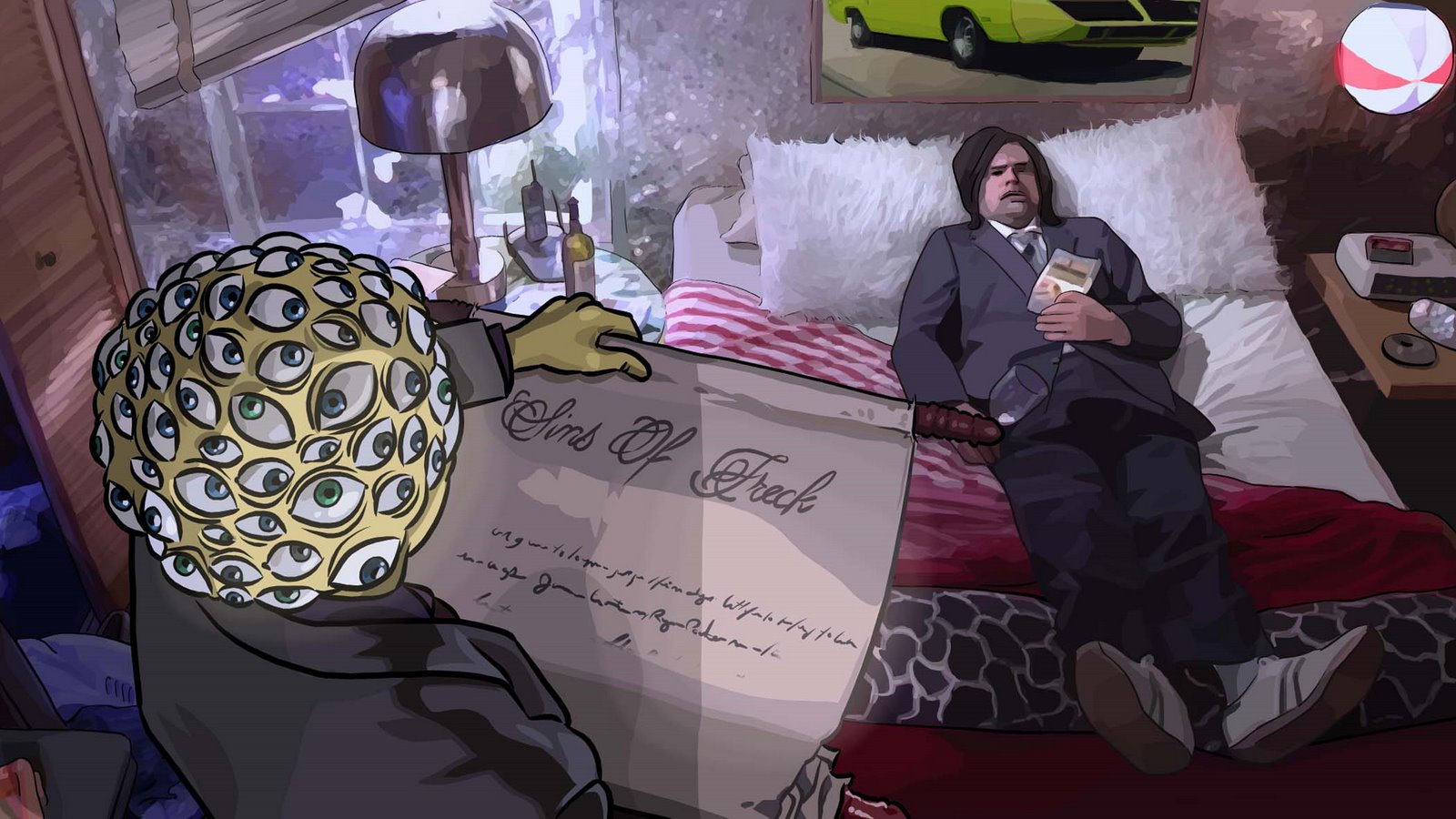
A Scanner Darkly centers on a post-drug war America that finds itself in a heavily Orwellian state, one where phone calls are traced and video recordings invade even the most intimate of actions. However, despite these intrusive technologies, drugs, nonetheless, manage to intrude into society, via various dealers and drug circles. One drug, in particular, Substance D proves debilatating in its psychotic alterations, leading heavy users to suffer from split brain psychosis and intense and visceral paranoia. As such the police force for Orange County invests in methods to destroy the trafficking of the drugs, using agent Bob Arctor (Keanu Reeves) to infiltrate a high-powered Substance D ring, involving the anarchistic, yet maddeningly militaristic Barris (Robert Downey, Jr.) and his stoner-like pal Ernie Luckman (Woody Harrelson). Perhaps the groups most troublesome individual is Charles Freck (Rory Cochrane) whose addiction to Substance D, has all but entirely destroyed his mind. As Arctor's involvement with the group heightens, so does his burgeoning friendship with the group, particularly one with sexual implications with a come-and-go guest in the house Donna (Winona Ryder). It is during a day at work that Arctor is informed by his superior Hank, who, like Arctor wears a "scramble suit" which is a constantly shifting identity suit that makes the identification of their creator's form so rare that it only occurs about one in every million manifestations. Needless to say, the double duty of attempting to continue to mask his presence as Arctor while also getting "closer" to breaking up the drug ring proves far too much to handle, only worsened by his continual use of Substance D, within the confines of his work. He begins to become the subject of tests by the police psychiatrists, only to be told that his brain has now split and is beginning to work against itself. It is one night, after a failed attempt at romance with Donna that Arctor's insanity splits and he finds himself seeing persons present in situations they are not present, which results in him being entirely pulled of the case where he was to investigate himself. It is during his last "talk" with Hank that he realizes his boss may well be Donna undercover, leading to the final break from sanity, leading to his being placed in rehabilitation. It is during his rehabilitation that he is sent to a farm to aid in "growing items," which is intercut with a scene of Donna, known, out of cover as Audrey, talking with a superior about his possible memories of a drug, which will allow him to hopefully undercover the truth that the farm using addicts from Substance D, is, in fact, the same place growing and harvesting the chemical.
The film is absolutely baffling and nearly incomprehensible on first examination, after all, it is Dick's very moving text that is both a cautionary tale against drug use, as well a work created to pay homage to his friends whose lives were invariably damaged by the drugs of the era. It is perhaps this framework that makes the narrative so complex, because Linklater's adaptation makes it clear that it neither condemns nor praises those involved in drug use. In fact, it shows the layers of dependency and paranoia that emerge as a result of such engagements. For example, Barris is always spouting ideas about being watched by the government and being steps away from getting narc'ed out. This would be illogical in most film settings, but this is the entire narrative of the film, Barris is continually in contact with a friend who is essentially awaiting a moment to bust him for his use and distribution of Substance D. Furthermore, Arctor's misery seems to stem from his concern that he is alienated from the society around him, believing that the performances he puts on are meaningless, because what results is his failure to earnestly connect with any one on an earnest level. The irony extends itself when one considers that, as part of his job, he must wear a suit that continually alters his identity, so much so that he is never himself, but on the rarest of occasions. Tragedy, emerges then when he does seem to have a moment of genuine connection between another person only to be denied that pleasure, when she claims to be too involved in drugs, but what proves to be the likely alternative is that she knows engaging with him could destroy the larger plan to exploit him to attack the drug producers down the line. In fact, Arctor is even told that he is insane, leading to his questioning every action, even the moment when he does realize that Hank, is indeed Audrey/Donna he is so unstable that to question it would be to affirm his own fall into psychological instability. The result, of all this, I would suggest is not to condemn the drug users for their eventual fall out, but instead, to critique the nature of drug trafficking, both in its indifference to those it hurts, as well as the way in which the government uses it to their advantage in one moment, only to turn their heads and condemn it in another breath.
Key Scene: The moment when Arctor catches a glimpse of Donna in the scramble suit is so built up and delivered with such succinct certainty that it is hard not to be completely blown away by its occurrence.
The bluray is phenomenal. Show Dick and Linklater some love and grab a copy.
A Scanner Darkly centers on a post-drug war America that finds itself in a heavily Orwellian state, one where phone calls are traced and video recordings invade even the most intimate of actions. However, despite these intrusive technologies, drugs, nonetheless, manage to intrude into society, via various dealers and drug circles. One drug, in particular, Substance D proves debilatating in its psychotic alterations, leading heavy users to suffer from split brain psychosis and intense and visceral paranoia. As such the police force for Orange County invests in methods to destroy the trafficking of the drugs, using agent Bob Arctor (Keanu Reeves) to infiltrate a high-powered Substance D ring, involving the anarchistic, yet maddeningly militaristic Barris (Robert Downey, Jr.) and his stoner-like pal Ernie Luckman (Woody Harrelson). Perhaps the groups most troublesome individual is Charles Freck (Rory Cochrane) whose addiction to Substance D, has all but entirely destroyed his mind. As Arctor's involvement with the group heightens, so does his burgeoning friendship with the group, particularly one with sexual implications with a come-and-go guest in the house Donna (Winona Ryder). It is during a day at work that Arctor is informed by his superior Hank, who, like Arctor wears a "scramble suit" which is a constantly shifting identity suit that makes the identification of their creator's form so rare that it only occurs about one in every million manifestations. Needless to say, the double duty of attempting to continue to mask his presence as Arctor while also getting "closer" to breaking up the drug ring proves far too much to handle, only worsened by his continual use of Substance D, within the confines of his work. He begins to become the subject of tests by the police psychiatrists, only to be told that his brain has now split and is beginning to work against itself. It is one night, after a failed attempt at romance with Donna that Arctor's insanity splits and he finds himself seeing persons present in situations they are not present, which results in him being entirely pulled of the case where he was to investigate himself. It is during his last "talk" with Hank that he realizes his boss may well be Donna undercover, leading to the final break from sanity, leading to his being placed in rehabilitation. It is during his rehabilitation that he is sent to a farm to aid in "growing items," which is intercut with a scene of Donna, known, out of cover as Audrey, talking with a superior about his possible memories of a drug, which will allow him to hopefully undercover the truth that the farm using addicts from Substance D, is, in fact, the same place growing and harvesting the chemical.
The film is absolutely baffling and nearly incomprehensible on first examination, after all, it is Dick's very moving text that is both a cautionary tale against drug use, as well a work created to pay homage to his friends whose lives were invariably damaged by the drugs of the era. It is perhaps this framework that makes the narrative so complex, because Linklater's adaptation makes it clear that it neither condemns nor praises those involved in drug use. In fact, it shows the layers of dependency and paranoia that emerge as a result of such engagements. For example, Barris is always spouting ideas about being watched by the government and being steps away from getting narc'ed out. This would be illogical in most film settings, but this is the entire narrative of the film, Barris is continually in contact with a friend who is essentially awaiting a moment to bust him for his use and distribution of Substance D. Furthermore, Arctor's misery seems to stem from his concern that he is alienated from the society around him, believing that the performances he puts on are meaningless, because what results is his failure to earnestly connect with any one on an earnest level. The irony extends itself when one considers that, as part of his job, he must wear a suit that continually alters his identity, so much so that he is never himself, but on the rarest of occasions. Tragedy, emerges then when he does seem to have a moment of genuine connection between another person only to be denied that pleasure, when she claims to be too involved in drugs, but what proves to be the likely alternative is that she knows engaging with him could destroy the larger plan to exploit him to attack the drug producers down the line. In fact, Arctor is even told that he is insane, leading to his questioning every action, even the moment when he does realize that Hank, is indeed Audrey/Donna he is so unstable that to question it would be to affirm his own fall into psychological instability. The result, of all this, I would suggest is not to condemn the drug users for their eventual fall out, but instead, to critique the nature of drug trafficking, both in its indifference to those it hurts, as well as the way in which the government uses it to their advantage in one moment, only to turn their heads and condemn it in another breath.
Key Scene: The moment when Arctor catches a glimpse of Donna in the scramble suit is so built up and delivered with such succinct certainty that it is hard not to be completely blown away by its occurrence.
The bluray is phenomenal. Show Dick and Linklater some love and grab a copy.
Subscribe to:
Posts (Atom)