Showing posts with label animated film. Show all posts

22.7.13

2013 Summer Reading Classic Film Book Challenge (Book 2) British Cinema and the Cold War: The State, Propaganda and Consensus

I recall earlier on in my academic career giving a presentation on the image of Latin America in Hollywood from the forties through the seventies, which meant that I had to discuss the effect of Cold War ideology on a particular set of films released from the fifties through the sixties.  After I had completed my presentation a former professor of mine asked my thoughts on what "caused the Cold War" to which I do not recall my exact response, but I am certain it was something along the lines of suggesting that is impossible to pinpoint all the complexities of what started and to another degree what ended the war of ideals.  I figured that by entrenching myself behind the purely filmic I would never have to deal with such analysis, or could at least pass it off with vague indifference.  I used to think that, but then I read Tony Shaw's magnificent study of British cinema during the era titled British Cinema and the Cold War: The State, Propaganda and Consensus.  Where many historians will occasionally throw a piece of culture or two into their political breakdowns as a means to show that they are not stuffy intellectuals, Shaw does not bend under the pressures of historical exactitude and manages to draw out the necessary information about British involvement between East and West opposition.  Furthermore, when doing histories of cinema, it is often the case that the film historian working on the piece will make sweeping brush strokes about rather detailed historical moments, hoping that by doing so the reader will glean only enough to make their argument worthwhile.  Shaw does neither, he works with intimate care to assure that both the history and the cultural product receive an equal degree of mention, making sure to acknowledge the moments when an event led to a cultural product, just as he notes moments when a film, or a series of films lead to a political movement or were used in a propagandistic manner to affirm or discredit a cause.  I can say with absolute certainty that there is not a better text written about Cold War culture available and would even argue that Shaw's text stands to be one of the best works on history of film in general, holding such importance as Haskell's From Reverence to Rape or pretty much any text released by the late Roger Ebert.  Simply put, there are few texts with such cohesion as Shaw's, and it only helps that he choses absolutely enthralling films to discuss.

The Cold War and cinema does, admittedly, seem like a highly specialized topic and one that would be relevant to only those doing research.  Indeed, I came to it by the way of looking for information about masculinity in the era and while Shaw's book does not provide much in the way of that topic, it did prove quite informative in my understanding of studio systems, production and the process of British filmmaking that will invariably help me undertake at least two different imminent projects.  As noted earlier, this serves a hybrid text that intersects two areas of academia flawlessly allowing for unison to form.  When this is unsuccessful the result can be unflattering, as is the case with Jeremy Black's incredibly well-researched buy dry and unreadable The Politics of James Bond.  I would go so far as to suggest that Shaw's book is the ideal place to start if a person were interested in looking at the way in which politics influence film, regardless of era or locale.  Similarly, Shaw handles the equally complex topic of propaganda with such grace and poise that were it not for the seminal text by Edward Bernays I would say that this would be the place to begin such a quest for understanding.  Fortunately, even with his ability to attract the most general of readership, Shaw's text provides moments of insight and hidden gems for the more seasoned reader, tackling more experimental and non-mainstream texts alongside the important franchise works of the time, given brief but necessary credit to both the Carry On series, as well as James Bond.  Furthermore, in his understanding of the global nature of Cold War cinema, Shaw occasionally taps into the wealth of American films made during the time to draw upon ones that would extend metaphorically to Britain as well.  His reading of Dr. Strangelove is spot on and refreshing in comparison to its usual entrenchment within the psychoanalytic.  For those who have a preconceived notion of British cinema existing in a stuffy vaccuum of period piece melodramas and quip heavy comedies should take a glance at British Cinema and the Cold War, it will cause you not only to reconsider an entire nationhood's film history, but it will inspire you to branch your research beyond just the cinematic texts.


Best film discovery of the book:  While it is technically a rediscovery, because I know I watched it at least once as a kid, Shaw's discussion of the 1954 animated version of Animal Farm speaks to it as being one of the highlights of Cold War cinema, despite its seemingly specified audience.  A bit baffled by its inclusion, I decided to catch up with it only to realize that it is a creepy and thematically dark text that does wonders to metaphorically comment upon the Cold War, as well as existing as a solid adaptation.  You can find relatively cheap copies of the text readily available on Amazon, for which the cool cover helps.

5.4.13

I Saw Death Rising From The Earth: A Scanner Darkly (2006)

I recently stumbled upon the madness that is cultural outpour via Nerve.com, a decidedly counterculture forum.  I particularly enjoy some of their deeper delving into insanity through experimentation with over consuming various things, whether they be legal or illegal.  However, I as a cinephile and part-time film critic was particularly intrigued, and, subsequently, enraged by their various "ranked" listings, where they take it upon themselves to put things like director's films in chronological order.  It was one particular post titled Philip K. Dick Adaptations from Worst to Best that caught my attention.  I am no scholar of Dick's work and have not seen a considerable amount of the films mentioned, however, I have attested to my love of Blade Runner and quickly assumed that it would be this film that would easily steal the number one spot on the list...this was not the case.  The folks at Nerve.com went with A Scanner Darkly, a film I was familiar with, but had only seen clips of up until that point.  I was perplexed and decidedly upset by the choice, feeling as though the perfect Blade Runner had no business in any spot but first.  However, I knew that to truly affirm this statement I would need to watch A Scanner Darkly in its entirety and really synthesize it as a film before making a definitive statement.  So upon watching it I can say this, Blade Runner is still a considerably better film, but damn if A Scanner Darkly is not a menacing, dystopic piece of cinema that is deserved of high, high praise.  I am not entirely familiar with the book on which this is based, but looked it up and discovered it to be written in 1977, which is baffling, especially since watching it now, some seven years after its filmic release, I cannot help but consider how both prescient and ahead of its time the text really was and still is, particularly in its consideration of the maddening effects of drug culture on identity, self-respect and interactions between various persons consuming such psychologically altering substances.  Of course, I am aware that some of these reactions are a result of Richard Linklater's adaptation and filming, particularly his use of rotoscoping, to give it an otherworldly feel, while still touching dangerously close to reality, in fact, if one blurs or clouds their vision during the viewing, it suddenly becomes all too real and incredibly disconcerting.  The implication are heavy in this film and its stylized nature certainly attracts viewers, the message brilliant and while again not Blade Runner, certainly exists within the higher tiers of science fiction filmmaking.


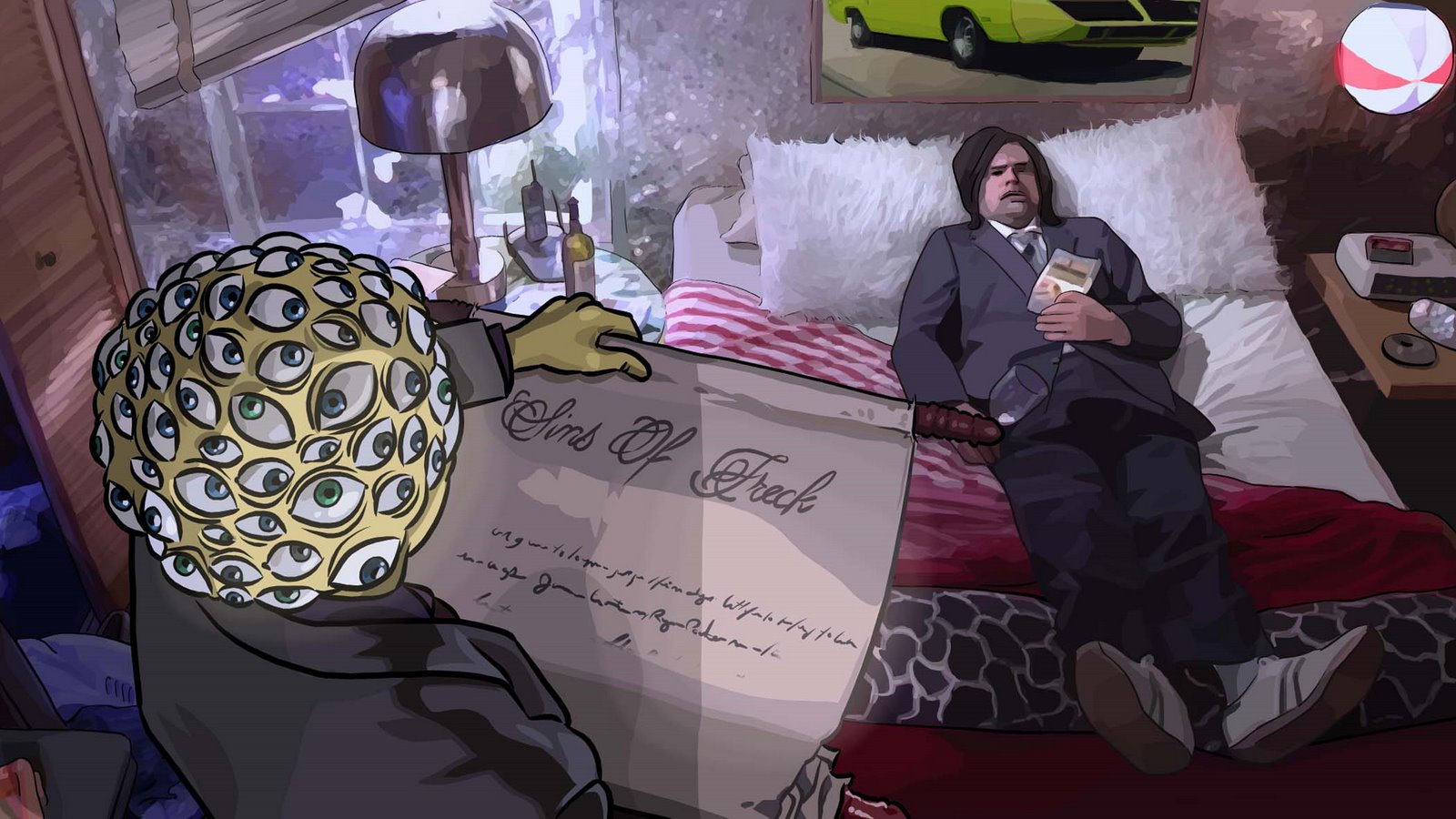
A Scanner Darkly centers on a post-drug war America that finds itself in a heavily Orwellian state, one where phone calls are traced and video recordings invade even the most intimate of actions.  However, despite these intrusive technologies, drugs, nonetheless, manage to intrude into society, via various dealers and drug circles.  One drug, in particular, Substance D proves debilatating in its psychotic alterations, leading heavy users to suffer from split brain psychosis and intense and visceral paranoia.  As such the police force for Orange County invests in methods to destroy the trafficking of the drugs, using agent Bob Arctor (Keanu Reeves) to infiltrate a high-powered Substance D ring, involving the anarchistic, yet maddeningly militaristic Barris (Robert Downey, Jr.) and his stoner-like pal Ernie Luckman (Woody Harrelson).  Perhaps the groups most troublesome individual is Charles Freck (Rory Cochrane) whose addiction to Substance D, has all but entirely destroyed his mind.  As Arctor's involvement with the group heightens, so does his burgeoning friendship with the group, particularly one with sexual implications with a come-and-go guest in the house Donna (Winona Ryder).  It is during a day at work that Arctor is informed by his superior Hank, who, like Arctor wears a "scramble suit" which is a constantly shifting identity suit that makes the identification of their creator's form so rare that it only occurs about one in every million manifestations.  Needless to say, the double duty of attempting to continue to mask his presence as Arctor while also getting "closer" to breaking up the drug ring proves far too much to handle, only worsened by his continual use of Substance D, within the confines of his work.  He begins to become the subject of tests by the police psychiatrists, only to be told that his brain has now split and is beginning to work against itself.  It is one night, after a failed attempt at romance with Donna that Arctor's insanity splits and he finds himself seeing persons present in situations they are not present, which results in him being entirely pulled of the case where he was to investigate himself.  It is during his last "talk" with Hank that he realizes his boss may well be Donna undercover, leading to the final break from sanity, leading to his being placed in rehabilitation.  It is during his rehabilitation that he is sent to a farm to aid in "growing items," which is intercut with a scene of Donna, known, out of cover as Audrey, talking with a superior about his possible memories of a drug, which will allow him to hopefully undercover the truth that the farm using addicts from Substance D, is, in fact, the same place growing and harvesting the chemical.


The film is absolutely baffling and nearly incomprehensible on first examination, after all, it is Dick's very moving text that is both a cautionary tale against drug use, as well a work created to pay homage to his friends whose lives were invariably damaged by the drugs of the era.  It is perhaps this framework that makes the narrative so complex, because Linklater's adaptation makes it clear that it neither condemns nor praises those involved in drug use.  In fact, it shows the layers of dependency and paranoia that emerge as a result of such engagements.  For example, Barris is always spouting ideas about being watched by the government and being steps away from getting narc'ed out.  This would be illogical in most film settings, but this is the entire narrative of the film, Barris is continually in contact with a friend who is essentially awaiting a moment to bust him for his use and distribution of Substance D.  Furthermore, Arctor's misery seems to stem from his concern that he is alienated from the society around him, believing that the performances he puts on are meaningless, because what results is his failure to earnestly connect with any one on an earnest level.  The irony extends itself when one considers that, as part of his job, he must wear a suit that continually alters his identity, so much so that he is never himself, but on the rarest of occasions.  Tragedy, emerges then when he does seem to have a moment of genuine connection between another person only to be denied that pleasure, when she claims to be too involved in drugs, but what proves to be the likely alternative is that she knows engaging with him could destroy the larger plan to exploit him to attack the drug producers down the line.  In fact, Arctor is even told that he is insane, leading to his questioning every action, even the moment when he does realize that Hank, is indeed Audrey/Donna he is so unstable that to question it would be to affirm his own fall into psychological instability.  The result, of all this, I would suggest is not to condemn the drug users for their eventual fall out, but instead, to critique the nature of drug trafficking, both in its indifference to those it hurts, as well as the way in which the government uses it to their advantage in one moment, only to turn their heads and condemn it in another breath.

Key Scene:  The moment when Arctor catches a glimpse of Donna in the scramble suit is so built up and delivered with such succinct certainty that it is hard not to be completely blown away by its occurrence.

The bluray is phenomenal.  Show Dick and Linklater some love and grab a copy.

23.3.13

I'll Be Shooting For My Own Hand: Brave (2012)

It is almost always a sure thing that a film by Disney will at the very least look amazing, and it is only a notion extended when one considers that the best work by the company is often released by Pixar, which is exceptionally spectacular.  However, what is much less assured is to what social commentaries the films may make, for example, Wall-E serves as a gorgeous piece of 3D animated film while also being a surprisingly scathing critique of all things leading our technological society to brainless reliance on machines.  In contrast is Tangled, one of the more cinematic Disney film, that draws upon some excellent references to old school Robin Hood movies, as well as also containing a significant female character.  Yet, Tangled, like so many of its predecessors manages to regress into heteronormativity by its closing moments never really allowing the revolutionary gender politics it seems so intent on setting up in the films opening moments.  Brave, a film from last year, seemed to continually emerge as this sort of enigmatic feminist statement directed at kids, via a Pixar film, although, the more I think about it, I would argue that Pixar aims the narrative elements of its films at adults, while offering sound visual elements to capture children.  Regardless, Brave is, much to my surprise, quite embracing of women's singularity and manages to make a considerable portion of the narrative center around this element, as one young girl struggles to reject gender commodifications and perform in a way that she finds comfortable and liberating, regardless of the expectations of tradition.  Brave is both a highly entertaining film, as well as one that keeps its narrative focus direct and socially advanced.  It was quite easy for me to become captured in the flora laden landscape of the film occupied by vibrant characters and some of the best human-based Pixar animation to date.  It is an incredibly fast-paced film that is perfect for young audiences, yet manages to pack a heavy set of gender reconsiderations into its world in the process.  While it is by no means a superior film to Frankenweenie, I can better understand now, after viewing, why this film has received such rave reviews, and, ultimately, and Oscar.


Brave focuses on the young life of Merida (Kelly MacDonald) a princess, in a Scottish clan whose love for archery and living in the outdoors has emerged directly from the tutelage of her father Fergus (Billy Connolly) a king whose leg was lost defending his family and clan from a deathly bear attack.  This emphasis on athleticism and outdoor activities is much maligned by her mother Elinor (Emma Thompson) who hopes that Merida will willingly align herself with history and give her hand to a suitor from a nearby clan as a means of assuring peace in the area.  While Fergus is quite lacking in his support of such a decision, he does realize its necessity to assure clan peace, therefore, falling in line with Elinor when she forces Merida to follow the orders and give her hand to who ever wins a contest. Even after Merida attempts to win her own hand in the competition, the fact proves that she must still get married.  In a last ditch moment of frustration,  Merida visits The Witch (Julie Walters) who agrees to provide Merida with an escape in exchange for a metal amulet.   The spell takes the form of a cake that Elinor is to eat, Merida thinking it will only cause her mother to change her mind gives it to her in excitement, yet when Elinor becomes sick almost immediately after consuming the food things take a serious turn.  The spell Merida has obtained causes her mother to change, not her mind, but physical form into that of a bear, of course, leading to her immediate danger when Fergus senses the presence of a bear within his castle.  Escaping from the castle with just enough time to spare, Merida and her mother seek The Witch to alter the spell, but she is nowhere to be found, instead leaving a riddle as to how to reverse the spell, before her mother becomes like Mor'duu another person whose selfish desires led him to being turned into a bear.  Yet, the persistent chase of Fergus leads to a showdown in a stonehenge-like battlefield, where Merida brings a fixed tapestry that she had damaged earlier in frustration against her mother.  Realizing the seriousness of the matter, Fergus steps back and, with Merida in tears, Elinor finally becomes a human again, the family reunited and the clans at ease.  The narrative ends with Merida embracing her role as princess, but with the full knowledge that she can choose to marry, or not to, at her own convenience.


While I am fully aware that it is not a particularly radical film in its portrayal of unconventional gender roles, Brave, as a piece of animated film, could have been much more heteronormative and still probably made a ton at the box office.  However, the deliberate choice, on the part of the collective of directors and writers to make Merida her own individual, even in the closing moments of the film is quite a powerful thing.  The film is about choosing a lifestyle that is both comforting and rewarding, as opposed to preordained and mandatory.  Merida loathes the idea of feminine beauty and constant beauty regiments, emphasized by her unkempt hair and her disdain when it is trapped within a headdress.  Elinor does not seem so opposed to Merida's personal pleasures and enjoyments because she assumes that it is unnatural or playing against her gender, but because she is fully aware of the political consequences of her daughters choice not to act the part.  It is a larger commentary on institutionalization, internalization and fear of working against an unrealistic notion of the ideal.  In fact, I would not even suggest that this film outright rejects femininity, because, after all, it is Merida's fixing of a tapestry that allows her mother to return to human form.  I am not suggesting that now, textile and tapestry work is uniquely feminine, but within the historical context of the film that would have certainly been the case, therefore, the narrative seems to open up its necessity.  With both commentaries existing against one another it seems to be a film that draws out the necessity of possessing both masculine and feminine qualities, without being forced to exist within one spectrum at one time.  Furthermore, Merida's existence by herself in the films closing moments say that gender is not predicated on finding an other to fifth the dichotomy, but can certainly be its own stand alone element and should be entirely the choice of the individual in question.

Key Scene:  The archery contest is fun and hearkens back to the old Robin Hood films of the thirties.

This is not a film I feel is absolutely worth owning, however, it is quite enjoyable and certainly worth renting.