Showing posts with label Robert Downey Jr.. Show all posts

8.4.13

It's A Call For Help Intended As A Private Communique: Zodiac (2007)

In the past few years Mad Men has been given a ton of praise for, amongst other things, its incredible ability to capture the imagery, culture and general state of mind of the era it is depicting, both in the decaying stature of white, male privilege as well as the ever so faint heartbeat of the change that is moments from emerging in America.  David Fincher's criminally underrated Zodiac is certainly a film with a similar attachment to such a style, all be it set a decade later and over a much longer period of time, transition seamlessly and poetically, making even his clear moments of large periods of transition seem effortless and completely within the framework of the lengthy film.  As of late, I find myself bemoaning everything that is associated with Fincher's Fight Club, mostly for its following and fans who believe it to be the sole moment of revolutionary cinema.  I am certainly behind the quality of Fight Club as a film, but much like the blind supporters of the beatniks it has its rather obvious flaws, ones that seem to emerge with age.  Of course, this is not about what will, undoubtedly, prove to be the dynamic directors most well-remembered tim but is, instead; about what might tragically be his most overlooked.  Zodiac is a meticulously designed and deceptively straightforward film, that manages to take one of America's most baffling serial killer cases and turn it into a gripping human drama that is both narratively tight and cinematically profound.  This, of course, is of little surprise, after all, we are talking about a filmmaker who always proves consistent, even when doing something completely out of his comfort zone with The Curious Case of Benjamin Button.  Even his Netflix series House of Cards stands shoulders above most things being circulated in theaters at this very moment.  Much as it seems to be the case with so many of Fincher's films Zodiac demands that its viewers be both fully invested in their characters day to day activities, while also understanding that since they engage with an inherently terrible system that all persons are susceptible to failure, greed and ultimate a brutal downfall, and that doing the right thing is rarely reward, if not outright punished.


Zodiac, as should be little surprise, follows the emergence and tracking down of the infamous Zodiac Killer, who spent a considerable portion of the seventies randomly killing individuals in, and around, the San Francisco Bay Area.  Of course, as is the case with most crime thrillers the killer is only the secondary subject, Zodiac instead focuses on people attempting to solve the puzzle and rather literal enigma that is the killer who called himself Zodiac.  Firstly, there is the established, all be it, cynical  news reporter Paul Avery (Robert Downey Jr.) who sees this case as a means to blast his career to the next level, pulling no punches in his attempts to track down everything he can regarding the case.  Within the same news agency is Robert Graysmith (Jake Gyllenhaal) whose life as a cartoonist takes a sharp turn when he decides to decode the letter from the Zodiac, an act that leads him to become irreversibly obsessed with the case, skipping work and eventually ignoring his live-in girlfriend and children with the hope of meeting and aiding in the arrest of the killer.  Finally there is the cop assigned to the various Zodiac related deaths, David Toschi (Mark Ruffalo) who realizes that the paperwork and legal expectations of his every action result in it being nearly impossible to ever arrest or come close to the killer, who made quite certain that his tracks were well-covered.  At various points throughout the narrative the three interact, although never simultaneously, in some cases Robert and Paul work together within the confines of their office, while in another situation Robert approaches David after a film screening at a local theater to explain his unusual relationship to the case and while David continues work on the case, it is eventually Robert who takes the reigns on finding the killer, in the process becoming uncertain as to whether it is justice or curiosity that keeps him going.  In the end, enough minor pieces of information assemble to allow Robert to make eye contact with the killer, in a brief but tense moment and the film then cuts to one of the Zodiac Killer's survivors identifying him in a photograph, allowing after nearly a quarter century for the killer to be brought to trial.


Zodiac is a film that is fully aware of its length, never rushing through a scene or overlooking an aspect to assure a comfortable runtime, which is something, unfortunately, that appears to have worked against it in its box office numbers.  I, however, found the film to be excellent and worth every moment invested, I would even go so far as to say that I was a bit upset when the credits did begin to role, because I thoroughly enjoyed its subject matter and execution.  I, however, say all this to consider what is going on within Fincher's relatively calculated and contemplative film.  The answer seems to be rather obvious, it is a film about tracking down a killer who is not only excellent at being elusive, but also seems keenly aware about the general misdirection and time spent organizing and justifying efforts within the police force, which allows for him to enact random murders and various misdirections, all while those chasing him are still getting the go ahead.  This woe of bureaucracy does, however, come with a certain degree of safety.  When David engages in situations with the individual who does prove to be the Zodiac killer he is afforded the comfort of back up and an advantage in the way of guns and safety, where as, when Robert begins his independent investigation he is forced to navigate spaces alone, although in the films most tense seen this loneliness rears its ugly head when Robert comes to encounter a person whose ties to the Zodiac make his every movement worth questioning to the point of paranoia.  So Zodiac seems to suggest that dealing with crime requires a navigation between the protections of bureaucracy, while also remembering that many rules are to be altered as necessary.  Of course, as the narrative also suggests, living in such a liminal world can prove detrimental, at least that appears to have been the case with Paul.  Another layer is of course the notion of time and authority, something that is always working against the characters best interests even in the brief moments of earnest happiness or positive encounters within the film.  Yet it also suggests that with time, all injustice will eventually be reprimanded.

Key Scene:  There are two time transitions in this film one of a tower being built and the other solely using music that are brilliantly jarring and help to yank the viewers back in after long narrative lulls.

This is cinema gold and was long out of print on bluray.  It has recently returned to shelves and is worth grabbing before it witnesses another tragic fate.

5.4.13

I Saw Death Rising From The Earth: A Scanner Darkly (2006)

I recently stumbled upon the madness that is cultural outpour via Nerve.com, a decidedly counterculture forum.  I particularly enjoy some of their deeper delving into insanity through experimentation with over consuming various things, whether they be legal or illegal.  However, I as a cinephile and part-time film critic was particularly intrigued, and, subsequently, enraged by their various "ranked" listings, where they take it upon themselves to put things like director's films in chronological order.  It was one particular post titled Philip K. Dick Adaptations from Worst to Best that caught my attention.  I am no scholar of Dick's work and have not seen a considerable amount of the films mentioned, however, I have attested to my love of Blade Runner and quickly assumed that it would be this film that would easily steal the number one spot on the list...this was not the case.  The folks at Nerve.com went with A Scanner Darkly, a film I was familiar with, but had only seen clips of up until that point.  I was perplexed and decidedly upset by the choice, feeling as though the perfect Blade Runner had no business in any spot but first.  However, I knew that to truly affirm this statement I would need to watch A Scanner Darkly in its entirety and really synthesize it as a film before making a definitive statement.  So upon watching it I can say this, Blade Runner is still a considerably better film, but damn if A Scanner Darkly is not a menacing, dystopic piece of cinema that is deserved of high, high praise.  I am not entirely familiar with the book on which this is based, but looked it up and discovered it to be written in 1977, which is baffling, especially since watching it now, some seven years after its filmic release, I cannot help but consider how both prescient and ahead of its time the text really was and still is, particularly in its consideration of the maddening effects of drug culture on identity, self-respect and interactions between various persons consuming such psychologically altering substances.  Of course, I am aware that some of these reactions are a result of Richard Linklater's adaptation and filming, particularly his use of rotoscoping, to give it an otherworldly feel, while still touching dangerously close to reality, in fact, if one blurs or clouds their vision during the viewing, it suddenly becomes all too real and incredibly disconcerting.  The implication are heavy in this film and its stylized nature certainly attracts viewers, the message brilliant and while again not Blade Runner, certainly exists within the higher tiers of science fiction filmmaking.


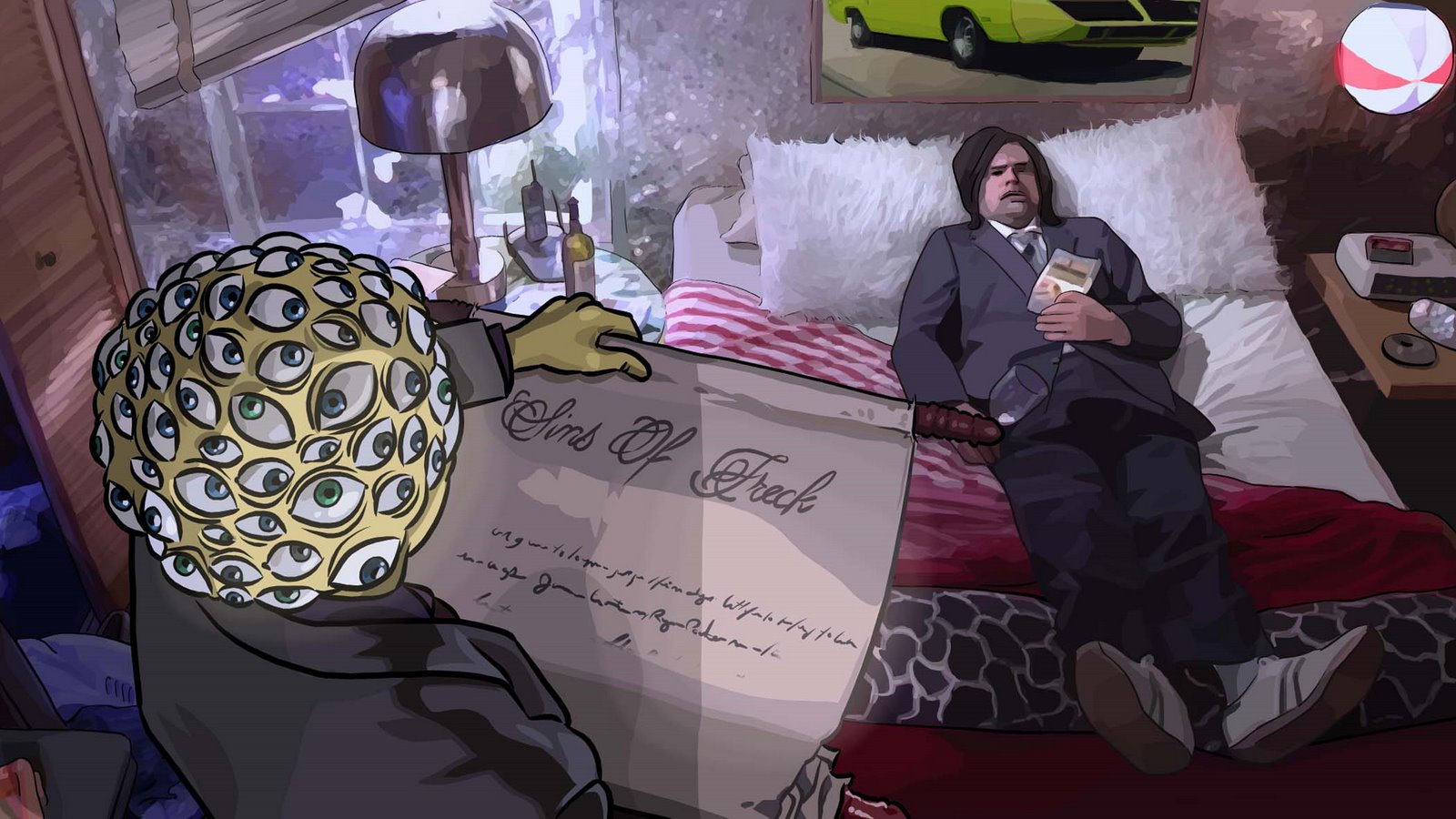
A Scanner Darkly centers on a post-drug war America that finds itself in a heavily Orwellian state, one where phone calls are traced and video recordings invade even the most intimate of actions.  However, despite these intrusive technologies, drugs, nonetheless, manage to intrude into society, via various dealers and drug circles.  One drug, in particular, Substance D proves debilatating in its psychotic alterations, leading heavy users to suffer from split brain psychosis and intense and visceral paranoia.  As such the police force for Orange County invests in methods to destroy the trafficking of the drugs, using agent Bob Arctor (Keanu Reeves) to infiltrate a high-powered Substance D ring, involving the anarchistic, yet maddeningly militaristic Barris (Robert Downey, Jr.) and his stoner-like pal Ernie Luckman (Woody Harrelson).  Perhaps the groups most troublesome individual is Charles Freck (Rory Cochrane) whose addiction to Substance D, has all but entirely destroyed his mind.  As Arctor's involvement with the group heightens, so does his burgeoning friendship with the group, particularly one with sexual implications with a come-and-go guest in the house Donna (Winona Ryder).  It is during a day at work that Arctor is informed by his superior Hank, who, like Arctor wears a "scramble suit" which is a constantly shifting identity suit that makes the identification of their creator's form so rare that it only occurs about one in every million manifestations.  Needless to say, the double duty of attempting to continue to mask his presence as Arctor while also getting "closer" to breaking up the drug ring proves far too much to handle, only worsened by his continual use of Substance D, within the confines of his work.  He begins to become the subject of tests by the police psychiatrists, only to be told that his brain has now split and is beginning to work against itself.  It is one night, after a failed attempt at romance with Donna that Arctor's insanity splits and he finds himself seeing persons present in situations they are not present, which results in him being entirely pulled of the case where he was to investigate himself.  It is during his last "talk" with Hank that he realizes his boss may well be Donna undercover, leading to the final break from sanity, leading to his being placed in rehabilitation.  It is during his rehabilitation that he is sent to a farm to aid in "growing items," which is intercut with a scene of Donna, known, out of cover as Audrey, talking with a superior about his possible memories of a drug, which will allow him to hopefully undercover the truth that the farm using addicts from Substance D, is, in fact, the same place growing and harvesting the chemical.


The film is absolutely baffling and nearly incomprehensible on first examination, after all, it is Dick's very moving text that is both a cautionary tale against drug use, as well a work created to pay homage to his friends whose lives were invariably damaged by the drugs of the era.  It is perhaps this framework that makes the narrative so complex, because Linklater's adaptation makes it clear that it neither condemns nor praises those involved in drug use.  In fact, it shows the layers of dependency and paranoia that emerge as a result of such engagements.  For example, Barris is always spouting ideas about being watched by the government and being steps away from getting narc'ed out.  This would be illogical in most film settings, but this is the entire narrative of the film, Barris is continually in contact with a friend who is essentially awaiting a moment to bust him for his use and distribution of Substance D.  Furthermore, Arctor's misery seems to stem from his concern that he is alienated from the society around him, believing that the performances he puts on are meaningless, because what results is his failure to earnestly connect with any one on an earnest level.  The irony extends itself when one considers that, as part of his job, he must wear a suit that continually alters his identity, so much so that he is never himself, but on the rarest of occasions.  Tragedy, emerges then when he does seem to have a moment of genuine connection between another person only to be denied that pleasure, when she claims to be too involved in drugs, but what proves to be the likely alternative is that she knows engaging with him could destroy the larger plan to exploit him to attack the drug producers down the line.  In fact, Arctor is even told that he is insane, leading to his questioning every action, even the moment when he does realize that Hank, is indeed Audrey/Donna he is so unstable that to question it would be to affirm his own fall into psychological instability.  The result, of all this, I would suggest is not to condemn the drug users for their eventual fall out, but instead, to critique the nature of drug trafficking, both in its indifference to those it hurts, as well as the way in which the government uses it to their advantage in one moment, only to turn their heads and condemn it in another breath.

Key Scene:  The moment when Arctor catches a glimpse of Donna in the scramble suit is so built up and delivered with such succinct certainty that it is hard not to be completely blown away by its occurrence.

The bluray is phenomenal.  Show Dick and Linklater some love and grab a copy.

12.3.13

Superheroes? In New York? Give Me A Break: The Avengers (2012)

So I know this month is dedicated to women in film and I intend fully to still post at least one film a day from within that broad umbrella, but I have been viewing a streak of rather solid films along with the ones being posted about and I thought it would be a shame not to include some of them in between as well, especially considering that I am currently on break and need everything imaginable to avoid from actually having to write a paper that is due when I get back to school.  Furthermore, there are still and handful of movies I need to see from 2012 before properly making a list of my favorite films.  While The Avengers certainly could have been a contender in pretty much any other year of films, it will certainly not make to my top film list of this year, however, that is not to undermine its excellence by any means.  The Avengers stands as an excellent example of a superhero movie that is both wildly entertaining and also filled with philosophical reflections and more than a few political ideologies, yet, while they are made very present, unlike the far less successful The Dark Knight Rises, The Avengers manages to allow viewers to come to such commentaries on their own, as opposed to wasting an already lengthy runtime attempting to shove them down their throats.  Yet, Joss Whedon, in his infinite wisdom, is careful not to invest too much interest in any single ideology and, in fact, shows the positive elements, as well as the very negative portions of any given situation.  Furthermore, having failed to see any of the franchised characters films prior to this, I only had their collaboration to go off of, and I found the introductions to each character to be absolutely captivating and succinctly executed, providing even the most unfamiliar viewer, such as myself, with the necessary information on their positive traits as well as their flaws.  The best part about all of this positive execution is that even if it were not to be present the magnitude and commitment with which the action sequences are shot is so stellar and fresh that it could have been entirely watchable on these grounds alone.  The Avengers stands as a promising outlook onto what the blockbuster film can and should be and is quite deserved of its financial success.

The film begins with work being done at an underground facility run by the top secret globally financed  agency S.H.I.E.L.D. whose work with the Tessaract, a highly powerful cube made of some impenetrable space materials, has caught the attention of Loki (Tom Hiddleston) a demi-god from the planet of Arsgard who sees the item as a means to take control of, and subsequently destroy the earth.  He begins taking over the plant by putting its employees under control with a mind-altering specter, taking control of both the Tessaract's main engineer and Hawkeye (Jeremy Renner) a highly trained archer who works for shield.  This all occurs despite heavy efforts by Nick Fury (Samuel L. Jackson) to stop Loki, yet when Loki gets away and it is made quite clear that global destruction is his plan, Fury demands that the collective known as the Avengers be assembled to challenge Loki.  This group includes a vast array of personalities, whether it be Black Widow (Scarlett Johansson) an ex-assassin turned S.H.I.E.L.D. agent who finds herself troubled by a criminal past, the gamma ray physicist whose temperment has led him from simply being Dr. Bruce Banner (Mark Ruffalo) to that of The Hulk, as well as the aptly named Captain America (Chris Evans) who stands as America's first superhero, which is solidified by his being frozen underwater and only recently revived to be part of The Avengers.  The group also includes the "genius, playboy billionaire" Tony Stark (Robert Downey, Jr.) whose technological skills allow him to be Ironman, a nearly invincible fighting machine.  Finally, considering that Loki is their main enemy, the group also includes Thor (Chris Hemsworth) Loki's adoptive brother and protector of both Asgard and to some degree Earth.  Further along the line they also pull Hawkeye from Loki's power and bring him back to The Avengers.  Suffice to say, this group must learn to play nice together, between dueling egos and past injustices, they eventually come together, but even their heavy degree of unity is challenged by the sheer power of Loki and his army of alien beasts.  This eventually requires a heavy moral push on the part of Fury and the sacrifice of a few officers in the process.  Fortunately, the group does eventually overcome Loki and safe the earth from being consumed in a large black mass.  All of them go their separate ways having grown from the experience, however, as a sequence after the closing credits suggests, it is far from their last bout together.


The film makes it blatantly clear that no individual within The Avengers is completely void of problems, whether it be Tony Stark creating a shell of a life of decadence to protect from the very real fact that he has shrapnel inches from his heart that could kill him at any moment, or Bruce Banner whose quest to advance humankind resulted in such frustration and disappointment that he can no longer control his mental state, or Black Widow whose negative past life has become so prominent that navigating through the current world proves nearly impossible.  Even the seemingly forward thinking Captain America suffers from relevance issues in his inability to relate to a contemporary world that does not embrace his jingoistic ideologies, let alone look positively on the image of the American flag.  One could read each of the members of The Avengers, including the demi-god Thor, as ways to approach issues in the world, Thor of course representing the placing of one's hopes in a higher power, Captain America as a putting hope in a group ideal, or Stark as a means to use money to escape the real issues of ones life.  However, as the narrative created by Whedon shows, none of these answers work with any degree of success when placed on their own, yet when a combination of these come together it helps considerably and they can take on even the most seemingly insurmountable of forces.  It reads nicely as a coming together narrative of diversity, even if the group is noticeably occupied by white bodies, something that will hopefully change in the years to come, as it relates to comic book heroes.  The brilliance comes not in this commentary, however, but in the reminder that in many instances this occurs through a shared ideal, one that transcends personal vendettas, and, often, this shared idea has been fabricated by some half-truth, in the case of The Avengers, it is overselling the sacrifice of an officer on the part of Nick Fury that really pushes them into action.  The film clearly asks viewers to consider if such exploitation is justified and, if so, who is to be praised, the superheroes or the man who put them into action?  If all this were not enough, it also critiques the way in which power is controlled by a council of shadowy figures, which seems to be more and more a truth in a world of global wars and back room political dealings.

Key Scene:  As great as "that one scene with The Hulk" is, I have to show favor to the Stuttgart scene, because it is a direct counter to the normal tradition of superhero movies and was much welcomed on my part.

This is certainly worth buying, although I would personally wait for it to drop in price before doing so, considering that it was mass produced, it is only a matter of time.