Showing posts with label homosocial bond. Show all posts

2.1.14

Lawyers Don't Surf!: Point Break (1991)

The bad movie is a beloved area of movie going and cinephilia all its own.  Between movies with cheesy special effects and some of the worst acting conceivable, one has a wide array of options to view, if they are prepared to completely disavow any respect for cinematic tradition.  Now, these films are treated for their absurd nature with love, many receive far more care and distribution than monumental art house films whose demand simply does not match that of The Toxic Avenger or the bizarre film that is The Room.  These works usually traipse the line of new director establishing themselves and being created on a shoestring budget as passion projects by a group of friends.  Bad movies are bad, but notably they are not cinematic masterpieces.  I would have adhered to this ideology with such a strong voice only yesterday at this time, but then I watched Kathryn Bigelow's 1991 action/surf/buddycop/romatic drama that is Point Break and was required to completely reorganize my understanding of bad movies.  Point Break is everything that should not exist is a respectable piece of cinema blown about over a two hour window, emphasized by hokey camera shots and enough overly forced dialogue to make even these least sensible person to the art of acting cringe.  Pair this with what has to be one of the more curious studies of masculinity and male desire committed to film and I would argue that Bigelow is knowingly creating a terrible film as a means with which to call attention to the medium and the genre itself, appropriating a variety of different genres that deal with masculine identity as a means to critique the genre and show the latent homoeroticism at play in movie going.  Since this film, it would be hard to establish the identity of Kathryn Bigelow as a decidedly feminist filmmaker, one working within the space of masculine war areas to look at issues of identity.  While Zero Dark Thirty is quite a promising departure from her earlier fare, Point Break may well be her masterpiece, if only for its unapologetic attachment to all things bad in cinema as a means to crack into a larger commentary on what is truly terrible about the relationships of viewers and film.  It might have been purely accidental, but Point Break is a post-modern stroke of cinematic negation and deconstruction in the most veiled and backdoor means imaginable.


Point Break focuses on the relocation of burgeoning FBI agent and former football star Johnny Utah (Keanu Reeves) a poised, but notably green behind the years guy, who wants to quickly make a big name in the department to move into higher positions.  While Utah is far from pleased with his location matters are made slightly worse when he is assigned with the veteran cop and general wise ass Pappas (Gary Busey) who seems more concerned with playing into conspiracy theories within the department, particularly with their to the books boss Ben Harp (John C. McGinley).  Nonetheless, Utah and Pappas are assigned to work on a case of bank robberies, undertaken by the group known as The Ex-Presidents, a moniker attached for their wearing of presidents masks while enacting the robberies.  While the department has very little to go on regarding the identities of the members of the group, there is a strong indication that their whereabouts are somehow tied to a beach outside of Los Angeles.  As such, both Utah and Pappas are designated to go undercover and discover exactly who is involved in the ordeal, or at the very least to find information regarding the whereabouts of The Ex-Presidents.  Under the guise of being a lawyer interested in surf lessons, Utah finds an in through a local surfer girl named Tyler (Lori Petty) to whom he takes to desiring almost instantly.  It is by Tyler's extension that Utah meets Bodhi (Patrick Swayze) discovering in him a source to all the going-ons in the beach, as well as a friend.  Indeed, Utah seems almost as enamored with Bodhi as he is Tyler, finding his own drive to catch the perfect ride almost saintly.  While Utah continues to chase down leads on the possible members of The Ex-Presidents when a chase and gunning down of a series of neo-Nazi's proves a bust, a minor incident leads Utah to become certain that it is indeed Bodhi and his friends who have been undertaking the crimes all along, putting the still learning cop in a compromising position between friendship and the law.  One that goes sky high in its ambitions and crashes hard in its final outcome.  All with the variants of bro being thrown out along the way.


Sure it would be delightful to just go into the almost impossible incessant variations on the possible spellings of Reeves' and Swayze's respective pronunciations of "bruh," and I am sure this has become a drinking game by this point, but I do have an earnest curiosity directed towards the way in which language, look and performance all sort of coalesce within the space of Point Break to become a dynamic and deconstructed understanding of the male body on display in film and by extension how that male body shares in looking at other bodies both dietetically and non-diegetically.  If one were to read the synopsis for Point Break or to look at the poster, it seems like rather straightforwardly a buddy cop and/or law/justice type narrative, but the reason this film works on a distinctly different level is that it spends so much time--perhaps unnecessarily so--on considering the relationship between Utah and Bodhi, one that often goes unspoken and still possesses a high degree of sexual longing.  The initial encounter between Utah and Bodhi comes at Bodhi's confusion as to why Tyler is now clinging onto the newly present surfer, seeming as though he is jealous of her affections being relocated.  However, this sequence is immediately followed by a game of football where Utah is able to show off his skills athletically, all which culminates in his tackling of Bodhi into the shore of the beach.  While Bodhi's friends call foul, this aggressive touch by Utah seems to awaken a mutual desire between the two, as though the sport allowed them a figurative sexual encounter that goes unspoken throughout rest of the film, emphatically shared when Utah allows the fleeing Bodhi to continue climbing a fence and never stopping him with gunfire.  His hesitation occurs only after the two share an impossible locking of eyes from a great distance.  Other focusing on the male body in curious ways takes precedence over the accidental looking at women that comes after the encounter on the beach, particularly in the scene of the Nazi house bust, where women in the shower are only caught through passing glimpses or mirrored surveillance.  It would suggest that Utah now only cares about looking and watching Bodhi and by extension so should the viewers.  The closing moments of Bodhi's limp body falling into the ocean, juxtapose Utah's own birth-like sequence earlier in the film, one awakening and the other violently repressing.  It is a Freudian "wet" dream if you will, all played out under the guise of simple, bad movie mockery.  Brilliance here comes through a back avenue for those willing to play along with the joke.

Key Scene:  Any time Reeves gets to throw out some surfer talk is glorious, but the real performance of note comes from Swayze whose accent is so realized that he should have done a cameo on the now gone The Californians from SNL.

Buy this on bluray, it is a mess of a movie with a far deeper message.  Indeed, the only initial comparison I can even think to make is my current favorite film of 2013 Springbreakers.

16.12.13

My Rival Is A Baby Blue Racing Car: Viva Las Vegas (1964)

Showmanship is somewhat of an intangible thing in a contemporary frame of reference as the performer that is all encompassing in skills, that also happens to perform the socially ascribed understanding of masculinity is somewhat rare.  While Justin Timberlake is probably the only current example of this, it was in my mind a space only reserved for the likes of Fred Astaire and a few of the other classic crooners, although there could be a slighted case made for Tom Waits falling into this equation.  Although that would result in its own rambling digression.  I say this because my encounter with Viva Las Vegas led me to an appreciation for Elvis Presley as a showman, sure he is far from the world's best actor, but he delivers his lines with just enough Robert Mitchum inspired swagger to afford himself respect, particularly when placed within the larger scope of singing and dancing.  Elvis could certainly belt out some lyrics and he was assuredly poised in his jive dancing.  Indeed, the title song for Viva Las Vegas is most well known musically, but I am somewhat certain that I will no longer find myself capable of detaching it from swaying and swinging occurring within its reprise in the film.  However, this is only one element of the film as it too proves to be a perfect consideration of how the male gaze works in film, perhaps even sufficing as the pinnacle of such occurrences.  Where Laura Mulvey to have not engaged with a critique of Classic Hollywood through the scope of River of No Return, then this romp through Vegas showgirl bars, paired with a noted fascination on the figure of Ann-Margaret.  This problem acknowledged, much like River of No Return, Viva Las Vegas is an absolute cinematic feast, one whose vibrant variant of Technicolor allows for its showy locations to glimmer and sparkle in all their neon excess, never pulling back the gaudiness during any of its 86 minute run time.  Admittedly the film does meander around a bit, particularly during the closing race scenes, but in early sixties desire for a natural order, the film does return to the highly heteronormative in the most puritanical of senses.  Be warned though, it is damn near impossible to not begin tapping one's foot during this musical.


Viva Las Vegas centers on the exploits and engagements of Lucky Jackson (Elvis Presley) an aspiring sports car racer and full-time mechanic.  With his eye on a particularly high grade engine, Lucky gambles his money at a game of craps with success.  However, even this good fortune does not prove quite enough to attain the engine instantly, particularly since the owner has yet to receive any form of compensation from Lucky.  While in the works to attain his car, Lucky encounters Italian racing phenom Count Elmo Mancini (Cesare Danova) whose own desires to win cause him to actively bribe Lucky into being his car-based bodyguard during the race, agreeing to lose to him in the process.  The wild Jackson refuses flat out, instead suggesting that he can only play to win.  However, understanding the power and skill present within Mancini, he asks to look under his hood to see what he is working with in terms of machinery.  During this engagement a woman named Rusty Martin (Ann-Margaret) comes with the hopes of getting her car fixed, wherein her looks lead to another form of competition between Lucky and Mancini over her attraction and admiration.  While it is rather clear that Rusty takes a liking to Lucky over Mancini, the aristocratic Italian finds ways to uses his economic wealth to his advantage, all the while Lucky is forced to work in service jobs to attain the money necessary to run in the race, a task made all the more difficult when during an encounter with Rusty he is knocked into a pool.  While swimming out of the pool he loses his cash, only to have a precocious child throw it into a water drain.  Understanding that it will take almost guile alone to win Rusty from Mancini, Lucky navigates his way into being their server during a romantic date, at which point Lucky makes Mancini out to be a fool and promotes his status as ideal in the process.  Eventually Lucky does accrue the required money and races against Mancini and others winning the race and subsequently the hand of Rusty in the process, the two, one can assume, will go onto live their youth together as a mechanic and lifeguard respectively.


This movie is about male spaces, more so even than most war films or sports movies.  This, mind you, is coming from a musical.  However, I assure that this observation is well-grounded and extends to almost every portion of the film.  This is primarily evidenced in the cinematic male gaze at play in the film, which is first realized through the legs of Ann-Margaret's Rusty as she ventures into the shop in which both Mancini and Lucky work, here the two men previously fixated on the undercarriage of a car, extend the same curious gaze outward to the physical features of Rusty, playing on the object nature of her body, particularly that thing which facilitates mobility.  However, where the mobility is frozen by the gaze and Rusty cannot move without the help of the two men, both because her car is literally broken, but her legs are figuratively rusted as her name would suggest, until they allow her movement.  This shared desire for driving and objectifying Rusty allows for a certain layer of the homosocial bond to occur, wherein both Lucky and Mancini can also objectify Rusty's otherness, particularly in contrast to their own masculine game playing.  The otherness of Rusty allows the two to fight and claw, whilst ultimately blaming it on Rusty.  Indeed, one of the earliest entries into my blog was regarding the 1926 silent film The Flesh and the Devil wherein I argued that it might be the greatest example of the homosocial bond in cinema, however, Viva Las Vegas does give it quite a run for its money.  If this were not emphasis enough the interactions between Lucky and Rusty all revolve around his still hoping to attain a spot in a race and, subsequently victory, wherein Rusty devotes a musical number to her admitting a need to compete with a car.  If the metaphor of the male space were only a mere passing though, this song and Rusty's internalization of her equating to a vehicle, assure viewers that in the world of Lucky and Mancini both women and cars are things to be driven and used for sport and leisure, indeed, the closing moments of this film revolving around a wedding would be simple and outwardly normative, the addition of the race prior only makes it a thing to be won.  Marriage is a race for Lucky and Mancini with Rusty playing the part of the veritable trophy.

Key Scene:  While it was probably not the best musical number of the entire film, I was particularly keen on The Yellow Rose of Texas as it showed the true breadth of Presley's performing chops.

This film is problematic, but it is equally watchable and worth the time of cinephiles and films theorists alike.  Furthermore, it is quite easy to come by for a cheap price.

3.12.13

Love Is Like The Measles: Seven Brides For Seven Brothers (1954)

When I set about to make an entire month devoted to musicals I knew to expect a variety of performances almost all of which would find themselves entrenched within the idealism and wholesome world of Classic Hollywood.  Indeed, while there are a considerable amount of pre-code Hollywood musicals that have a decided dose of the subversive, most come from a time when promoting the perfect image was not only preferred but necessary to success.  Long detached from the grit of the post-World War II noir film is something like the genre hybrid Seven Brides for Seven Brothers, wherein the styles and cinematic grandiosity of the western are borrowed, for the most part successfully, to consider the nature of love and burgeoning romance in the wild world of the establishing West.  Sure Seven Brides for Seven Brother will never prove to be the musical of the ages, relying far more on one solid dance number and intermittently interesting singing to keep itself afloat, but what it does possess is enough heart and a surprisingly intriguing post-modern context enough to stay relevant in filmic and musical discourse.  Indeed, in all its impossibility, Seven Brides for Seven Brothers manages to be a curious work that begs questioning and revisitation in a way far detached from say Singin' in the Rain or The Wizard of Oz, wherein the classic status remains unquestioned, unfortunately, also leading to the seeming belief that any new critical discourse on the film is unwarranted.  Fortunately, the odd burgeoning academic will come along and see a work through a new and necessary lens affording an astute reading or reconsideration upon a seemingly beaten down text, the late Alexander Doty certainly did so with The Wizard of Oz.  A film like Seven Brides for Seven Brothers, while nowhere near as prolific as Singin' in the Rain does warrant a reconsideration as it exists in an unusual contrast to its other colorful music counterparts, so much so that to consider it as a narrative wherein sexuality and gender become ambiguous is not only quite plausible but seemingly the intention by some bizarre temporal extension.  Seven women and seven men may situate the narrative, but their relations are far from glaringly normative by the film's end.


Seven Brides for Seven Brothers initially focuses on the endeavors of the mountaineering Pontipee men, led by the rustic and forthright Adam (Howard Keel).  Adam travels into his local town in the hopes that like tobacco, sugar and lumber he can bargain to attain a wife.  Adam, the demise of the town is seen as a woeful, but necessary source to the town's economy and certainly not ideal for the marrying type, yet when he finds himself adoring a local girl named Milly (Jane Powell) he springs into action and proposes to her in an immediate and direct way, suggesting that were he in the East he would have been quite elaborate with the entire ordeal, but considering the wily ways of the frontier, time does not afford such patience.  Both liking Adam and accepting the brash forwardness of his offer, Milly accepts his proposal and the two get married in a rather unceremonious way, Milly immediately traveling to the outskirts of town to join Adam and his six brothers in their mountain lifestyle.  The six brothers, all named contingent on their relation to birth and a letter in the alphabet, the most unfortunate of which being Frank (Tommy Rall) whose full name is Francincense as his mother adored the fragrance from its biblical reference and could not think of a proper F name upon his release.  While Milly is, at first, frustrated and dismissive of the ways of the people in the Pontipee house, she warms to their endearing charm and realizes them in need of nothing more than a considerable amount of social etiquette training and mannerisms.  While it is a hard won battle, Milly is eventually able to instill considerable manners into the men of the Pontipee family all culminating in their acrobatic and poised dancing during a housebuilding party, doubled by their patience when jealous men of the town attack them in the process.  While they must eventually resort to self defense against the bombardments of physical attacks the brothers do learn manners and begin seeking brides.  Although their kidnapping ways are highly problematic they do attain the adoration of a group of women and eventually marry finding happiness and companionship in the film's closing moments.


I mention that this film is a bit subversive, even if accidentally so, in the way it handles gendered relationships.  Assumedly the Pontipee family is a group of men, led by Adam, who are attempting to look over land that their late parents left them.  However, it is not entirely clear who these parents were, nor that they ever existed in the first place.  What is indeed clear though is the close knit relationship that emerges between Adam and his supposed brothers, one that takes on a clear, albeit non-sexual, homosocial bond.  The Pontipee boys with their scruff and constant bickering, paired with physical attacks upon one another is textbook replication of male celebrations that also evoke notions of male desire to celebrate in each others' male privilege.  This privilege obviously tied to their power through a non-lack is celebrated and constantly in opposition to Milly who they initially see as a curiosity in that she is a figure attached to Adam and one that is purportedly for his conquest. The initial night involving Milly's staying and refusing to sleep with Adam, while the brothers wait incessantly is certainly a degree of such an idea. This curiosity again is not one where they all desire to bed Milly, but perhaps one where they all possess desires that cannot be enforced in a public context, the brothers are highly jovial to one another and again, with no clear lineage connecting the seven men the desire even if only passively in a homosocial context, nonetheless, becomes worth noting.  While all the men wish to find a way to talk with women and eventually become married, this hesitation and they inability to communicate with the opposite sex take on a layer of sexual confusion and detachment from a heteronormative expectation, one that is physically attacked by the men of the town who see their presence as threatening.  The fact that the narrative pushes towards an idea of marriage in the closing moments is tenuous at best, as each brother involved must become married only at the encroachment of the patriarchal figure, just as the women must continually accept such advances even if the men are only doing so in the most performative of contexts.

Key Scene:  The ballet/tap dancing on the strips of lumber sequence!

This film is as feel good and simple as they come, but also very much a rental and nothing more.

18.5.13

I Wish I Knew How To Quit You: Brokeback Mountain (2005)

Aside from a ton of the classics included in this month of westerns, I was fairly grounded about my wanting to include Brokeback Mountain amongst the list, primarily because I would strongly defend is placement within the genre, considering the setting and characters of the film, although it is a blatant revision of the tradition in a fresh and much needed manner.  I also wanted to justify its inclusion on the list because it had been a shame gap in my viewing, despite being told that it was a phenomenal work, although that should have been of little surprise considering that it is from the masterful Ang Lee whose varied film career reflect and individual who deeply concerns himself with challenging his own limitations, while also considering deeply personal experiences in the process.  Like his earlier works, The Ice Storm in particular, Brokeback Mountain manages to be a modest production with a grand social statement, one that is as much an indictment of American traditionalism in the face of fear mongering as it is a consideration on the nature of love, desire and intimate friendship.  I will admit that given its release date as being prior to my eventual appreciation for cinema on a large scale, I had allowed the reputation of the film to proceed itself and had foolishly believed that it would simply be a highly exploitative consideration of the experiences of two gay ranch hands.  Of course, I realized my misguided preconceived notions were wrong rather quickly, as Lee manages to make a highly romantic, sensual and passionate film that causes even the most calloused of viewer to root for the struggles of the main characters.  Furthermore, Lee does not shy away from the very real tragedies that emerge when an unaccepted love narrative emerges, showing the physical and emotional toll on those both directly and tangentially involved in something that is pure and unbridled, doing so to near Shakespearean proportions.  Each minimalist guitar strum pushes the narrative closer and closer to breaking of the dam of stoicism, eventually releasing into a deluge of emotions in what easily has to be one of cinema's most heart wrenching sequences of the past ten years.  For people who assume that Brokeback mountain is a irrelevant Oscar bait picture, I strongly urge you to revisit it and all it has to offer, I am sure you will come to realize that there is a lot going on in the magnificent work.

Brokeback Mountain begins during the summer of 1963 when two struggling ranch hands agree to take work from Joe Aguirre (Randy Quaid) herding sheep in Wyoming.  The men Ennis Del Mar (Heath Ledger) and Jack Twist (Jake Gyllenhal) come from broken homes, Ennis having little recollection of his parents after their death at a young age, while Jack has a tenuous relationship at best, something that allows them to bond, despite both loathing the work involved with ranching.  During a night of drunkenness the two engage in intercourse, an act that is cause for hesitation, mainly for Ennis who has a wife and children at home to care for, although he admits to possessing strong feelings for Jack.  Upon the end of their trip Ennis returns to his wife then fiancé Alma (Michelle Williams) and gets married, while Jack settles down with a local beauty and cowgirl named Lureen (Anne Hathaway).  After a handful of years pass, Ennis receives a postcard from Jack asking to visit with him and perhaps go on a fishing trip, to which he responds with elation and the two instantly rekindle their relationship, which is found out by Alma who accidentally catches them kissing.  Life proves to become difficult for both men, when Alma and Ennis eventually get divorced, while Jack struggles to assert his authority to his wealthy father-in-law, while facing the realization that he cannot make it as a rodeo star.  The two continue their meetings, until Ennis begins a relationship with Cassie (Linda Cardenelli), while Jack presumably begins another relationship with the husband of one of Lureen's friends.  During yet another trip, Ennis attempts to change the date of their next meeting, which results in a heated debate and hateful words being spouted towards one another and they both leave on bad terms.  More time passes and Ennis attempts to write to Jack only to receive a return card informing him that he is deceased.  This discovery causes Ennis to contact Lureen who says that he died in a freak side of the road repair accident, although Ennis knows that it was a result of a violent hate crime.  In an attempt to obtain his ashes, Ennis visits Jack's parents, taking with him some of Jack's clothing, a possession he caries with him and clearly uses as a point of influence in his decisions, particulalry in the closing moments of the film when he approves of his daughters impending marriage contingent on her assuring him that he is doing so out of love.

Brokeback Mountain, like many of the films discussed this month is not entirely a western in the traditional sense, nor does it ever offer itself as something that would be definitively genre.  However, Lee, pulling from the short by Diana Ossana, realizes the power and sway of the western mythology, particularly for masculinity within the midwest.  The film is set in the sixties, therefore, men of the era would have grown up with the rough and tumble images of Robert Mitchum and John Wayne and been rather familiar with the work of Howard Hawks, and just in case viewers would be uncertain of this, Lee includes scenes of the characters at drive-in movie theaters enjoying films and aware of a cultural landscape outside their respective towns.  The masculinity is something both Ennis and Jack manage to maintain, especially since they have chosen to raise families in a conservative word, while Ennis is particularly skilled at asserting his own male prowess, as is obvious in the fireworks scene, Jack is at constant odds with his own feelings of inferiority, seeking fulfillment through rodeos only to realize that he can assert himself when he is being bullied, even if indirectly, as is the case when his father-in-law has a spout during Thanksgiving concerning a football game on television.  The masculinity in this film is performed and to varying degrees so to is femininity performed, particularly with Alma who attempts to feign ignorance to Ennis's fishing trips and their true meaning in order to maintain a structured household.  What is not performed however is feelings of love and passion, while it seems initially as though Jack and Ennis will have a fleeting, purely physical relationship, as their feeling grow over time it is evidence that love is far greater than any need for sexual gratification, particularly when it is revealed that Ennis finds Jack's involvement with other men to be infidelity.  Were it to purely be physical he would have, undoubtedly, accepted it as par for the course.  Lee also realizes the very fragile nature of sexuality in an America going into the Cold War and suggest that many partnerships between a heterosexual couple could have easily been out of necessity and mutual friendship, Alma even offers at one point to return to a marriage with Ennis as long as he will admit to his sexual identity.   Unfortunately, even when the notion of queerness is indirectly expressed it is faced with mocking and fear, resulting in the death of Jack.  The death and murder have no rational explanation, aside from an act of hatred, much like the challenging, yet powerful scenes in Boys Don't Cry.  Brokeback Mountain wants viewers to not only accept the natural and organic love between same sex partners, but to also reflect on what cultural venues have led to the demonizing and emasculation of those who do not engage in heteronormative behavior.

Key Scene:  While it may be obvious the scene when Ennis visits Jack's room is easily the most heart breaking moment of the entire film and will have even the most dismissive of viewer reconsidering the depth of true love.

This is an important film in many ways and will only prove relevant in decades to come, I strongly urge you to grab a copy and watch it immediately.

12.5.13

No Stranger Ever Good Newsed Me: Red River (1948)

It really little surprise that Howard Hawks would find himself doing double time in my month of westerns, considering that both the previously viewed Rio Bravo, as well as the wonderfully classicist Red River stand as the giants within the genre.  As one of the employees at my local record stores suggest, Hawks had a certain ability to pick a genre and hit whatever he made within its confines out of the park, think not only of the westerns in question now, but his screwball comedies, most notably His Girl Friday and Bringing Up Baby, not to mention exceptional films in other genres as well.  As equally critically acclaimed as Rio Bravo, if not slightly more underrated, Red River is a chiaroscuro picturesque focus on the cattle herding element of western expansion, a narrative which in any other director but Hawks' hands would prove unbearably slow paced and lacking in the action necessary for the western.  However, as established with the previous discussion of Rio Bravo, Hawks is not a director whose primary aims are those of action, he is a narrative oriented filmmaker, yet, given his cast and the emotional investment of each line of dialogue the film, nonetheless, becomes very vibrant and fast-paced, making the even more intense scenes of shootouts and stampedes seem otherworldly in their excited pacing.  Also this is an unusual western from my frame of reference because it involves the presence of something unexpected, John Wayne playing the antagonist, a surprise doubled by the narratives beginning which would suggest him to be the good guy.  Of course, John Wayne is not the out and out bad guy, although he does engage in some dastardly actions throughout the film, he is simply a figurative obstacle for the coming of age of Montgomery Clift's character and sets in as an intriguing consideration of what exactly comes of those whose unbridled drive for success inevitably result in their tragic downfall.  Red River is a film whose plot is so straight-foward as to almost seem arbitrary, but within the mask of simplicity, Hawks provides viewers with a consideration of how self-identity is formed on an epic scale.


Red River begins with Thomas Dunson (John Wayne) informing his pioneering group that he is seeking his own course of action detached from their trek, much to the dismay of the pioneering leader, as well as his lover whom he casts away concerning himself for her safety.  This highly melodramatic scene is incredibly brief and the narrative then transfers to Thomas and his ranch partner Nadine Groot (Walter Brennan) searching about the land with the intent of finding an appropriate place to create a cattle ranch only to run into a rather aggresive young man who attempts to hold Thomas up with no success.  The young man Matt Garth (Montgomery Clift) proves to be wide-eyed and lost a fact that leads Thomas to take him under his wing and teach him the ways of cattle driving, with the hopes of finding an assistant and future owner for his establishment.  The narrative then progresses again a couple of years to find Thomas having trouble maintaining a profit with his cattle leading to a belief that he will have to take the herd over a long distance to sell them and make a nice profit.  This trek while dangerous receives the support of Matt  and Nadine and eventually even gets the help of a whole crew most notably Cherry Valance (John Ireland) a man almost of equal age to Matt and the two create a mutual admiration.  Thomas before the trip makes it rather clear that the trip will be intense and warns against anyone coming who might want to quit.  Once on the trip this statement proves quite valid as weather, stampedes and the psychological state of the crew prove too much to bare, leading Thomas, heavily relying on a bottle of whisky, to come down hard on any perpetrator, whether it be for minor theft or desertion.  Eventually, Thomas and his actions prove too much for Matt and he stands up to the aging man taking it upon himself to drive the cattle to a new location.  This endeavor is successful for Matt, after a minor run in with a group of attacking natives, yet Thomas, folows close on his trail, considering that a few scenes earlier he vowed to kill Matt upon finding him again.  Despite the outright success of the transactions, Matt is fully aware that he must face Thomas in the street, or else fear his constant presence for the remainder of his life.  When the two meet in the streets it turns from incredibly violent to familiar jousting to humor in a matter of moments.  Thomas, realizing that Matt has grown to be successful retracts his death threats and instead offers to share their future cattle brand and identity.


While I could pull from trope upon trop with this film, I want to talk about something that has been discussed on this blog in detail before that, of course, being the idea of the homosocial bond.  This is the intensely intimate relationship shared between men in a believe that their identities as brothers through situation is highly valued.  This is often depicted in war and sports films and certainly has a heavy presence in westerns as well.  The interesting thing with its manifestation within the context of Red River is that it quickly crosses from the purely homosocial to the distinctively homosexual.  I know it is a trick to read into films with such an anachronistic framework, but as the late Alexander Doty would argue, when it comes to repressed narratives such appropriation is necessary and when it is offered it should not be ignored.  Red River very much has a set of homosexually fueled relationships whether it be the tense relationship between Thomas and Matt which is both paternal and one of longing, they fail to kill one another because they are "too soft," yet it is also highly likely that their intense feelings of passion block them from doing so.  Yet the relationship that is really worth noting is the one between Cherry and Matt which is highly lustful from its onset, during their initial encounter the two size one another up, and each shares in a gaze of the other that is decidedly drawn out, an act that is quickly followed by the two exchanging guns and showing off their skills as marksmen...by this point the tension is palpable, although never fully enacted upon.  If this is not enough to justify the reading one can consider the scenes around the campfire when women are discussed by either man, the other often looks at them in a disgusted manner, hoping it to be a joke as to no betray their shared longing, in fact, in a bit of clever dialogue, Hawks often has these discussions cut off, not as a means to suggest the characters silence, but, instead; to say that talks that betray the homosocial, and, in this case, homosexual longing are not welcome.  Tragedy strikes in the films closing, however, when Cherry dies at the hands of Thomas, allowing for a female character to fully invade the narrative and reject both forms of bonding in the name of a more heteronormative framework.

Key Scene:  The post stampede scene will prove to be one of the most haunting images of the entire month and will stand magnificently next to those from Jarmusch's Dead Man.

This is a film that is leaps above its contemporaries and stands high in the genre as a whole.  Unfortunately, there is no bluray available at the moment so I would suggest renting it until one becomes available.

23.8.12

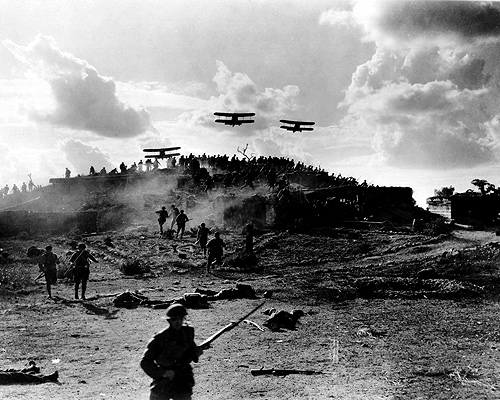
You Know What To Do When You See A Shooting Star?: Wings (1927)

A rather large burden comes with laying claim to being the first film to ever win a Best Picture Oscar.  Such is the case for the 1927 silent film Wings, directed by William Wellman, a prestigious filmmaker who would go on to make a name for himself in the era of talking films as well.  If one is to completely detach themselves from the historical relevance of a film like Wings, it is easy to dismiss the work as simple melodrama with a love story that would become standard issue within Hollywood for decades to follow, however, it is too simple to deny the films it place in history, as a magnificent work of cinematic experimentation and storytelling.  It would be unlikely that I ever place this film on a short list of my favorite silent films, yet, I cannot deny that if I were to compose a rather lengthy list of historically pertinent films that this would make the cut.  Wings is exactly the kind of film you hear older scholars and aging moviegoers refer to when they describe the golden age of filmmaking.  The star-studded film, is a spectacle to view between the ethereal acting of Clara Bow and the pristine condition of the high-definition transfer, tragically though, the film simply has not aged well.  I, as a viewer, found myself constantly dismissive of the narrative, one that seemed far to steeped in the political ideologies and societal norms that are all but antiquated.  That is not to say the movie is not well made and worth watching, I simply argue that it does not stand the test of time as many other works of the era managed to do, like The Jazz Singer, Wings is a film that is necessary viewing, but not necessary to keep around for future viewings.  With all this being mentioned, I cannot express how many moments of sheer cinematic magic occur within this film, it possesses a series of amazing battle scenes that would be lost to CGI in the technology-laden world of filmmaking these days.  Wings is a great movie, nobody can deny that fact.


Wings, as many war films do, focuses on two small town rivals.  The first begin the good ol'boy Jack Powell (Buddy Rodgers) who is so in love with the neighborhood beauty that he fails to realize the girl next door is completely infatuated with him.  Second, there is the dashing well-to-do David Armstrong (Richard Arlen) who gains the affects of the towns ideal woman, much to the demise of Jack.  It seems, without knowing the plot of the film that Wings will play out as a romantic comedy, however, in a near jarring fashion, warfare overtakes the narrative as both Jack and David become recruits to the U.S. Air Force.  Realizing that this war allows her a chance to win over the heart of Jack, Mary Preston (Clara Bow), his neighbor, joins the motor division of the war effort, something females were allowed to engage in during The Great War.  During their training, Jack and David emerge as bitter rivals, often tricking one another into messing up during various activities, yet as the training continues and each proves their efforts, the two end up becoming friends and realize their combative natures could be far more well applied to the war effort.  The two pour their days into fighting German aircrafts, while witnessing a variety of loss, most notably that of Cadet White, who is played briefly and masterfully by a young Gary Cooper.  During one particularly grueling assignment the two risk their lives to fight German planes, David is shot down and assumed to be a casualty of war, while Jack returns safely and is awarded a heroes welcome for his endeavors.  His actions allow him to take a leave in Paris, one that is suggested to be full of drinking and fornication.  Despite being promised extended leave, Jack is called back to service, an action that is undertaken by Mary, who due to bad timing is caught naked in Jack's room, resulting in her dismissal from service.  Jack begrudgingly continues with his service and continues fighting Germans, all the while David, who is still alive, manages to steal a German aircraft and attempt to return home.  Unfortunately, Jack mistakes David for a German and shoots him down during a firefight, a mistake he only realizes while on the ground.  Jack subsequently returns home to apologize to David's parents, who are clear to blame the war, and not Jack, for the death of their son.  As is the case with such films, Jack has a prophetic realization of his love for Mary and the two are shown united in the films closing.

A variety of commentaries are available when discussing a film like Wings.  The first that I wish to mention is something that I have brought up whilst discussing a previous silent war film, Flesh and the Devil.  In this post, I provide a lengthy analysis of how the two male characters posses a homosocial bond between one another that borders on a sexual nature.  While it is certainly not as cataclysmic for the women involved within the narrative of Wings, a homosocial bond exists within Wings, particularly between Jack and David.  While the two are at odds in the films beginning, their forced cohabitation together leads them to become close on an emotional level, which leads to an undeniable amount of intimacy.  It is especially hard to deny the implicit sexual component of such a bond, particularly in David's death scene, an instance in which Jack literally fondles David and plays with the locks of his hair.  This is clearly the overarching criticism available within a film like Wings, yet it is also notable for its depiction of women in the war effort.  This activity was something that was somewhat nonexistent within war films, prior to World War II when allied forces depicted women in a variety of films engaging in war related activities, whether at home or on the war front, perhaps the most well known of these being So Proudly We Hail!.  The smart choice of the narrative to depict Mary in the war effort is historically accurate, while they may not have been fully involved with work within the motor pool they were certainly present as nurses and the fact that the film even acknowledges her presence is something of note.  It is an issue that the film dismisses her from service because of assumed sexual promiscuity, yet it is certainly indicative of then contemporary ideologies.  Problematic as it may be it is certainly worth praising for breaking a movie mold.

Key Scene: The entire Paris club scene is cinematic inventiveness at its finest.

While this is a great film, it is certainly not something that needs to sit on your shelf and collect dust.  Renting the bluray will be more than justifiable, as it needs to be seen, if purely as a piece of history.  Also, it happens to have a bit of Pre-code nudity on the part of Clara Bow, something that surprised my upon viewing.

6.8.12

You Know Billy, We Blew It: Easy Rider (1969)

When the powers that be that controlled Hollywood from the onset of the silent era to well into the 1950's fell out of control, what happened to American filmmaking would forever change viewers understandings of cinematic narrative.  With non-linear narratives and Soviet style montage sequences American moviegoers, thirsty for something revolutionary were enthralled by the psychedelic and cool stylings of New Hollywood filmmaking and while Easy Rider was not the first film to offer such imagery and commentary it has, undoubtedly, come to represent the era more so than any of its contemporaries.  Between its drug-induced soundtrack, Odyssey-like quest story and its purely disparaging commentary on the state of youth in America, it represents the 60's masterfully and manages to still say something honest and uncomfortable about the state of society, regardless of being almost fifty years old.  One of the many contenders on my "coolest movies" list, Easy Rider makes you want to jump back in time and strap on an American flag leather jacket and simply cruise the highways of America, not because you are out to prove yourself a bad-ass, but because you truly hope to find the meaning of everything between a cup of coffee in a diner and a revelatory trip on lsd next to some cacti.   However, just like Jack Kerouac's prolific novel On The Road, Easy Rider takes away the coolness of nostalgia, by slapping on a harsh reality that the ideal world of the past is easily disrupted by those who interfere out of irrational hostility and a loathsome fear of change.  Easy Rider is hardly a story of redemption and it is certainly not intended to be taken lightly, but between the magnitude of such a low-budget film and the fact that it was ever produced in the first place is something to celebrate in itself and let us not forget that the film is in the AFI Top 100 film list for a damn good reason, it is with little argument one of the most American films ever released.

Easy Rider follows the exploits of Wyatt (Peter Fonda) who also refer to himself as Captain America, in honor of his motorcycle and jacket adorned with the stars and stripes and Billy (Dennis Hopper) a leather jacket long haired hippy who is preoccupied with making money and getting stoned.  After a successful drug sale, Wyatt and Billy decided to take their newfound fortunes and travel across The United States, with the ultimate intention of stopping in at Mardi Gras.  Along the way, they meet a variety of individuals who provide them with details about the American experience, one that is clearly muddied by disillusionment.  The first individual they encounter is simply known as The Stranger on the Highway (Luke Askew) and asks for a ride to his compound in the desert of the Midwest.  There Wyatt and Billy witness an "off the grid" community of youth that have left the city in hopes of ascending their corporeal existence into something more spiritual.  However, it is clear that their existence is more focused on orgiastic free love and heavy drug use than anything else.  Itching to get to Louisiana Billy cuts their stay there short and they continue on the road towards the southern state.  Along the way the are arrested for interfering with a town parade and are forced to spend a night in jail, there they meet a functional alcoholic named George Hanson (Jack Nicholson) who just happens to be a well known lawyer and helps the duo out of jail in exchange for tagging along with them on their trip.  Donning his old football helmet, George becomes a pseudo-guide through the south and all seems fine until they enter into a local diner, only to be ridiculed and ignored by the servers due to their unconventional attire.  Distraught the three spend the night in the woods outside the town and are eventually attacked by a group of locals, which results in the death of George and injuries to both Wyatt and Billy.  Enraged the two continue on their quest to New Orleans and eventually make it to an infamous brothel. There they meet two girls and spend the night together, partaking in acid and having a crazy trip.  After this experience Billy and Wyatt hit the road again and have become quite upset with the state of their trip and decide to call things off completely, however, before they can return from where they came they are gun downed by two rednecks who think it a fun game to fire a shot gun at the passing motorcyclists.  The film then ends not with a nostalgic remembrance of the two travelers, but instead, just an image of the flaming motorcycle as the screen pans out in an incredibly reflective moment.


Easy Rider is not the first motorcycle movie released by any means, nor is it even the first movie with either Peter Fonda or Dennis Hopper that places its central focus on the experiences of motorcycle driving rebels.  What Easy Rider is the first to do, however, is to condense all the concerns, commentaries and dilemmas that plagued young America post-1968 into one film and boy does it make a lasting impression.  While it is never fully acknowledged, we can come to assume that Wyatt is a Vietnam veteran, his choice to wear the American flag being an ironic homage of sacrifice to an ungrateful nation.  His relatively clean look suggests a man traveling cross-country in the hopes of finding an answer to his existential sense of loss.  He seems to interact earnestly with each person he encounters; hoping that they will provide him a reason to continue on, sadly this never seems the case.  In opposition then, is Billy, whose constant state of intoxication and anger suggest a man who is trying to outrun something.  If we find ourselves confused about Wyatt's past, even less is known about Billy aside from the fact that he really wants to get laid and retire with money in Florida.  In fact, it is quite clear that many of the characters within Easy Rider combine into a pastiche of the collective disillusionment of sixties America.  Whether it be the stranger who desires a complete disconnect from technology, or George who is so overwhelmed by his parental expectations that he spends his days drinking himself into oblivion, simply because he cannot stand to reside in the harshness that is reality.  The film is problematic in that it only focuses on the narratives of white males, but there is certainly a possibility that Hopper intended this as another layer of commentary on the issues of America during the time, it is impossible to say, but worth considering.

Key Scene: The drug trip scene in the New Orleans mausoleums, as filmed by Laslo Kovacs is hands down the best drug sequence in a movie ever....and I mean ever.

I was ecstatic when Criterion released its box set of the "America: Lost and Found" series and was finally able to purchase it about a month ago.  This is one of many films in the set and is well worth purchasing, the Bluray transfer of Easy Rider looks phenomenal.

4.5.12

Alright! Everyone On Their Heads!: Attack The Gas Station! (1999)

This continued study of New  Korean Cinema only seems to be getting better, particularly with my recent viewing of Kim Sang-Jin's Attack the Gas Station!, a visceral and experimentally shot study of crime and urban life in Korea.  Set in the matter of two nights, the film explodes off the screen with kinetic energy unlike anything I have seen in sometime and is incredibly reminiscent of the works of both Quentin Tarantino and Guy Ritchie.  Geared towards a youth audience Attack the Gas Station! is unapologetic in its narrative and visual leanings, and holds no qualms in showing graphic violence and dropping expletives.  However, where a film like Attack the Gas Station! seems to diverge from the previously mentioned directors in its underlying social commentary and depth of character development.  The film would have been incredibly watchable had the director provided no back story for the main character, but the decision to add such an element makes it a far more enjoyable movie than the reviews I read prior to viewing could have ever hoped to do.  While the copy I viewed suffered from terrible dubbing, the general gritty and violent nature of the film made this fact go away almost instantly and I found myself enthralled with the characters every action, no matter how degrading or socially unacceptable in may have been.  The violence in Attack the Gas Station! is not poetic and it is certainly not meant to be vengeful as has been the case for so many movies I have previously reviewed, it is simply there as a means of entertainment and once a viewer realizes this, they are allowed to let go of serious expectations and enjoy a sporadic and at times zany film.


Attack the Gas Station! follows four young punks who have taken it upon themselves to rob gas stations for their money, however, after a night of success at a particular station they decide to hit up the joint again with the hopes that their revenue will be similar.  However, this is not the case, and in a fit of confusion and rage they decide to manage the gas station themselves and take one hundred percent of the profits.  The gang's leader is No Mark (Lee Sung-Jae) who espouses "speak soft and carry a big stick" mentality that proves perfect for his position as the group clearly obeys his every word.  The group also includes Painter (Yu Ji-Tae) a quiet individual who clearly excels at defacing property.  There is also Rock Star (Kang Sung-Jin)  who is the most flamboyant of the group, with his leather pants and seemingly unending lines of curse words.  Finally, there is Mad Dog (Yu Oh-Sung), a crazed individual, as his name suggests, who has a fight to the death mentality, which is only emphasized by the continual presence of a large wooden stick that he uses as a means of enforcement.  Throughout the night the group, in a rather comedic manner, attempt to maintain the gas station, while both dealing with a diverse group of customers, while also assuring that the employees of the gas station do not escape from captivity.  The groups inability to run the station, leads to disgruntled customers and run-ins with local gang members as well as one delivery boy who is fed up with continually dropping food off to them at various times through the night.  We are led to believe that the group is engaging in such behavior simply as a means to rebel, but as flashbacks for each of the characters suggests, they have come to their situations as a result of outside forces oppressing them in various ways, and the ultimate result is that this lifestyle is the only thing they find success within.  The film ends in a huge fight scene that is tense and thrillling and truly has to be seen to be believed, but as any good film should, the members of the group discover something about themselves that transcends their personal lives.  Each walks away from the mess more mature and ready to integrate their unique lifestyles into more socially acceptable means. 

So, while I am careful to note the simplistic nature of the commentary within the film, I cannot express how well delivered the commentary is as a whole.  At first it appears to be a simple film about rebellion, but this quickly evolves into a commentary on adapting youth mentalities into a South Korea that continues to industrialize at a more rapid rate.  Multiple scenes in the film depict Painter destroying various signs the promote unity and work ethics within South Korea.  It is not until we realize that he was once an aspiring artist whose dreams were shattered by rhetoric of "real work" and "respectable" employment that his rage is explained.  Fortunately, by the films close painter has found a way in which to adapt his skills to assure gainful employment and thus fit into a vision of South Korea in which every person finds success.  While it could be easy to read such a narrative as inherently conservative, I would argue that this is by no means the case; instead it is rather liberal in its commentary on proper employment.  The other gang members find success as musicians, baseball players and drill instructors.  Attack the Gas Station! is not a film about what one cannot do with innate skills, but instead about promoting the cultivation of such skills in unique and profitable ways.  In fact, the film is incredibly critical of ideologies that dismiss individuals lack of social involvement and note the such rhetoric comes from both the upper and lower classes, as is evidenced by the various businessmen who dismiss No Mark and his friends, as well as the gang members who claim that the gang cannot excel beyond their petty turf wars.  Ultimately, the film reminds viewers that in order to prove successful, one must ignore social commentaries that are unfavorable and affect their own positive change, even if said change requires a night of thievery and debauchery to inspire the desire to move forward.

Attack the Gas Station! is something to be viewed fully and without interruption.  I cannot begin to recommend it enough, particularly to those individuals who find themselves fans of action films; to me this is one of the best in some time.  A copy is a must, also it appears as though there is a sequel.

31.10.11

It's Not Psychology, It's Metaphysics: Jules and Jim (1962)

Every romantic comedy involving an awkward and convoluted triangle love affair has Francois Truffaut to thank, his 1962 masterpiece Jules and Jim.  Truffaut's film, very much lodged in the ideals of The French New Wave, portrays two stalwart friends and a sexually free woman engaging in an intimate relationship in every sense of the word.  The stylistic nature of New Wave filmmaking allows Truffaut to portray the frantic nature of love between multiple people by undercutting dialogue, jumping to reactions early and even inserting long inexplicable shots of the natural world around the characters, all adding a genuine feeling of spontaneity to experiencing love.  Truffaut, as he does with many of his films, captures the essence of human nature, often focusing on the tragedies of existence, but always reminding viewers that even the most dire of situations can procure moments of happiness.  Jules And Jim is an unconventional look at the trials and tribulations that is at all times honest, absurd and heartfelt.  It should be no surprise that the film is tied very closely to Truffaut's own life experiences, a practice reflected in many of his works, most notably The 400 Blows.


The title characters Jules (Oskar Werner) and Jim (Henri Serre) are the ideal male pal combination.  Jules an Austrian novelist and critic and Jim a French poet find themselves enamored with each others intellect and love for the written word.  Throughout the early portions of the film they find themselves perusing the nooks and crannies of Paris, often translating the seminal literary works of each ones respective countries and relating it to their own seemingly mundane lives.  It is assumed that their rather repetitive existence promises to remain untouched, however, when both of them meet the quirky, yet attractive Catherine (Jeanne Moreau) infatuation occurs instantly, for both Jules and Jim find themselves attempting to win over the heart...and body of Catherine.  After a variety of humorous competitions, mostly of a verbal nature, it is Jules who wins Catherine over and takes her to live on the Parisian countryside.  Jim accepts his loss and succumbs to loneliness.  Both accept their situations and even fight a in a war that pits them against one another and all seems fine, however, a few months after the war Jules invites Jim to visit him at his country home.  While doing so, Catherine, whether inadvertent or not, seduces Jim and the two begin to confess their previous feelings.  After a series of miscommunications and letters, Jim discovers that he is to be the father of Catherine's child.  However, Catherine loses the child, but not her affection for Jim.  In a rather awkward moment, Jules catches Catherine and Jim in a moment of intimacy, but chooses to pretend it never occurred and instead passively asks for Jim to remove himself from their home.  Realizing that she is madly in love with Jim, Catherine drives herself and Jim off a bridge into water to assure that they can be together in death.  The film then cuts to Jules, narrating the funeral of both Catherine and Jim explaining that Catherine's casket was relatively small, while Jim's was quite large, reflecting his rather grandiose nature.  This final commentary by Jules says it all, the relationship that proved most important was the one between two friends, who know each others most intimate secrets and that Catherine, for all intents and purposes, ruined their bond both figuratively by becoming a romantic interference and literally by killing Jim, thus separating him from Jules indefinitely.


As I noted this film is a very intimate work on the part of Francois Truffaut, particularly because this film is quite reflective of his close, though brief, relationship with Jean-Luc Godard.  Godard and Truffaut share the spotlight in The French New Wave and film critics continue to debate which individual can claim rulership as the film movement's leader.  The duo built their close relationship while working as film critics for the Cahiers Du Cinema and began making short films as side projects; often incorporating each others help as it proved necessary.  The ultimate result was the creation of two distinctly different directors that just happened to use a lot of the same methods.  In fact, the two worked so closely that many actors appeared in both directors' films and both directors borrowed the others unused footage.  Their friendship proved most productive with the release of Breathless, a film written by Francois Truffaut and directed by Jean-Luc Godard.  Both Godard and Truffaut received international acclaim for this film, as did Truffaut for the previously mentioned film The 400 Blows.  It seemed as tough Truffaut and Godard were destined to be best friends for life and continue to work in collaboration well past the fall of The French New Wave.  This change, however, with the rise in workers revolutions in France during the early 1960's.  Godard and Truffaut found themselves promoting differing political ideologies during the revolts high points.  Their relative views became so severe that the duo broke off their friendship and ceased contact up to the point of Truffaut's death in 1984.  In my opinion this film reflects this occurrence in Truffaut's life, even if it predates the actual fallout between the two directors.  Jules is intended to represent Godard, particularly given the directors Swiss origins and Jim is undoubtedly Truffaut a fact that is only made more probable by Godard previously making a film titled Charlotte Et Son Jules.  Jules and Jim end their relationship and fail to rekindle it before Jim's death and the same thing occurred between Godard and Truffaut.  I know this all implies that Truffaut is a psyching, but I am not saying it is meant to reflect it perfectly; instead it just shows how much a director like Truffaut pulled from personal experience for his films.  Perhaps this helps to explain the intimate and very honest nature of the late director's work.

This is one of the staples of art house cinema and one of Truffaut's finest outings.  I highly recommend checking the film out and getting the Criterion release, because the supplements are phenomenal.

27.9.11

Blood Brothers, Flowers and Crackling Ice: Flesh And The Devil (1926)


Every time I believe I have found the penultimate silent film something comes along to challenge all my assumptions.  The Greta Garbo driven Flesh and the Devil is one such example.  The acting, narrative and cinematography have brought me a state of awe that has not occurred since first viewing Metropolis.  What makes this particular viewing experience even better was that I was able to attend a viewing of the film with live organ music, giving me a faint idea as to what it may have been like to attend a film in the twenties.  Sadly, it was blatantly obvious that my girlfriend and me were the youngest couple there and were probably half the age of the next oldest person there.  I wish yet again that persons my age had a love for the beauty of silent era filmmaking, but as this events showed, it has yet to happen.  Regardless, I am enthralled by Flesh and the Devil and am making it a mission of mine to become much more versed in the MGM titles that were released during this golden age of cinema.


Flesh and the Devil follow a handful of characters as they interact in a lavish and old-world German village, particularly the relationship between two long time friends Leo (John Gilbert) and Ulrich (Lars Hanson).  They are shown as compatriots whose single concern is assure that they advance forward in unison, even if it means occasionally shoveling shit for the other, in the most literal sense of the term.  Their bond appears to be sturdy and incapable of divide.  This inextricable connection changes, however, with the emergence of Felicitas (Greta Garbo) a sultry women who exudes a sexuality so strong that Leo become instantaneously enamored with her.  Their budding relationship seems perfect, until it is brought to Leo’s attention that Felicitas is already married to Count von Rhaden (Marc McDermott).  In an attempt to assure Felictas’ love Leo duels and kills the count resulting in Leo’s exile to avoid severe punishment.  During his long leave of absence, Leo thinks fondly of Felicitas, literally envisioning her name in his dreams.  Felicitas, however, has moved on to wed Ulrich who is completely oblivious to the past relationship between Leo and Felicitas given its secretive nature.  Ulrich in a moment of celebration is able to bring Leo back early hoping to share his good news.  Much to Leo’s dismay he was hoping to marry Felicitas.  The film then focuses on Felicitas and her attempts to seduce Leo without leaving Ulrich.  As Leo, and the village priest make ever apparent, such a polygamous relationships is impossible and more importantly sinful.  The misunderstanding almost leads to Leo and Ulrich attempting to kill one another, an action Felicitas attempts to be indifferent towards.  In a climactic ending Ulrich realizes that Leo was only attempting to regains his love and that in reality it was Felicitas whose actions were tantamount to betrayal.  This deceit is punished, however, because while attempting to stop the shootout Felicitas falls through a thin piece of ice, leading to her cold and lonely death.  Ulrich and Leo are reunited as buddies once again to move freely through the world without the burdens of a competing sexual threat.

In a joking manner I left the screening saying that I had no clue why Brokeback Mountain was so controversial, this film was much “gayer.”  I meant that jokingly because the characters of Leo and Ulrich are very intimate.  The two are shown as an inseperable entitiy, often predicting the others actions and preparing to make each others movements go through with relative ease.  In such a scenario their coupling represents the finest example of the homosocial bond I have ever seen in film.  While the leading males never enter into a traditional homosexual act (they do come damn close at the end), they are obviously attracted to one another, in so much as they believe themselves deserved of one another’s blood.  Their attraction, according to the homosocial bond, is not sexual in nature but more narcissistic in their desire to be with some one that equally represents them.  Both Leo and Ulrich are white males who are relatively well to do.  It is not only desirous for them to partner with one another, but ideal in terms of survival.  In the simplest terms they are friends due almost entirely to likemindedness.  With this in mind, it completely changes the purpose and image of Felicitas.  Unlike the femme fatale the film portrays her to be, she is instead a threat to the power advantages of Ulrich and Leo’s homosocial bond.  She represents an opposing ideal, which would mean severing their unity that assured mutual safety.  Luckily for the duo and problematically for the film, their homosocial bond transcends Felicitas and her feminine interference.  Such an ending is obvious an early twentieth century equivalent of the rather degrading term “bros before hos,” but clearly represents ideals prevalent in the 1920’s.  Watch the film with this discussion in mind, seriously it is really obvious and almost tragically humorous.

I want to reiterate how spectacular this film is, particularly the acting and cinematography.  Both were revolutionary and far superior to many films that are made today.  It is well worth seeing and owning and I would suggest getting a copy as soon as possible, as it only exists in the outdated world of VHS.