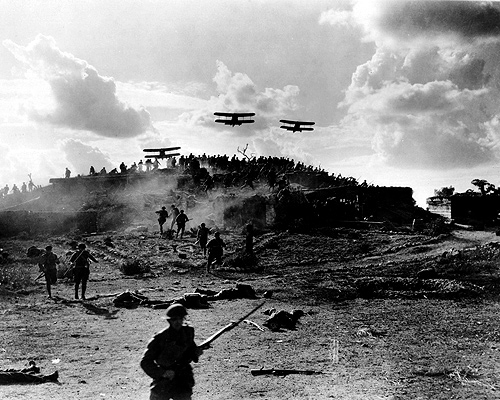
I am willing to excuse a lot in regards to film historicism, given the amont of courses I have taken and reading I have done regarding cultural shifts in America. For example, I can respect both Holiday Inn and The Jazz Singer detached from their unfortunate uses of blackface, where as I have trouble forgiving and overlooking the racist and sexist elements of The Birth of a Nation or Gone With the Wind in favor of their cinematic exuberance. A film like Cimarron is doubly problematic, because while it does have a few moments of genuine cinematic magic, it is attached with the fate of being a silent film forced into the mold of a the still newly working talking pictures, and does not manage to take its moments of experimentation and unique camerawork farther than the occasional captivating side shot. While it is an issue all its own, the fact that the film makes egregious use of racist and sexist imagery to get its message across, only to embrace, in the end, the aid of white America in racial freedom, Cimarron is an insanely problematic and particularly offensive work. It could be, in a sense, seen as the Western epic thirties version of The Help, a film so infuriatingly frustrating when it comes to race relations that I actively petition it when given an opportunity. Yet, even the problematic The Help suggests that the white figure in question has a deep-seeded understanding that racial injustice is wrong, in Cimarron all the characters begin as racist and learn to evolve away from such issues. I want to emphasize here that I am not a person who quickly dismisses the films of the thirties, which are decidedly mixed in results, in fact, I thoroughly enjoy a lot of the output from classic Hollywood in this era, after all it did provide viewers with multiple Marx Brothers classics, and the magnificence that is King Kong. I wanted to get over my decidedly visceral rejection of this work and embrace it wholly as a realized vision of an early western, but, to be honest, it is hardly that either and fails to capture viewers with any coherent plot, instead, aiming for an audacious and lofty multi-decade narrative that ultimately fails miserably in the two-hour time allotment. However, it should be no surprise that it won the Oscar for Best Picture upon its release, after all, the Academy rarely gets it right.
Cimarron begins with the race for American expansion to the West at the hands of many ambitious American pioneers of all classes. The particular movement is to the newly established Oklahoma territory which the United States government has recently made available after the relocation of its native populations. One such settler Yancey Cravat (Richard Dix) takes this opportunity to relocate his family, including his wife Sambra (Irene Dunne) and their young son. This movement is seen as frivolous and dangerous by everyone except Yancey who views it as a means to make a bigger name for himself within the newspaper business. The family servant/slave Isaiah (Eugene Jackson) also sneaks along for the ride, an act that Yancey seems hesitant to chastise, mostly because Isaiah will provide a source of work in the bustling settlement town they make it to upon the end of their travels from Kansas. Yancey is immediately confronted by the ruff and tumble members of the town, particularly as set of gunslingers who find his Yankee ways and desire to establish social etiquette and respect within the town foolish and an invasion of their lawless existence. Nonetheless, using a chance sermon as a means to state his goals, and rid himself of the pesky criminals in a very real way, Yancey becomes the most established and respected member within his community, pushing the newspaper and the power that comes along with it, much to the frustration of Sambra who sees her familial structure faltering, particularly when her son falls for a Native American girl, much to her anger. Yancey grows in stature and engages in multiple violent shootouts only continuing to grow in power and progressive idealism, eventually using his sway to help the native populations and act that ultimately severs his bond with Sambra, so much so that it is not until well after the discovery of oil and modernization sweeps up the rustic world of the new west that they are to reunite. At this point in the narratives closing, Sambra has become an established politician, one of the first women to do so and has turned away from her discrimination of the Native populations. Yet when she meets an aging and decrepit Yancey on the streets she comes to the realization that it was his actions that made everything possible, forever immortalized in a statue built in his honor in the closing moment of the film.
This whitewashing, very literally, of the American west is a problem that proves to occupy many westerns of the classic era, whether it be the contentious relationship in both the classic John Wayne vehicles Stagecoach and The Searchers or in the pseudo-western River of No Return. Yet in these films the Native American population fights against the seemingly unquestioned invasion of White Americans by using physical violence and blocking of their navigation of the space. The very opposite happens in Cimarron there are seens of Yancey and his family literally walking through the spaces of the so-called "injuns" of the area, expecting them to simply move out of the way of their larger and oppressive stage coaches. Furthermore, there is a very spoken disregard for the native bodies within the film, Sambra constantly degrading their every action and assuming them to be so savage as to be beyond even basic human respect. In fact, when a Native American man provides her son with a gift of a feathered hat, she quickly takes it from him and tells him not to talk or even acknowledge any native members. In fact, she is completely in favor of walking over the space the various natives occupy if it assures the continued advances of the American ideal of whiteness. When native voices are allowed to speak it is in a problematically demur and incredibly performative, one can recall both versions of Ruby Big Elk speaking in fractured sentences and "native proverbs" that are paired with excessive arm gestures. The native identity in this film is one of simultaneous exploitation and exoticization, never allowing their narrative even the slightest of value. I could embrace the film for its earnest depictions of what reality was for Native American populations during this wild time in American History, but that would suggest that the writers and filmmaker had the express intent of drawing attention to such injustice, whereas it is rather clear that they see it as a mere fact of the era.
Key Scene: The opening sequence is quite enjoyable in its action heavy nature, although the metaphor it exudes is far less awesome.
The only way I would suggest watching this is if you were attempting to navigate your way through all the Academy's Best Picture winners, if not, avoid this film it is hardly worth the drawn out two hours it demands.
Showing posts with label academy awards. Show all posts
13.3.13
I Help Girls Out: Vera Drake (2004)
Abortion is a very touchy issue as most can confess, when it is considered in the context of film it is often met with much trouble or confrontation. In some cases it exists as a narrative connection between splintering opposition that creates a problematically complex story, as occurs in Tony Kaye's pseudo-documentary Lake of Fire, or serves a possible choice in the background of a film centering on birth issues, evident in both Juno and Knocked Up. When a film does consider the act head on it is often met with much opposition or attempted quieting on the part of censors or individuals who think their conservative ideals should rule supreme on a society. Fortunately, for this blogger, who is decidedly and adamantly pro-choice the presence of a film like Vera Drake allows for a very real consideration on the issues of abortion and gender politics, while also proving extremely watchable and socially prescient. Vera Drake is neither an exploitative mess, like many other abortion themed films seem so intent on doing, nor is it entirely idealistic about its presence, it is a film very much intent on simply portraying the facts of abortion in mid-20th century Britain, an act that was done not out of a push towards moral degradation, but as a means to provide an affordable option to women who were still ignored heavily within the medical system, particularly if they were of a lower class and without the economic means to navigate healthy medical procedures. Furthermore, while the film makes it quite clear that the act of procuring an abortion is directly experienced by the woman receiving said procedure, Mike Leigh's film depicts a very real extension of social condemnation to any persons involved in such an act. Cinematically shot, and magnificently acted, Vera Drake manages to take a very touchy subject and strip it down to its factual situations, noting the points where even the most stalwart of upholders of law realize the grey area of such, then illegal, procedures, and how dangerous the act can be even in the most practiced of hands. Abortion, in the filmic narrative of Vera Drake, is not a denied occurrence, but a very real fact of the times, one that is brought to the forefront and demanded to be considered beyonds its violent misconceptions.
Vera Drake follows the title character, played masterfully by Imelda Staunton, an aged woman whose life as a domestic caretaker helps bring money to her family. Along with her husband George (Richard Graham) the couple is looking after their son Sid (Daniel Mays) who also makes money by working as a tailor, as well as their daughter Ethel (Alex Kelley) whose mannerisms suggest a very mild mental disorder. Regardless of the fact that three of the family members are employed, the family still appears to be in considerable poverty, only worsened by the fact that Vera must also take care of her ailing mother and father who are essentially bedridden. Yet, despite all these woes, the family seems particularly close, with the exception of a rather condemning sister-in-law. Things even begin to look up when a young man named Reg (Eddie Marsan) takes a liking to Ethel, eventually proposing to her much to the excitement of the entire Drake family. Yet, while the entirety of this is going on, Vera has been procuring free abortions to women around the city, seeing it as a means to help them in their most needy moments. She does so quite elusively and appears to be quite successful, until one of her patients is admitted to the hospital with rather serious stomach pains, resulting from an issue in the operation. This occurrence leads a doctor to inquire as to where the woman received the illegal abortion, eventually leading to Vera. A set of detectives interrupt the Drake's in the middle of celebrating their daughter's engagement and take Vera in on charges of willfully harming an individual. In this moment, Vera's alternate life emerges, received with much confusion by the family, particularly Sid who thinks she has betrayed the family, although Reg, who up until this point has been rather ignorant, reminds them that being able to afford to take care of a child plays heavily into being able to love them. During trial, the initial detectives do their best to let Vera off with a fine and minimum sentence, realizing that her intention was by no means to harm anyone, yet when it reaches a higher court the judge shows no pause in extending a heavy sentence to her, thus placing her in jail on a two year incarceration. The closing scene, with a sense of poetic tragedy shows the family sitting in the dining room at a loss for what to do without the presence of Vera.
I state that this film does a lot for the manner in which one considers abortion in a social context. Firstly, the problematic issue of medical costs and class access arise when one girl is shown attempting to discretely go through the proper channels to get a legal abortion, only to be told that she does not possess enough money, causing her to seek alternative methods to end the pregnancy, one that the narrative suggests was a result of rape. This still holds true for abortion in a contemporary context, many women who attempt to obtain same and legal procedures, are either turned away due to lack of medical insurance or as a result of providers refusing to provide services due to ethical grounds. As such alternative means to end pregnancies are sought and low costs without the assurance of absolute safety. Of course, in The United States organizations such as Planned Parenthood offer services for individuals in need, yet this is always predicated on funding from the community, as the government fails to properly finance the services, again resting almost solely on conservative politicians refusing to aid persons in need. Furthermore, the film is also careful to note the diversity of women who receive abortions, whether it be relatively well to do women hoping to discreetly rid themselves of an unwanted pregnancy, or a worn out mother of seven whose male figurehead is adamant not to allow for contraceptive use, even considering women of color, which is particularly fascinating given their particular otherness in fifties Britain. This too reflects a contemporary understanding of abortion, an issue which many people assume happens only to lower class women of color. In fact, the persons who obtain abortion are quite diverse, although statistics do suggests it is particularly prevalent in the previously mentioned group, it does extend well beyond this group. Finally, the film asks viewers to consider whose ethically at fault her, reminding them that if Vera did not need to do this she certainly would not, but she sees it as a means to help those who cannot afford medical care, as opposed to forcing them to carry to term a child that will in no way be taken care of with any degree of decency. Vera Drake paints a very real picture of issues in abortion, masked cleverly in a seemingly dated period piece, not as a means of distancing the subject, but as a clever reflection on its still pertinent problems.
Key Scene: The initial interrogation by the police at Vera's home may well be one of the greatest acted moments in contemporary film and the contemplative cinematography only adds to its effectiveness.
As it stands there is no bluray of this movie, which is a shame because it is gorgeous. Fortunately, the DVD is super cheap and still looks great. Vera Drake is a definite must-own, unless of course you are a conservative pro-lifer, but if that is the case you probably hate good film anyways.
Vera Drake follows the title character, played masterfully by Imelda Staunton, an aged woman whose life as a domestic caretaker helps bring money to her family. Along with her husband George (Richard Graham) the couple is looking after their son Sid (Daniel Mays) who also makes money by working as a tailor, as well as their daughter Ethel (Alex Kelley) whose mannerisms suggest a very mild mental disorder. Regardless of the fact that three of the family members are employed, the family still appears to be in considerable poverty, only worsened by the fact that Vera must also take care of her ailing mother and father who are essentially bedridden. Yet, despite all these woes, the family seems particularly close, with the exception of a rather condemning sister-in-law. Things even begin to look up when a young man named Reg (Eddie Marsan) takes a liking to Ethel, eventually proposing to her much to the excitement of the entire Drake family. Yet, while the entirety of this is going on, Vera has been procuring free abortions to women around the city, seeing it as a means to help them in their most needy moments. She does so quite elusively and appears to be quite successful, until one of her patients is admitted to the hospital with rather serious stomach pains, resulting from an issue in the operation. This occurrence leads a doctor to inquire as to where the woman received the illegal abortion, eventually leading to Vera. A set of detectives interrupt the Drake's in the middle of celebrating their daughter's engagement and take Vera in on charges of willfully harming an individual. In this moment, Vera's alternate life emerges, received with much confusion by the family, particularly Sid who thinks she has betrayed the family, although Reg, who up until this point has been rather ignorant, reminds them that being able to afford to take care of a child plays heavily into being able to love them. During trial, the initial detectives do their best to let Vera off with a fine and minimum sentence, realizing that her intention was by no means to harm anyone, yet when it reaches a higher court the judge shows no pause in extending a heavy sentence to her, thus placing her in jail on a two year incarceration. The closing scene, with a sense of poetic tragedy shows the family sitting in the dining room at a loss for what to do without the presence of Vera.
I state that this film does a lot for the manner in which one considers abortion in a social context. Firstly, the problematic issue of medical costs and class access arise when one girl is shown attempting to discretely go through the proper channels to get a legal abortion, only to be told that she does not possess enough money, causing her to seek alternative methods to end the pregnancy, one that the narrative suggests was a result of rape. This still holds true for abortion in a contemporary context, many women who attempt to obtain same and legal procedures, are either turned away due to lack of medical insurance or as a result of providers refusing to provide services due to ethical grounds. As such alternative means to end pregnancies are sought and low costs without the assurance of absolute safety. Of course, in The United States organizations such as Planned Parenthood offer services for individuals in need, yet this is always predicated on funding from the community, as the government fails to properly finance the services, again resting almost solely on conservative politicians refusing to aid persons in need. Furthermore, the film is also careful to note the diversity of women who receive abortions, whether it be relatively well to do women hoping to discreetly rid themselves of an unwanted pregnancy, or a worn out mother of seven whose male figurehead is adamant not to allow for contraceptive use, even considering women of color, which is particularly fascinating given their particular otherness in fifties Britain. This too reflects a contemporary understanding of abortion, an issue which many people assume happens only to lower class women of color. In fact, the persons who obtain abortion are quite diverse, although statistics do suggests it is particularly prevalent in the previously mentioned group, it does extend well beyond this group. Finally, the film asks viewers to consider whose ethically at fault her, reminding them that if Vera did not need to do this she certainly would not, but she sees it as a means to help those who cannot afford medical care, as opposed to forcing them to carry to term a child that will in no way be taken care of with any degree of decency. Vera Drake paints a very real picture of issues in abortion, masked cleverly in a seemingly dated period piece, not as a means of distancing the subject, but as a clever reflection on its still pertinent problems.
Key Scene: The initial interrogation by the police at Vera's home may well be one of the greatest acted moments in contemporary film and the contemplative cinematography only adds to its effectiveness.
As it stands there is no bluray of this movie, which is a shame because it is gorgeous. Fortunately, the DVD is super cheap and still looks great. Vera Drake is a definite must-own, unless of course you are a conservative pro-lifer, but if that is the case you probably hate good film anyways.
11.3.13
I'm A Bagel On A Plate Full Of Onion Rolls: Funny Girl (1968)
I must admit that my growing up in a world of South Park and Family Guy created a certain expectation of Barbara Streisand as being this over-the-top and over-the-hill performer whose dramatics and larger than life sensibilities were a thing to be mocked, this information was of course all procured without every actually seeing a single film involving Streisand, or hearing any of her music for that matter. Since those days that seem so long ago I have come to understand Streisand as a legitimate performer and a woman more than capable of singing. Sure she has a certain degree of maudlin about her performances, just check out her homage to Marvin Hamlisch at this years Oscars. Yet to completely dismiss her as a performer is illogical, it is simply a performance method that works surprisingly well for her stylistically and represents the theatricality that seems to evidence Streisand's staying power. No worries if this is all a bit new, I only came to this realization after watching Funny Girl yesterday as a part of this month of women oriented film, of which, I knew I could not overlook Streisand. In this film, much is to be said about her commitment to theatricality as a means to acknowledge her otherness, both as a Jewish woman and one whose body image does not necessarily reflect that of the societal mythologized ideal. Through an embracing of humor, Streisand and director William Wyler depict a larger social commentary within a rather normal musical. I say that not to dismiss it cinematically, it is by no means the most stellar musical I have ever seen, but it does take its critical lens very seriously and nearly deserves unadulterated praise for that alone. While, Streisand makes the film comedic, she is also very aware of the seriousness of the narrative, particularly as it relates to expectations in a heteronormative relationship, something that can prove disparaging when both parties have not laid out their expectations from the onset. Overall, Funny Girl does not stand out as a flawless piece of filmmaking and suffers from its misguided concern for showiness, yet Barbara Streisand is phenomenal and certainly deserved the Oscar she obtained, as a result, and just to reemphasize this fact, Streisand can sing, and she sure shows it in this film.
Funny Girl centers on Fanny Brice (Barbara Streisand) a now successful Broadway performer who is setting introspectively in the theater putting on a recent production of Ziegfeld Follies, for which she is the star. The film then moves to a flashback, in which viewers are shown Fanny's twisting and unconventional move to stardom from being the object of affection in her crowded Jewish home to making a name for herself not as an outright Broadway beauty, but for learning to embrace her considerable attractiveness, while also using her unconventional looks as a means to poke fun at her performances, something crowds love, despite the frustration of her manager. During one of her early performances she meets Nick Arnstein (Omar Scharif) an exotic horse racer and gambler who takes an instant liking to Fanny, to which she is more than welcoming, finding his dark features and suave mannerisms to be captivating. The narrative then moves into Fanny and Nick learning to navigate their decidedly different lifestyles, for Fanny constant traveling and for Nick needing to stay put when luck suits him to do so. However, one thing is clear the two care deeply for each other and eventually agree to get married, something that both embrace dearly, yet no amount of affirmation can help to contest their truly unique lifestyles and when Nicky fails to attend one of Fanny's performances due to riding a hot hand of gambling the two have a considerable falling out, yet, Fanny knows he was only doing what he thought to be in his best interests. When it is revealed that Nicky has accrued huge debts she attempts to help him by providing him with a job prospect, but his desire to be self-made causes him to refuse, ending up with him becoming involved in an illegal bond trade and subsequent arrest, all the while Fanny trucks along with her career, up until the moment from the films opening, where she is now revealed to be sitting and awaiting the return of her loving husband, while also realizing that the world she exists in is something she obtained almost entirely on her own, aside from an initial white lie on the part of Nicky to expedite the process.
Funny Girl almost mocks the assumption that everything financial should necessarily involve a masculine presence. While Ziegfeld the character is certainly present in the narrative and finances many of the performances in which Fanny earns her reputation, she refuses to adhere to the uniformed rigidity associated with such situations, much to his dismay, although he realizes that attempting to subdue anything that is Fanny would be to ruin her stardom and presence on stage. Even her husband Nicky proves to contradict the image of masculine provision, in that he makes money intermittently and is always seemingly lost within moments to follow, yet he finds it impossible not to navigate the capitalist fueled world of bourgeois decadence, complete with phallic cigars, near empty brandy sifters and thousand dollar bills. It would be easy to state that Nicky has a gambling problem, yet, when he has a chance to win money against Fanny's family with a sure hand he refuses to do so, perhaps solely as a result of respect, but more likely a result of his assumptions of money and masculinity. His choice to not take money from these women is somewhat ironic, because it is made rather obvious that these woman have managed to create a space all their own completely detached from masculine provisions. Sure it is not as lavish and luxurious a world as the card rooms where Nicky plays, or the crystallized worlds of Fanny's stages, but they are happy in their self-sufficiency and ability to navigate their world with considerable success. This is clearly something that influences Fanny as she uses it as an inspiration to strive for career advancement, which she does, despite being and othered other. The closing scenes of her occupying an entire theater only speak to how successful she has become with her economic endeavors, which, unlike Nicky, are backed by mental comfort as well.
Key Scene: The rollerskating scene is hilarious and well done and helps to explain why this film gets referenced so frequently as one of the best musicals of all time.
This did not blow me away by any means, but it has a historical relevance and says some interesting things within its narrative, as such I strongly encourage renting it, or finding a streaming version.
Funny Girl centers on Fanny Brice (Barbara Streisand) a now successful Broadway performer who is setting introspectively in the theater putting on a recent production of Ziegfeld Follies, for which she is the star. The film then moves to a flashback, in which viewers are shown Fanny's twisting and unconventional move to stardom from being the object of affection in her crowded Jewish home to making a name for herself not as an outright Broadway beauty, but for learning to embrace her considerable attractiveness, while also using her unconventional looks as a means to poke fun at her performances, something crowds love, despite the frustration of her manager. During one of her early performances she meets Nick Arnstein (Omar Scharif) an exotic horse racer and gambler who takes an instant liking to Fanny, to which she is more than welcoming, finding his dark features and suave mannerisms to be captivating. The narrative then moves into Fanny and Nick learning to navigate their decidedly different lifestyles, for Fanny constant traveling and for Nick needing to stay put when luck suits him to do so. However, one thing is clear the two care deeply for each other and eventually agree to get married, something that both embrace dearly, yet no amount of affirmation can help to contest their truly unique lifestyles and when Nicky fails to attend one of Fanny's performances due to riding a hot hand of gambling the two have a considerable falling out, yet, Fanny knows he was only doing what he thought to be in his best interests. When it is revealed that Nicky has accrued huge debts she attempts to help him by providing him with a job prospect, but his desire to be self-made causes him to refuse, ending up with him becoming involved in an illegal bond trade and subsequent arrest, all the while Fanny trucks along with her career, up until the moment from the films opening, where she is now revealed to be sitting and awaiting the return of her loving husband, while also realizing that the world she exists in is something she obtained almost entirely on her own, aside from an initial white lie on the part of Nicky to expedite the process.Funny Girl almost mocks the assumption that everything financial should necessarily involve a masculine presence. While Ziegfeld the character is certainly present in the narrative and finances many of the performances in which Fanny earns her reputation, she refuses to adhere to the uniformed rigidity associated with such situations, much to his dismay, although he realizes that attempting to subdue anything that is Fanny would be to ruin her stardom and presence on stage. Even her husband Nicky proves to contradict the image of masculine provision, in that he makes money intermittently and is always seemingly lost within moments to follow, yet he finds it impossible not to navigate the capitalist fueled world of bourgeois decadence, complete with phallic cigars, near empty brandy sifters and thousand dollar bills. It would be easy to state that Nicky has a gambling problem, yet, when he has a chance to win money against Fanny's family with a sure hand he refuses to do so, perhaps solely as a result of respect, but more likely a result of his assumptions of money and masculinity. His choice to not take money from these women is somewhat ironic, because it is made rather obvious that these woman have managed to create a space all their own completely detached from masculine provisions. Sure it is not as lavish and luxurious a world as the card rooms where Nicky plays, or the crystallized worlds of Fanny's stages, but they are happy in their self-sufficiency and ability to navigate their world with considerable success. This is clearly something that influences Fanny as she uses it as an inspiration to strive for career advancement, which she does, despite being and othered other. The closing scenes of her occupying an entire theater only speak to how successful she has become with her economic endeavors, which, unlike Nicky, are backed by mental comfort as well.
Key Scene: The rollerskating scene is hilarious and well done and helps to explain why this film gets referenced so frequently as one of the best musicals of all time.
This did not blow me away by any means, but it has a historical relevance and says some interesting things within its narrative, as such I strongly encourage renting it, or finding a streaming version.
7.3.13
What Is Wrong Is Wrong, No Matter Who Said It: A Separation (2011)
I was a bit worried about including A Separation within this month, because aside from the few very captivating images I had seen during its Oscar win last year, I knew very little about it and was uncertain as to how heavily women would play into the narrative, a confusion that was not cleared up in the slightest by the presence of a plot synopsis, yet when my school decided to show its as part of their Middle Eastern Film Festival, I knew that I at the very least should check it out, at worst I would watch it and it would not apply to the blog for the month, yet, much to my elation, the film is very much concerned with women, both in context of contemporary Iranian society, as well as the manner with which they navigate spaces in culture and in film both in their presence and absence. A Separation is a very deliberate, some would say contemplative film, about the nature of bureaucracy, truth and the foundations of religious identity, all issues seemingly key to Iranian cinema, although I am hesitant to say this with certainty, having really only seen Abbas Kiarostami films as a commentary on Iran. It would be outright foolish to assume this to be the only image of Iran, much like saying only Kurosawa's vision of Japan is accurate, or to bring it closer to home, only Scorsese's image of America is honest. An American would be quick to negate the urban landscape within Scorsese's films as a full reflection of The United States. Of course, this is simply an aside, because much of Iranian cinema is inaccessible or has faded into obscurity, so Western film critics must draw from what is available and, perhaps in the future, more will make its way to a global audience. With all of this in mind, I must consider A Separation as some degree of a reflection of contemporary, at least urban, Iranian society, after all it, was the film submitted to the Academy of Motion Pictures for Foreign Language Film and managed to win it as well. I do not claim to understand the intricacies of gender politics as they relate to Iran, but I would be willing hedge a bet on this film representing them with some degree of accuracy, particularly in the materialist feminist consideration of gender/property oppression that emerges within the narrative. Possessing a decidedly vague ending, A Separation, nonetheless, appears to hold optimism as its central ideology.
A Separation begins with a divorce hearing between separated couple Nader (Payman Maadi) and Simin (Leila Hatami) who are told that they will find themselves incapable of divorcing unless they can agree to terms, one of which centers around the movement of their daughter Termeh (Sarina Farhadi) out of the country, a decision that Nader flat out refused to agree to, and seems to be the main point of divide between the couple. Simin seems intent on leaving with the family, but Nader refuses any possibility, almost entirely because of his Alzheimer's ridden father's immobility. Simin, while understanding the tragedy of the situation, nonetheless, extracts herself from the situation, leading to Nader needing to hire an employee to take care of his ailing father while he is at work. Finding reluctant help in Razieh (Sareh Bayat) Nader continues with his work, yet when Razieh claims that she cannot continue working, due to the religious issues with needing to bath the ailing man, Nader decides to consider her offer of allowing her unemployed husband to do the work instead, however, her husband Hojjat (Shahab Hosseini) has ties to creditors that keep him occupied, leading to Razieh returning as hospice. This occurs a bit longer, until one day Nader returns home from picking up Termeh to find the house locked. Frantically navigating the house, he discovers his father to be tied to the bed and passed out on the floor, only moments away from dying. Furious at Razieh he berates her upon his return and assumes her to also be guilty of stolen money, leading to him forcefully pushing him out of his apartment, in the process Razieh apparently slips down a few slick stairs, leading, Nader later discovers, to a miscarriage. This act leads to confrontation between Nader and Razieh and her husband Hojjat within the bureaucratically complex Iranian legal system. At one point Nader is accused of willful murder, while Razieh is blamed for negligence of an elder, leading to a legal battle that turns ugly when hostilities move outside of the court. Eventually, the group makes financial amends, heavily a result of Simin's intervention, moving things back to some degree of normalcy, although viewers are to assume that a high level of deception as occurred, not to mention that the events only solidify the desire for Simin and Nader to end things, much to the contesting of Termeh who is forced to decide which parent she would like to stay with.
The film really drives home the idea of truth as a relative term to one's ability to assure their comfort and safety, as well as those around them. None of the characters are inherently bad, per se, with maybe the exception of Hojjat whose past woes have led to a heavy amount of debts, and little explanation is given to explain what led to these debts, almost certainly suggesting illicit behavior. The patriarchal figurehead factors in heavily into how persons navigate the film, particularly Nader who finds himself fully aware of the realities of losing his wife if he does not agree to move, yet his obligation to his aging father is tantamount and leads to accepting the loss of his wife. Yet, while these narratives and ideas are key, the film seems deliberately set on suggesting that many of the issues faced by all involved in the narrative tie to the notion that women can only navigate the bureaucracy and legality of Iran with their male superiors guidance and presence. The main factor in preventing Simin from leaving is that she must do so with the permission of Nader who refuses to do so out of principle, completely ignoring the very real concerns for Simin's, as well as Termeh's, safety. Similarly, a viewer can easily argue that Razieh's inability to navigate the job market without the permission of her prideful husband proves problematic, considering that he cannot obtain work and she is legally not allowed to do so without his permission. It reminds one of notions of Marxist Feminism, which suggest that much of women's oppression finds its ties in private property and in the case of Iran their inability to possess it, even in the cases in which their husbands are detached from logical engagements to correct a financial situation. Even when Nader hires Razieh with the best of intentions, the fact that it is technically illegal suggests that if anything goes wrong, it will invariably the fault of the woman. The narrative, also seems to be in favor of this idea at first glance, but the reminder that it is male privilege and public sphere presence which has led to all the problems only rejects such a reading. A Separation is purposefully critical of gender politics in the film, yet, in a very clear statement Asghar Faradi seems to remind viewers that future generations of Iranians will be far less oppressive and the two young girls who navigate the filmic space as well certainly affirm that.
Key Scene: There are a ton of great monologues and interactions, yet a single brief shot of Nader and Simin on an elevator facing perpendicular to one another seems to really undermine these ideals.
This movie is phenomenal, I watched it on DVD, but plan to obtain the bluray and I suggest you do the same.
A Separation begins with a divorce hearing between separated couple Nader (Payman Maadi) and Simin (Leila Hatami) who are told that they will find themselves incapable of divorcing unless they can agree to terms, one of which centers around the movement of their daughter Termeh (Sarina Farhadi) out of the country, a decision that Nader flat out refused to agree to, and seems to be the main point of divide between the couple. Simin seems intent on leaving with the family, but Nader refuses any possibility, almost entirely because of his Alzheimer's ridden father's immobility. Simin, while understanding the tragedy of the situation, nonetheless, extracts herself from the situation, leading to Nader needing to hire an employee to take care of his ailing father while he is at work. Finding reluctant help in Razieh (Sareh Bayat) Nader continues with his work, yet when Razieh claims that she cannot continue working, due to the religious issues with needing to bath the ailing man, Nader decides to consider her offer of allowing her unemployed husband to do the work instead, however, her husband Hojjat (Shahab Hosseini) has ties to creditors that keep him occupied, leading to Razieh returning as hospice. This occurs a bit longer, until one day Nader returns home from picking up Termeh to find the house locked. Frantically navigating the house, he discovers his father to be tied to the bed and passed out on the floor, only moments away from dying. Furious at Razieh he berates her upon his return and assumes her to also be guilty of stolen money, leading to him forcefully pushing him out of his apartment, in the process Razieh apparently slips down a few slick stairs, leading, Nader later discovers, to a miscarriage. This act leads to confrontation between Nader and Razieh and her husband Hojjat within the bureaucratically complex Iranian legal system. At one point Nader is accused of willful murder, while Razieh is blamed for negligence of an elder, leading to a legal battle that turns ugly when hostilities move outside of the court. Eventually, the group makes financial amends, heavily a result of Simin's intervention, moving things back to some degree of normalcy, although viewers are to assume that a high level of deception as occurred, not to mention that the events only solidify the desire for Simin and Nader to end things, much to the contesting of Termeh who is forced to decide which parent she would like to stay with.The film really drives home the idea of truth as a relative term to one's ability to assure their comfort and safety, as well as those around them. None of the characters are inherently bad, per se, with maybe the exception of Hojjat whose past woes have led to a heavy amount of debts, and little explanation is given to explain what led to these debts, almost certainly suggesting illicit behavior. The patriarchal figurehead factors in heavily into how persons navigate the film, particularly Nader who finds himself fully aware of the realities of losing his wife if he does not agree to move, yet his obligation to his aging father is tantamount and leads to accepting the loss of his wife. Yet, while these narratives and ideas are key, the film seems deliberately set on suggesting that many of the issues faced by all involved in the narrative tie to the notion that women can only navigate the bureaucracy and legality of Iran with their male superiors guidance and presence. The main factor in preventing Simin from leaving is that she must do so with the permission of Nader who refuses to do so out of principle, completely ignoring the very real concerns for Simin's, as well as Termeh's, safety. Similarly, a viewer can easily argue that Razieh's inability to navigate the job market without the permission of her prideful husband proves problematic, considering that he cannot obtain work and she is legally not allowed to do so without his permission. It reminds one of notions of Marxist Feminism, which suggest that much of women's oppression finds its ties in private property and in the case of Iran their inability to possess it, even in the cases in which their husbands are detached from logical engagements to correct a financial situation. Even when Nader hires Razieh with the best of intentions, the fact that it is technically illegal suggests that if anything goes wrong, it will invariably the fault of the woman. The narrative, also seems to be in favor of this idea at first glance, but the reminder that it is male privilege and public sphere presence which has led to all the problems only rejects such a reading. A Separation is purposefully critical of gender politics in the film, yet, in a very clear statement Asghar Faradi seems to remind viewers that future generations of Iranians will be far less oppressive and the two young girls who navigate the filmic space as well certainly affirm that.
Key Scene: There are a ton of great monologues and interactions, yet a single brief shot of Nader and Simin on an elevator facing perpendicular to one another seems to really undermine these ideals.
This movie is phenomenal, I watched it on DVD, but plan to obtain the bluray and I suggest you do the same.
23.8.12
You Know What To Do When You See A Shooting Star?: Wings (1927)
A rather large burden comes with laying claim to being the first film to ever win a Best Picture Oscar. Such is the case for the 1927 silent film Wings, directed by William Wellman, a prestigious filmmaker who would go on to make a name for himself in the era of talking films as well. If one is to completely detach themselves from the historical relevance of a film like Wings, it is easy to dismiss the work as simple melodrama with a love story that would become standard issue within Hollywood for decades to follow, however, it is too simple to deny the films it place in history, as a magnificent work of cinematic experimentation and storytelling. It would be unlikely that I ever place this film on a short list of my favorite silent films, yet, I cannot deny that if I were to compose a rather lengthy list of historically pertinent films that this would make the cut. Wings is exactly the kind of film you hear older scholars and aging moviegoers refer to when they describe the golden age of filmmaking. The star-studded film, is a spectacle to view between the ethereal acting of Clara Bow and the pristine condition of the high-definition transfer, tragically though, the film simply has not aged well. I, as a viewer, found myself constantly dismissive of the narrative, one that seemed far to steeped in the political ideologies and societal norms that are all but antiquated. That is not to say the movie is not well made and worth watching, I simply argue that it does not stand the test of time as many other works of the era managed to do, like The Jazz Singer, Wings is a film that is necessary viewing, but not necessary to keep around for future viewings. With all this being mentioned, I cannot express how many moments of sheer cinematic magic occur within this film, it possesses a series of amazing battle scenes that would be lost to CGI in the technology-laden world of filmmaking these days. Wings is a great movie, nobody can deny that fact.
Wings, as many war films do, focuses on two small town rivals. The first begin the good ol'boy Jack Powell (Buddy Rodgers) who is so in love with the neighborhood beauty that he fails to realize the girl next door is completely infatuated with him. Second, there is the dashing well-to-do David Armstrong (Richard Arlen) who gains the affects of the towns ideal woman, much to the demise of Jack. It seems, without knowing the plot of the film that Wings will play out as a romantic comedy, however, in a near jarring fashion, warfare overtakes the narrative as both Jack and David become recruits to the U.S. Air Force. Realizing that this war allows her a chance to win over the heart of Jack, Mary Preston (Clara Bow), his neighbor, joins the motor division of the war effort, something females were allowed to engage in during The Great War. During their training, Jack and David emerge as bitter rivals, often tricking one another into messing up during various activities, yet as the training continues and each proves their efforts, the two end up becoming friends and realize their combative natures could be far more well applied to the war effort. The two pour their days into fighting German aircrafts, while witnessing a variety of loss, most notably that of Cadet White, who is played briefly and masterfully by a young Gary Cooper. During one particularly grueling assignment the two risk their lives to fight German planes, David is shot down and assumed to be a casualty of war, while Jack returns safely and is awarded a heroes welcome for his endeavors. His actions allow him to take a leave in Paris, one that is suggested to be full of drinking and fornication. Despite being promised extended leave, Jack is called back to service, an action that is undertaken by Mary, who due to bad timing is caught naked in Jack's room, resulting in her dismissal from service. Jack begrudgingly continues with his service and continues fighting Germans, all the while David, who is still alive, manages to steal a German aircraft and attempt to return home. Unfortunately, Jack mistakes David for a German and shoots him down during a firefight, a mistake he only realizes while on the ground. Jack subsequently returns home to apologize to David's parents, who are clear to blame the war, and not Jack, for the death of their son. As is the case with such films, Jack has a prophetic realization of his love for Mary and the two are shown united in the films closing.
A variety of commentaries are available when discussing a film like Wings. The first that I wish to mention is something that I have brought up whilst discussing a previous silent war film, Flesh and the Devil. In this post, I provide a lengthy analysis of how the two male characters posses a homosocial bond between one another that borders on a sexual nature. While it is certainly not as cataclysmic for the women involved within the narrative of Wings, a homosocial bond exists within Wings, particularly between Jack and David. While the two are at odds in the films beginning, their forced cohabitation together leads them to become close on an emotional level, which leads to an undeniable amount of intimacy. It is especially hard to deny the implicit sexual component of such a bond, particularly in David's death scene, an instance in which Jack literally fondles David and plays with the locks of his hair. This is clearly the overarching criticism available within a film like Wings, yet it is also notable for its depiction of women in the war effort. This activity was something that was somewhat nonexistent within war films, prior to World War II when allied forces depicted women in a variety of films engaging in war related activities, whether at home or on the war front, perhaps the most well known of these being So Proudly We Hail!. The smart choice of the narrative to depict Mary in the war effort is historically accurate, while they may not have been fully involved with work within the motor pool they were certainly present as nurses and the fact that the film even acknowledges her presence is something of note. It is an issue that the film dismisses her from service because of assumed sexual promiscuity, yet it is certainly indicative of then contemporary ideologies. Problematic as it may be it is certainly worth praising for breaking a movie mold.
Key Scene: The entire Paris club scene is cinematic inventiveness at its finest.
While this is a great film, it is certainly not something that needs to sit on your shelf and collect dust. Renting the bluray will be more than justifiable, as it needs to be seen, if purely as a piece of history. Also, it happens to have a bit of Pre-code nudity on the part of Clara Bow, something that surprised my upon viewing.
Wings, as many war films do, focuses on two small town rivals. The first begin the good ol'boy Jack Powell (Buddy Rodgers) who is so in love with the neighborhood beauty that he fails to realize the girl next door is completely infatuated with him. Second, there is the dashing well-to-do David Armstrong (Richard Arlen) who gains the affects of the towns ideal woman, much to the demise of Jack. It seems, without knowing the plot of the film that Wings will play out as a romantic comedy, however, in a near jarring fashion, warfare overtakes the narrative as both Jack and David become recruits to the U.S. Air Force. Realizing that this war allows her a chance to win over the heart of Jack, Mary Preston (Clara Bow), his neighbor, joins the motor division of the war effort, something females were allowed to engage in during The Great War. During their training, Jack and David emerge as bitter rivals, often tricking one another into messing up during various activities, yet as the training continues and each proves their efforts, the two end up becoming friends and realize their combative natures could be far more well applied to the war effort. The two pour their days into fighting German aircrafts, while witnessing a variety of loss, most notably that of Cadet White, who is played briefly and masterfully by a young Gary Cooper. During one particularly grueling assignment the two risk their lives to fight German planes, David is shot down and assumed to be a casualty of war, while Jack returns safely and is awarded a heroes welcome for his endeavors. His actions allow him to take a leave in Paris, one that is suggested to be full of drinking and fornication. Despite being promised extended leave, Jack is called back to service, an action that is undertaken by Mary, who due to bad timing is caught naked in Jack's room, resulting in her dismissal from service. Jack begrudgingly continues with his service and continues fighting Germans, all the while David, who is still alive, manages to steal a German aircraft and attempt to return home. Unfortunately, Jack mistakes David for a German and shoots him down during a firefight, a mistake he only realizes while on the ground. Jack subsequently returns home to apologize to David's parents, who are clear to blame the war, and not Jack, for the death of their son. As is the case with such films, Jack has a prophetic realization of his love for Mary and the two are shown united in the films closing.
A variety of commentaries are available when discussing a film like Wings. The first that I wish to mention is something that I have brought up whilst discussing a previous silent war film, Flesh and the Devil. In this post, I provide a lengthy analysis of how the two male characters posses a homosocial bond between one another that borders on a sexual nature. While it is certainly not as cataclysmic for the women involved within the narrative of Wings, a homosocial bond exists within Wings, particularly between Jack and David. While the two are at odds in the films beginning, their forced cohabitation together leads them to become close on an emotional level, which leads to an undeniable amount of intimacy. It is especially hard to deny the implicit sexual component of such a bond, particularly in David's death scene, an instance in which Jack literally fondles David and plays with the locks of his hair. This is clearly the overarching criticism available within a film like Wings, yet it is also notable for its depiction of women in the war effort. This activity was something that was somewhat nonexistent within war films, prior to World War II when allied forces depicted women in a variety of films engaging in war related activities, whether at home or on the war front, perhaps the most well known of these being So Proudly We Hail!. The smart choice of the narrative to depict Mary in the war effort is historically accurate, while they may not have been fully involved with work within the motor pool they were certainly present as nurses and the fact that the film even acknowledges her presence is something of note. It is an issue that the film dismisses her from service because of assumed sexual promiscuity, yet it is certainly indicative of then contemporary ideologies. Problematic as it may be it is certainly worth praising for breaking a movie mold.Key Scene: The entire Paris club scene is cinematic inventiveness at its finest.
While this is a great film, it is certainly not something that needs to sit on your shelf and collect dust. Renting the bluray will be more than justifiable, as it needs to be seen, if purely as a piece of history. Also, it happens to have a bit of Pre-code nudity on the part of Clara Bow, something that surprised my upon viewing.
14.8.12
This Rock Has Been Waiting For Me My Entire Life: 127 Hours (2010)
As I mentioned only a few posts ago, I am a huge fan of Danny Boyle's work. I plan to do a complete analysis of his entire body of work at some point in the future and still have a considerable amount of his works to get through. The most recent viewing was that of 127 Hours, the one film that worried me in his oeuevre, considering that it did not receive very much critical praise and stars one of my least favorite actors, James Franco. To be honest as the movie began I was rather skeptical of its validity, aside from some brilliant cinematography and unusual narrative it seemed to have very little going for it in a completely fillmic sense. I should have known better though, considering that the work was by Danny Boyle, as is so often the case with his works, he takes a situation and places it within normalcy and waits ever so patiently to take the viewers comforts away by large slaps of suspense, we see this in works like 28 Days Later... and to some extent Slumdog Millionaire. Furthermore, I was in awe of how well delivered James Franco's performance was, and while it certainly does not cause me to place him in a tier of great actors, it was a pleasant surprise to find his presence in scenes anything but grating. Perhaps the greatest element of this film is that it is grounded in a factual experience. Having heard about the film for a great deal of time I knew the twists within the film, yet found each piece of narrative rewarding and engaging from his initial departure to his climactic return to civilization. I am starting to gain some certainty about Danny Boyle's place in the filmmaking word, considering that one of his lesser films still proves to be leaps and bounds better than most of his contemporaries.
The film, as stated is based on the experiences of Aron Ralston, a carefree climbing enthusiast who spent a traumatic 127 hours trapped beneath a bolder in the canyons of Utah. The film begins with Aron (James Franco) leaving for his trip while making his plans and location a secret to his boss, girlfriend and even mother. It appears as though his trip will be of little difficulty, particularly considering that he runs into a duo of women hikers who he wins over with ease by showing them a cool hidden crevasse containing a pool. While the two women clearly display interest in him, Aron is aloof to their advances and continues on his journey with indifference. It is not much farther into this journey that he meets tragedy by slipping on a rock and becoming trapped underneath its mass. It is at this point that he begins to panic and struggle for freedom, drinking much of his water in the process. In a matter of hours, Aron's surival instinct kicks in and he begins using his small amount of items to help obtain freedom, as well as protect him from the constantly changing weather. Water proves to be Aron's greatest concern, so much so that he begins to drink his water in panic, to the point of needing to rely on his urine for a small amount of hydration. As delirium sets in, Aron begins to reflect on his life and his mistakes, something he keeps track of in his film journal. His visions range between his tumutuous relationship with his girlfriend to his rather distanced one with his mother. He attempts to beg for forgiveness, although he is doing it to the silence of the canyons. He even begins to see visions of his future, a time that involves him hanging out with a yet unborn son. After amputating his arm, Aron finally escapes the canyon and is helped by hikers in the canyon. The closing shots explain that Aron's premonitions came true, even the one about having a child.
127 Hours is a film about self-reflection and overcoming turmoil. However, it is unusual in that the entire process takes place within a single individuals world. For a better portion of the film, we are only shown the experiences of Aron. Even the moments that involve other people are stationed within his own consciousness, a fact that clearly influences the narrative. Furthermore, what makes 127 Hours particularly unusual is that the character within the film is far from perfect. Aron has many moments of failure and lack as a human, in most other films of that nature each action engaged in by the protagonist would be heroic. Beyond this, Boyle's film does not shy away from some of the more gruesome and brutal elements of its story. The film goes to great lengths to show the pain involved with amputating ones arm and Aron by no means deals with the act coolly. Even the action of him drinking his own urine is made intense by his constant bickering and concern. The ultimate seen of his pre-evolved materialistic nature is when he wines about the multitool his mother gave him, since it proves completely useless in helping him escape, however, he quickly realizes that when he was gifted the item he, nor his mother, could have ever imagined it would be used for such a task. With his heroism in question, it is important to remind readers that he is quite brave and acts with strokes of genius frequently throughout the film. This is clear when he manages to use each of his items to keep him warm in the cool desert nights, as well as his expert execution of a tourniquet, in one of the films most gruesome scenes. Ultimately, it is not a film that intends to make Aron an unquestionable hero, but one that simply tells his story for what it is, something so completely unbelievable that it seems fictional, were it not for the presence of the person alltogether.
Key Secne: The initial urine drinking scene is done in an experimental nature, as much of the film is, but is at its best during this portion.
For those who love Danny Boyle, 127 Hours is a must own work, for those who are unsure please rent it at least, it is well worth a viewing.
The film, as stated is based on the experiences of Aron Ralston, a carefree climbing enthusiast who spent a traumatic 127 hours trapped beneath a bolder in the canyons of Utah. The film begins with Aron (James Franco) leaving for his trip while making his plans and location a secret to his boss, girlfriend and even mother. It appears as though his trip will be of little difficulty, particularly considering that he runs into a duo of women hikers who he wins over with ease by showing them a cool hidden crevasse containing a pool. While the two women clearly display interest in him, Aron is aloof to their advances and continues on his journey with indifference. It is not much farther into this journey that he meets tragedy by slipping on a rock and becoming trapped underneath its mass. It is at this point that he begins to panic and struggle for freedom, drinking much of his water in the process. In a matter of hours, Aron's surival instinct kicks in and he begins using his small amount of items to help obtain freedom, as well as protect him from the constantly changing weather. Water proves to be Aron's greatest concern, so much so that he begins to drink his water in panic, to the point of needing to rely on his urine for a small amount of hydration. As delirium sets in, Aron begins to reflect on his life and his mistakes, something he keeps track of in his film journal. His visions range between his tumutuous relationship with his girlfriend to his rather distanced one with his mother. He attempts to beg for forgiveness, although he is doing it to the silence of the canyons. He even begins to see visions of his future, a time that involves him hanging out with a yet unborn son. After amputating his arm, Aron finally escapes the canyon and is helped by hikers in the canyon. The closing shots explain that Aron's premonitions came true, even the one about having a child.
127 Hours is a film about self-reflection and overcoming turmoil. However, it is unusual in that the entire process takes place within a single individuals world. For a better portion of the film, we are only shown the experiences of Aron. Even the moments that involve other people are stationed within his own consciousness, a fact that clearly influences the narrative. Furthermore, what makes 127 Hours particularly unusual is that the character within the film is far from perfect. Aron has many moments of failure and lack as a human, in most other films of that nature each action engaged in by the protagonist would be heroic. Beyond this, Boyle's film does not shy away from some of the more gruesome and brutal elements of its story. The film goes to great lengths to show the pain involved with amputating ones arm and Aron by no means deals with the act coolly. Even the action of him drinking his own urine is made intense by his constant bickering and concern. The ultimate seen of his pre-evolved materialistic nature is when he wines about the multitool his mother gave him, since it proves completely useless in helping him escape, however, he quickly realizes that when he was gifted the item he, nor his mother, could have ever imagined it would be used for such a task. With his heroism in question, it is important to remind readers that he is quite brave and acts with strokes of genius frequently throughout the film. This is clear when he manages to use each of his items to keep him warm in the cool desert nights, as well as his expert execution of a tourniquet, in one of the films most gruesome scenes. Ultimately, it is not a film that intends to make Aron an unquestionable hero, but one that simply tells his story for what it is, something so completely unbelievable that it seems fictional, were it not for the presence of the person alltogether.Key Secne: The initial urine drinking scene is done in an experimental nature, as much of the film is, but is at its best during this portion.
For those who love Danny Boyle, 127 Hours is a must own work, for those who are unsure please rent it at least, it is well worth a viewing.
21.7.11
Top Ten Thursdays: Best Picture Winners
The Oscar winner for best picture is often controversial and always leaves room for debate. It is certain that many films that have received the award did not by any means deserve, the most notable example being Chicago. Regardless, I have decided to offer up my ten favorites from all the winners since the Academy Awards began in the 1920's. They are by no means my favorite films from any given year, but they are all great pieces of cinema in there own right.
9. No Country for Old Men (2007)
A bleak film about a psychotic killer that is brilliantly suspenseful, No Country for Old Men was not my favorite film of the year, but it is certainly much better than many of its contemporaries.
One of the best Holocaust films to date, Schindler's list is a difficult film to watch and one that legitimized Spielberg as a respected director.
7. The King's Speech (2010)
The King's Speech is the most recent Oscar-winner. I found it to be a great film that is by all definitions perfect. The acting, cinematography, and music all coexist in perfect harmony. It is a lesson in period piece filmmaking.
Rain Man cemented both Dustin Hoffman and Tom Cruise as Hollywood players. The film itself is well shot and seems also transcendent of a decade with a large amount of terrible movies.
5. On The Waterfront (1954)
Marlon Brando's "I coulda been a contender speech" will break your heart.
4. The Godfather (1972)
Brando is so good in fact that his picture appears twice in this top ten list, although to be fair it is all about Al Pacino is this classic. I also have a review of this film worth checking out
Perhaps the most anti-consumerist film to ever win best picture, American Beauty shows the darkest depths of suburbia and leaves no possibility for redemption.
This existentialist manifesto and independent woman fashion statement is Woody Allen at this finest. It really makes me wish I grew up under a roller coaster.
1. Casablanca (1943)
Propaganda has never, and probably will never look this good again. Next to Breathless Bogart and Bergman provide cinema with their most memorable and iconic couple
Honorable Mention
The Bridge on the River Kwai (1957)
Midnight Cowboy (1969)
Amadeus (1984)
The Hurt Locker (2009)
10.All Quiet on the Western Front (1929)
One of the quintessential war films, this is a sobering vision of the inhumanity of warfare at a time when making such a film assured becoming a pariah.
9. No Country for Old Men (2007)
A bleak film about a psychotic killer that is brilliantly suspenseful, No Country for Old Men was not my favorite film of the year, but it is certainly much better than many of its contemporaries.
8. Schindler's List (1993)
One of the best Holocaust films to date, Schindler's list is a difficult film to watch and one that legitimized Spielberg as a respected director.
7. The King's Speech (2010)
6. Rain Man (1988)
Rain Man cemented both Dustin Hoffman and Tom Cruise as Hollywood players. The film itself is well shot and seems also transcendent of a decade with a large amount of terrible movies.
5. On The Waterfront (1954)
Marlon Brando's "I coulda been a contender speech" will break your heart.
4. The Godfather (1972)
Brando is so good in fact that his picture appears twice in this top ten list, although to be fair it is all about Al Pacino is this classic. I also have a review of this film worth checking out
3. American Beauty (1999)
Perhaps the most anti-consumerist film to ever win best picture, American Beauty shows the darkest depths of suburbia and leaves no possibility for redemption.
2. Annie Hall (1977)
This existentialist manifesto and independent woman fashion statement is Woody Allen at this finest. It really makes me wish I grew up under a roller coaster.
1. Casablanca (1943)
Propaganda has never, and probably will never look this good again. Next to Breathless Bogart and Bergman provide cinema with their most memorable and iconic couple
Honorable Mention
The Bridge on the River Kwai (1957)
Midnight Cowboy (1969)
Amadeus (1984)
The Hurt Locker (2009)
5.7.11
I Have Seen Beauty Thrive In The Most Fragile Of Places: The Secret of Kells (2009)
Prior to seeing this film, I had held an opinion that the only people producing spectacular children's movies these days was Pixar. However, I this spurt of ethnocentrism was been corrected upon viewing the English version of The Secret of Kells. Relying very little on CGI, this animated film instead creates a world of vivid watercolors and dark chalked out nightmares that rival the big budget films of Hollywood animation studios. Furthermore, the film brilliantly combines very simple commentary on the wrongs of destroying the environment with deep pondering on childhood and the loss of innocence to create a movie that is enjoyable for both children and adults. Next to Wall-E and the works of Hayao Miyazaki, The Secret of Kells is the most prominent thing to happen to animation since Toy Story.
The film is rather simplistic in its plot given its nature. However, simplicity by no means implies an uninteresting film. In fact this is a rather well perfected coming-of-age tale, complete with a disapproving parental figure, a "grass is greener" belief, and even the sting of loss necessary for proper maturity. The film itself follows one Brendan (Evan McGuire) as he longs to become a master illuminator in his village. His Uncle Abbot Cellach (Brendan Gleeson), however, finds the act of illumination to be futile in the face of a Viking attack which will, undoubtedly, destroy their village. Fortunately for Brendan, a famed illuminator visits the village and teaches him his own techniques, some of which include his venturing outside the village walls, where after a near death experience he meets Aisling (Christen Mooney), a sprite who claims to own the forest. What follows is a battle between Brendan's desires to become one with the natural world and his Cellach's forceful protection, which inevitably leads to a loss of not only the forest, but Cellach as well when he sacrifices himself to help Brendan pursue the power of the image.
It is the idea that words and ideas can prove more powerful than actions that drives this film. A simple message that is easily grasped by children and appreciated by adults. It is obvious that Cellach represents the oppressive nature of warfare, while Brendan and his mentors represent people of thought and compassion. Brendan learns while working on manuscripts that he is inextricably tied to the natural world and that no amount of brick walls can protect nature from intruding, as Aisling proves when she uses the wind to free him from the tower. As many great thinkers come to realize, change often requires destruction. Cellach is unable to appreciate the power of the natural world to change things until it is far to late, and in a sobering moment looks upon Brendan's illuminations and cries at their beauty. It is in this loss, however, that Brendan realizes that he must commit his soul to proclaiming the gloriousness of beauty and infuses himself into his work. Brendan's own Book of Kells posits a rejuvenation and rebirth of the world, remind the viewers that even after the most devastating losses one can grow and begin again.
This is a beautiful film. It is what children should be watching as opposed to half the crap that is released these days. However, it is certainly a great movie for adults as well, and I would recommend watching it on Netflix or grabbing a Blu-ray copy before it undeservedly falls to the wayside.
The film is rather simplistic in its plot given its nature. However, simplicity by no means implies an uninteresting film. In fact this is a rather well perfected coming-of-age tale, complete with a disapproving parental figure, a "grass is greener" belief, and even the sting of loss necessary for proper maturity. The film itself follows one Brendan (Evan McGuire) as he longs to become a master illuminator in his village. His Uncle Abbot Cellach (Brendan Gleeson), however, finds the act of illumination to be futile in the face of a Viking attack which will, undoubtedly, destroy their village. Fortunately for Brendan, a famed illuminator visits the village and teaches him his own techniques, some of which include his venturing outside the village walls, where after a near death experience he meets Aisling (Christen Mooney), a sprite who claims to own the forest. What follows is a battle between Brendan's desires to become one with the natural world and his Cellach's forceful protection, which inevitably leads to a loss of not only the forest, but Cellach as well when he sacrifices himself to help Brendan pursue the power of the image.
It is the idea that words and ideas can prove more powerful than actions that drives this film. A simple message that is easily grasped by children and appreciated by adults. It is obvious that Cellach represents the oppressive nature of warfare, while Brendan and his mentors represent people of thought and compassion. Brendan learns while working on manuscripts that he is inextricably tied to the natural world and that no amount of brick walls can protect nature from intruding, as Aisling proves when she uses the wind to free him from the tower. As many great thinkers come to realize, change often requires destruction. Cellach is unable to appreciate the power of the natural world to change things until it is far to late, and in a sobering moment looks upon Brendan's illuminations and cries at their beauty. It is in this loss, however, that Brendan realizes that he must commit his soul to proclaiming the gloriousness of beauty and infuses himself into his work. Brendan's own Book of Kells posits a rejuvenation and rebirth of the world, remind the viewers that even after the most devastating losses one can grow and begin again.This is a beautiful film. It is what children should be watching as opposed to half the crap that is released these days. However, it is certainly a great movie for adults as well, and I would recommend watching it on Netflix or grabbing a Blu-ray copy before it undeservedly falls to the wayside.
Subscribe to:
Posts (Atom)