Showing posts with label war movie. Show all posts

6.12.12

Your Shadow Is Over The LIne: J.S.A.: Joint Security Area (2000)

Sitting nicely between at the beginning of The New Korean Cinema wave, as well as clearly show influence from the Hollywood infiltration in Suth Korea the few decades prior, Chan-wook Park's much heralded and well received J.S.A., or Joint Security Area is an action thriller done right.  Often credited as Park's introduction to popular moviegoers, J.S.A. has subtle hints to the methods and commentaries the director would later incorporate in his Vengeance Trilogy, of which Oldboy is perhaps his most well-known work.  It contains a handful of well-known Korean actors, ones whose faces I can now identify, although learning names is still taking some practice, and comments upon perhaps the most strenuous of subjects to the Korean person, the hyper-intense relationship to their bordered communist neighbors North Korea.  Like Shiri, a work that was for quite some time the highest grossing film in South Korea, J.S.A. considers the validity and necessity of a division between Korea and goes so far as to cross the seemingly impenetrable, all be it non-physical, border.   As a thriller, J.S.A. is exceptional, playing into the all to familiar practice of a non-linear narrative within South Korean films, yet managing to use this detachment from temporal space to create contradictions between the recounting of hotly debated events resulting in the murder of a North Korean soldier.  As a film deeply entrenched within the political concerns of a divided Korea moving into the 21st century, Park is careful to consider the validity and verifiability of accusations of rule breaking, particularly when the tensions are predicated on political ideologies, ones enforced by colonized forces and non-present entities.  A border crossing film in the most literal sense, J.S.A. questions the notions of ideological divides and posits a possibility of something transcendent of such detachments, especially when loneliness and a longing for fraternal bonds come into play.


Joint Security Area situates itself quite knowingly within the history of a divided Korea, going so far as to incorporate images and writings reminding viewers, mostly Koreans already aware of the hostilities, of the lynchpin created by the DMZ in the 1950's.  With little explanation beyond this the film depicts the results of this pin being pulled when a shot fires and a North Korean soldier is killed, resulting in a shoot-out between two divided nations.  What follows is the joint investigation by a fictitious global initiative noticeably similar to the United Nations, which intends to investigate how the incident began. The investigation is led by Major Sophie Jean (Yeong-ae Lee) a child of a Korean War refugee and Swiss woman.  If her gender were not already a point of contention, her problematic mixed identity certainly adds a problematic layer. Yet as her investigation begins it becomes clear that the stories provided by the South Korean soldiers engaged in the act, as well as their North Korean counterparts do not match up, heavily predicated on a lack of explanation to a missing firearm slug.  For the South Korean army Sergeant Lee (Byung-hun Lee) represents the point of inexplicability, yet it becomes apparent that he has crossed over to the North Korean side, purely by accident, but, nonetheless, stepping on a mine in the process.  Lee is discovered by Sergeant Oh (Kang-ho Song) who is wary at first of his pleas for help, but after explaining that he can diffuse the bomb with his help Oh reluctantly agrees.  The two share a few moments of discussion and eventually end up sending mail to one another via a flying brick.  Upon the joking suggestion of another soldier in the North Korean Army Lee finally crosses the border and after initial fears the group begins hanging out, eventually bringing another soldier from each side into the picture.  The group keeps their meetings secret, but during one night of revelry, they are discovered leading to a panicked firefight that kills two North Korean soldiers.  The remainder of the narrative centers on Sophie's discovery of this, as well as her own problematic past as it relates to the Korean divide.  Tragically very few survive the entire altercation and the two countries remain problematically severed.

I mentioned in the introduction that this is a film entirely concerned with border crossing, this of course expands way beyond the simple idea of moving from the South to the North and exists on metaphorical levels as well.  Firstly, Sophie represents a variety of crossed borders, firstly in her mixed race identity that crosses national borders, as well as social and political ones.  Similarly, her place as a female within the masculine oriented world of the military represents a border as well.  Even the methods by which the film narratives itself transcend borders, Park's non-linear narrative and use of time both as a grounding signifier and a means to undermine moments crosses temporal borders quite frequently.  Of course the film, while bookended by Sophie's experiences is inevitably about the soldiers experiences as they do cross that literal border.  In crossing the "Bridge of No Return" Lee and Oh have invariably crossed their countires ethical and political borders as well, ones that have very dire consequences resulting in the very least with incarceration and at the very most death. However, the group also transcends notions of fraternal relations, almost to the degree of intimacy as they share food, fond memories of their girls back home and a latently sexual exchange of spit.  However, what proves to be the greatest border crossing has to be Park's choice to depict North Korea not as a place of propaganda driven blind followers, but a country being destroyed by lack of food and a grounded economic future that, nonetheless, finds hope in their leaders and the ideas of communism.  Park's film advocates a unison between two opposing ideas that does not mean synthesizing, nor does it mean absolute exclusion.  It, like Shiri, envisions a a border that exists to mark nothing more than delineations, but can always be moved across with little threat to one's life.

Key Scene:  The moment when the soldiers decide to take a picture of their friendship, Park choose to up the graininess of the scene, subsequently causing it to have a nostalgic feel in line with sentimentality and it comes off beautifully.

This movie is a bit pricey and I had to rent it from the USC library to watch.  With that being said it is quite excellent and purchasing a copy is on my to do list, as it should be on yours.

11.10.12

I Can't Go Home Without My Dog Tags: R-Point (2004)

It should be no surprise that I decided to include at least one horror movie in my month of scary movies that was from South Korea.  As some of my readers may know I have been focusing many a blog post on South Korean cinema, particularly New Korean Cinema as it has become a research interest of mine now that I am in grad school.  While I could have went with just about any contemporary South Korean film as they all have certain elements of horror and certainly always seem to have at least one gory scene, I decided upon South Korea's highest grossing film of 2004, Su-Chang Kong's R-Point.  While I expected a bloody, somewhat non-linear film full of suspense from a South Korean horror film, I did not also expect to engage with such an excellent war movie, particularly one about the Vietnam War.  A near-perfect genre hybrid R-Point is precisely what I have come to love over the past year and a half regarding South Korean cinema: realized plots, unapologetic moments of humor in serious situations and deeply ponderous reflections on the state of society in a modernized South Korea.  Despite being set in 1972, R-Point goes to great lengths to comment on notions of masculinity in South Korean culture, as well as reflect on their troublesome, and historically overlooked, involvement in Vietnam.  R-Point even goes so far as to do some very clever things with "the gaze" in cinema something that I cannot wait to bring up in future academic presentations.

R-Point begins with an eerie radio signal being dispatched over a communication line, in which it is realized that the people calling have been reported missing for at least six months.  After the credits roll we are introduced to the films main protagonist Lieutenant Choi (Woo-seong Kam) a rebellious, yet decorated veteran who is fresh the controversial murdering of a Vietcong woman, who he kills in cold blood without giving her a fighting chance at survival, even though it is realized that the woman was indeed armed.  Rather unwillingly he is assigned, along with the direction of Sergeant Jin (Byung-ho Sun) to lead an ever rag-tag group of soldiers to rescue the lost men from a location known as R-Point.  After a few tests, one of which requires checking for STD's, the men are sent on their mission and a quick photograph is snapped before engaging in their mission.  It is only a matter of moments before they engage in a firefight with some remaining Vietcong fighters, one of which is a woman, who a younger member of the squadron is too afraid to kill, a fear that Choi recognizes, agreeing to spare the woman's life.  The soldiers then enter R-Point only to discover that is has served as a burial ground for a large amount of Chinese soldiers, ones that many of the group fear still haunt the fields.  Upon discovering an abandoned temple the group sets up post and this is when things truly become bizarre, between dark apparitions and inexplicable radio signals from French soldiers things begin to fracture amongst the group, leading to suicides of members that may or may not have been in the group from the onset.  As sanity slips it is realized that each interaction and conversation may have been an illusion and distrust arises, particularly once Choi realizes that the Chinese soldiers were not the only ones to die  at R-Point.  In a climactic shootout amongst the group one soldier is left as survivor and as the narrative suggests it is due entirely to being morally redeemable and void of any blood on his hands.

R-Point does a number on the buddy film made famous during World War II, while it certainly begins as such, minus the initial horror element, this comfort soon falters upon realizing that their threats come not from the traditional aspects of war, but from something otherworldly.  In this case they cannot bond over masculine success in killing or being an expert marksman, as might have been the case in something like Platoon.  As such they resort to acts of excrement or sexual prowess to justify their power, as occurs when one soldier pees on the Chinese engravings as a claim of power, or when the group is tested for STD's and one man is mocked for testing clean.  Futhermore, as was relevant in the previous blog about House on Haunted Hill, questions of rationality and emotive responses to what is seen become a point of masculine power or lack there of, ultimately, contradicted in the films closing sequence in which every character is forced, simultaneously, to challenge their notions of the rational, which has very dire consequences.  Even their acts of excrement as domination are undermined in a scene in which a character is showered in blood, perhaps reflecting the past scene of pissing on grave stones, in which the soldier reacts in disgust because he is now being degraded in a way that one of the soldiers had previously degraded a sacred place.  Finally, the notion of the gaze is incorporate throughout the film, quite similarly to the way in which it occurs within Fallen, yet in this case it focuses solely on the male group and becomes, like Mulvey suggested a destructive force of sorts, yet in this case it is destroying masculine bonding and power, a rather interesting occurrence within a film that involves a very small, all be it influential, group of women.  However, and perhaps most important, is the clear commentary on how war negatively effects a persons psyche, particularly when they are a casualty and lose a serious portion of their self-identity.

Key Scene:  The initial encounter with the ghosts of the lost squadron is beautifully oneiric.

This is a great horror film and arguably an even greater war film, while I am not sure it would make the cut for my favorite war movies of all time, I could see it placing high on my favorite Vietnam films.  This is a must own for anyone who fancies Korean, horror or war films and a holy grail for somebody, like myself, who enjoys all three.

23.8.12

You Know What To Do When You See A Shooting Star?: Wings (1927)

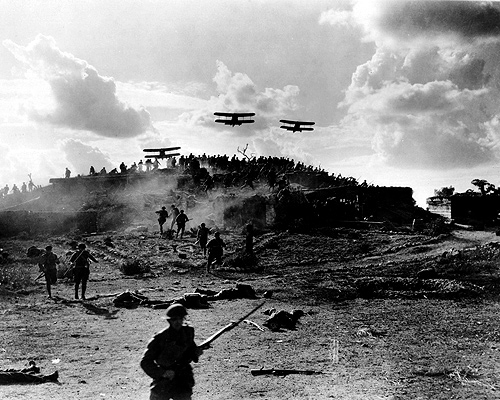
A rather large burden comes with laying claim to being the first film to ever win a Best Picture Oscar.  Such is the case for the 1927 silent film Wings, directed by William Wellman, a prestigious filmmaker who would go on to make a name for himself in the era of talking films as well.  If one is to completely detach themselves from the historical relevance of a film like Wings, it is easy to dismiss the work as simple melodrama with a love story that would become standard issue within Hollywood for decades to follow, however, it is too simple to deny the films it place in history, as a magnificent work of cinematic experimentation and storytelling.  It would be unlikely that I ever place this film on a short list of my favorite silent films, yet, I cannot deny that if I were to compose a rather lengthy list of historically pertinent films that this would make the cut.  Wings is exactly the kind of film you hear older scholars and aging moviegoers refer to when they describe the golden age of filmmaking.  The star-studded film, is a spectacle to view between the ethereal acting of Clara Bow and the pristine condition of the high-definition transfer, tragically though, the film simply has not aged well.  I, as a viewer, found myself constantly dismissive of the narrative, one that seemed far to steeped in the political ideologies and societal norms that are all but antiquated.  That is not to say the movie is not well made and worth watching, I simply argue that it does not stand the test of time as many other works of the era managed to do, like The Jazz Singer, Wings is a film that is necessary viewing, but not necessary to keep around for future viewings.  With all this being mentioned, I cannot express how many moments of sheer cinematic magic occur within this film, it possesses a series of amazing battle scenes that would be lost to CGI in the technology-laden world of filmmaking these days.  Wings is a great movie, nobody can deny that fact.


Wings, as many war films do, focuses on two small town rivals.  The first begin the good ol'boy Jack Powell (Buddy Rodgers) who is so in love with the neighborhood beauty that he fails to realize the girl next door is completely infatuated with him.  Second, there is the dashing well-to-do David Armstrong (Richard Arlen) who gains the affects of the towns ideal woman, much to the demise of Jack.  It seems, without knowing the plot of the film that Wings will play out as a romantic comedy, however, in a near jarring fashion, warfare overtakes the narrative as both Jack and David become recruits to the U.S. Air Force.  Realizing that this war allows her a chance to win over the heart of Jack, Mary Preston (Clara Bow), his neighbor, joins the motor division of the war effort, something females were allowed to engage in during The Great War.  During their training, Jack and David emerge as bitter rivals, often tricking one another into messing up during various activities, yet as the training continues and each proves their efforts, the two end up becoming friends and realize their combative natures could be far more well applied to the war effort.  The two pour their days into fighting German aircrafts, while witnessing a variety of loss, most notably that of Cadet White, who is played briefly and masterfully by a young Gary Cooper.  During one particularly grueling assignment the two risk their lives to fight German planes, David is shot down and assumed to be a casualty of war, while Jack returns safely and is awarded a heroes welcome for his endeavors.  His actions allow him to take a leave in Paris, one that is suggested to be full of drinking and fornication.  Despite being promised extended leave, Jack is called back to service, an action that is undertaken by Mary, who due to bad timing is caught naked in Jack's room, resulting in her dismissal from service.  Jack begrudgingly continues with his service and continues fighting Germans, all the while David, who is still alive, manages to steal a German aircraft and attempt to return home.  Unfortunately, Jack mistakes David for a German and shoots him down during a firefight, a mistake he only realizes while on the ground.  Jack subsequently returns home to apologize to David's parents, who are clear to blame the war, and not Jack, for the death of their son.  As is the case with such films, Jack has a prophetic realization of his love for Mary and the two are shown united in the films closing.

A variety of commentaries are available when discussing a film like Wings.  The first that I wish to mention is something that I have brought up whilst discussing a previous silent war film, Flesh and the Devil.  In this post, I provide a lengthy analysis of how the two male characters posses a homosocial bond between one another that borders on a sexual nature.  While it is certainly not as cataclysmic for the women involved within the narrative of Wings, a homosocial bond exists within Wings, particularly between Jack and David.  While the two are at odds in the films beginning, their forced cohabitation together leads them to become close on an emotional level, which leads to an undeniable amount of intimacy.  It is especially hard to deny the implicit sexual component of such a bond, particularly in David's death scene, an instance in which Jack literally fondles David and plays with the locks of his hair.  This is clearly the overarching criticism available within a film like Wings, yet it is also notable for its depiction of women in the war effort.  This activity was something that was somewhat nonexistent within war films, prior to World War II when allied forces depicted women in a variety of films engaging in war related activities, whether at home or on the war front, perhaps the most well known of these being So Proudly We Hail!.  The smart choice of the narrative to depict Mary in the war effort is historically accurate, while they may not have been fully involved with work within the motor pool they were certainly present as nurses and the fact that the film even acknowledges her presence is something of note.  It is an issue that the film dismisses her from service because of assumed sexual promiscuity, yet it is certainly indicative of then contemporary ideologies.  Problematic as it may be it is certainly worth praising for breaking a movie mold.

Key Scene: The entire Paris club scene is cinematic inventiveness at its finest.

While this is a great film, it is certainly not something that needs to sit on your shelf and collect dust.  Renting the bluray will be more than justifiable, as it needs to be seen, if purely as a piece of history.  Also, it happens to have a bit of Pre-code nudity on the part of Clara Bow, something that surprised my upon viewing.

9.8.12

To Her, He Was A Son: Ballad Of A Soldier (1959)

Russia, historically speaking, has cemented themselves as a stark contradiction to the American film style.  Whether it be the prolific Man With A Movie camera, or the entirety of Eisenstein's ouevre, narrative dissonance and non-linear editing are their thing, so when I approached Ballad of a Solider, I assumed these would be traits of the film, however, within only moments of viewing the clearly melodramatic film, I was baffled to find its clearly American composition.  Between long reaction shots, use of music to emphasize emotion and the focus of redemption within the narrative, Ballad of A Soldier is not entirely Russian in its composition.  Now that by no means makes this a terrible piece of cinema, in fact, it is quite great and clocking it at just under ninety minutes, the film is accessible and earnest.  Furthermore, the films is neither a clear condemnation of war efforts, nor is it set out in praising the validity of warfare.  The narrative of Grigoriy Chukhray's film, which he both wrote and directed, is as the title suggests about a soldier and is certainly a ballad at that, considering its lyrical nature. It focuses on one character and his vision of a slowly eroding nation, one that evolves from foolish youthful ignorance to adult disillusionment.  If it were not for films like Forbidden Games and Ivan's Childhood, I would define this as one of the greatest coming of age tales ever composed, but mind you if I ever were to make a list of the top ten, it would certainly make the list.

Ballad of a Soldier, begins immediately as action is depicted while the credits begin to roll.  We are provided with an image of an elderly woman wandering towards a dirt road that leads to her rural village.  The film's narrator quickly explains that she is waiting for her son, a soldier, who will never return, because he like so many his age, were casualties of World War II and was lost to a haunting memory.  The film then enters into a flashback, which introduces us to the films protagonist, Alyosha (Vladimir Ivashov) a wide-eyed private who has recently received praise for single-handedly destroying two tanks.  When offered medals for his feats, he counters with a request to simply visit his mother and help her repair his homes leaking roof.  Agreeing to his request, Alyosha's superior grants him six days to complete his task and return to his battalion.  Gracious at the amount of time he has been allotted, Alyhosa leaves camp ecstatic and heads towards his hometown.  His obstacles start immediately, however, when he is stopped by a fellow soldier who begs that he deliver a gift to his wife, who resides on a street quite close to a train station in which he will make a stop.  Alyosha in his kind manner, agrees and continues on his quest.  During his first stop via train, he also helps a crippled soldier, only to discover that he plans to leave his wife upon returning home, with the help of a station agent, Alyosha convinces the man to stay with his wife, unfortunately, his task means that he will miss his scheduled train.  After bribing a guard, he is able to ride on a cargo train and eventually meets a young woman named Shura (Zhanna Prokhorenko) for whom he immediately falls.  This quick romance fills in the remainder of the travel narrative as she comes with him to drop off the gifts to the soldiers wife, only to discover that she has left him for another man.  After a bittersweet departure from Shura, Alyosha affords just enough time to visit his mother briefly, giving her a kiss and the gift of a headscarf before leaving back to the war front, a place that the narrator reminds us will be his final resting place.


I stated that Ballad of a Soldier is not blatantly a condemnation of war and am quite certain of that assertion.  While it certainly shows the casualties and destructive nature of battling in the name of politics, the narrative suggests that it is simply part of human nature and necessary for individuals to understand that the world is indeed divided into good and evil.  While this certainly would drive Nietzsche into a fit, it seems much more appropriate for Russian tradition.  With heavily existential motifs a part of their cultural history, Ballad of a Soldier is certainly similar.  Alyosha represents an individual who adheres to the good nature of the world, despite being constantly shown that people are inherently bad, particularly those with power or those out of the eye of condemnation, as are evident in the demanding train guard or the cheating wife.  Yet, even in these moments of despair, Alyosha does meet people inspire him to do right, a notion that is initially implanted in him by the general who allows him to take leave.  Now the issue arises with Ballad of a Soldier in the death of Alyosha, something that is depicted off screen.  If we were shown the death of the young soldier on screen, we would be provided with something that would either confirm or deny his existence, yet the film closes with him leaving into the horizon.  The notion of a soldier like Alyosha is a memory, something that you can praise in a ballad, yet something that exists in an incomprehensible world.  Ultimately, Ballad of a Soldier is not a commentary on war as much as it is a nostalgic reflection on a generation who lost their youth.

Key Scene: The initial meeting between Alyosha and Shura is so well shot and acted that it seems to be documentary footage.

Yet another brilliant offering from Criterion, Ballad of a Soldier is a must own and I doubt it will get a bluray upgrade so there is no time like the present.

3.5.12

Man Is Born Crying. When He Has Cried Enough, He Dies: Ran (1985)

To steal a phrase from the popular Lord of The Rings meme, "One does not simply adapt Shakespeare."  I mean this will all seriousness; because it is hard encapsulate the deep-seeded ideologies, multiple narratives, and poetic grandeur of the world's most well known bard.  When it fails, it seems like a skeleton of a narrative that offers little more to the viewers than a overdone storyline that anybody could have offered.  However, when one does adaptations of Shakespeare correctly the result is epic filmmaking that captures the human condition on film and inevitably rips violently at the heart strings of its viewers.  Akira Kurosawa's Ran, an adaptation of Shakespeare's King Lear is one such example.  In the matter of two and a half hours, Kurosawa manages to make the screen explode with the ebb and flow of human suffering from the eyes of Eastern ideology.  The actors deliver their various performances with such conviction and subtly that it gives the best of Shakespearean troupes a run for their money.   The excellent narrative is only helped by Kurosawa's unflinching cinematic grandeur, which continually encompasses both the large ideas of the world and the tiniest of moments in a being's existence.  I often have a battle in my mind between Ozu and Kurosawa for best Japanese director, but it is films like this one that remind me that the late director of Seven Samurai may just edge out his fellow countryman. 

As an adaptation of King Lear, one can imagine the levels of deceit and familial disappointment that exist within Ran and Kurosawa certainly shows these notions.  The film focuses on the stepping down from power of a once great ruler named Hidetora Ichimonji (Tatsuya Nakadi) who realizes that his time in charge is over.  As such, he places power in the hands of his eldest son Taro (Akira Terao) who accepts his responsibility with nervous gratitude.  His younger sons react in opposing manners; Jiro (Jinpachi Nezu) gladly follows the orders of his father as middle keeper of the lineage, while the youngest son Saburo (Daisuke Ryo) mocks the decision and steps away from his ties to the family altogether.  Befuddled, Hidetora attempts to continue on his way without his youngest son.  Foolishly, Hidetora assumes that his transfer of power will still allow him all the rights of ruler without the responsibilities.  However, Taro's wife Kaede (Mieko Harada) pushes her husband to demand his place a ruler, ultimately, causing Taro to confront his father in a rather violent manner.  What results are various levels of deceit amongst the family, the employees of the clan and the villagers surrounding the castle.  In violent, yet poetic, fashion the rest of the film builds up to a war between the brothers all awaiting the return of their father who goes blind and crazy, as a result of his decision.  Ironically, although very Shakespearean, the only voice of reason throughout the film appears to be the fool Kyoami (Pita) who through song and rhymes explains the problems of human existence.  Ultimately, all the characters die either through violent ends or heartbreak, but viewers should not be surprised, because after all King Lear is a tragedy.  There is certainly more to the plot I just explained, but to go into any greater detail would be to ruin its watchability, it is far more experiential than a simple paragraph could ever hope to show.

The important question to ask when discussing Ran is how precisely is it an acceptable adaptation of a Shakespeare play.  The first element that makes the film a great adaptation is its loyalty to the original text.  While the names of the characters and their exact words have changed from the original source material, they, nonetheless, reflect King Lear rather clearly and it does not take a Shakespeare scholar to realize this.  Secondly, performance is key to making Shakespeare adaptations acceptable.  Without a deep understanding of the words and ideas being expounded the film will fall flat, however, as I noted earlier, Ran is full of brilliant performances and even knowing that I do not understand a bit of Japanese, I still managed to gather the deep moving nature of each word spoken by the characters in the film, not once was a line delivered dully.  The final factor, and perhaps most difficult to manage is to ensure that any adaptation of a Shakespeare work be unique and fresh.  Ran does this, perhaps more successfully than any other filmic adaptation I have seen to date, including Kurosawa's own adaptation of The Bad Sleep Well, although from a formalist standpoint it is a far superior film.  Perhaps Ran is so unique given that it is Japanese, yet Kurosawa's use of The Buddha, samurai code and the world of feudal Japan to rethink a story of familial deceit seem so original that I kept having to remind myself that he was borrowing heavily from Shakespeare.  With that being said, I guess what ultimately makes a Shakespeare adaptation work is the ability of a director to blatantly steal the bard's work, yet, doing such a good job of thievery that it seems like their own.  While imitation is the sincerest form of flattery, at times it can match, or, dare I say, outdo the original.

Some time ago, Criterion possessed the rights to Ran, but given their recently ended relationship with Studio Canal it appears as though it will never come back.  However, if you find yourself with the finances, picking up a copy of the out of print DVD will certainly prove rewarding.

9.4.12

It Will Be 9/11 Times 2356: Team America: World Police (2004)

I saw this film a few years after its initial release and rewatched it recently per the request of a friend who is about to ship off to OCS training.  Upon my initial viewing of the film, I enjoyed all the blatant humor within the film that I had already come to adore from the minds of Trey Parker and Matt Stone.  This second time around, however, I was able to pick up on many of the slighted social critiques and clever political diatribes that were initially less apparent.  I make no qualms about my love of the work of Parker and Stone and while they may receive flack for their bawdy antics and complete disregard for moral decency, the two clearly understand the problems of the world far better than most politicians could even begin to imagine.  As such, Team America is something profoundly larger than a musical about puppets fighting the war on terrorism, as it is more than appropriate to say that South Park is about much more than a group of kids growing up in rural Colorado.  Team America is instead a scathingly accurate commentary on our world post-911, particularly how we dealt with the cultural appropriation of patriotism, terrorism and national unity in a time when all seemed dire.  Team America amidst its explosions, toilet humor and knowingly terrible acting reminds viewers that comedy is the best medicine to despair, as well as the most accessible route to astute social commentary.


Team America: World Police follows a group of trained soldiers whose soul purpose appears to be the assurance of freedom globally and the cessation of all things terrorist.  The group is led by a man named Carson whose sauve ways and leadership assure that the group will fight terrorism with little trouble, however, after a cowardly attack by a dying terrorist Carson is killed and Team America is left without a vital organ to their entire process.  Confused and desperate, the groups leader Spottswoode, recruits a respected Broadway actor named Gary to fill the void, believing that his excellent acting skills will prove useful in the infiltration of terrorist cells and the discovery of any hidden WMD's.  Reluctant, Gary attempts to sequester himself into a life of solitude that finds him constantly beating himself up over the death of his family by zoo guerillas.  It is not until Gary reflects on his own place in assuring freedom that he decides to join Team America and fight terrorism.  His addition to the group is received with mixed feelings, some finding him absolutely appalling and unfit to replace Carson, while others find him to be a perfect replacement.  Agreeing to help, Team America, along with Gary, plunge themselves into dealing with the removal of WMD's from Cairo only to discover too late that a far bigger player controls the terrorist movement, that of North Korean dictator Kim Jong-Il, whose own self-deprecating loneliness has led him to desire the complete destruction of the world.  Oblivious to the true problems of the world, Jong-Il is helped by American actors who see Team America as conservative blowhards.  The group known collectively as the Film Actors Guild is led by Alec Baldwin and agrees to do a benefit in North Korea.  This benefit, as Jong-Il knows, will allow him a moment of global distraction long enough to bomb the world.  While the group has trouble unifying to fend of Jong-Il in a last sprint of unity the group is able to deter his actions and Gary is finally able to discover his true acting talents.  The film closes on a frozen frame of Team America celebrating their victory as they await their next mission to assure freedom, because as the film reminds us, it is not free, but actually costs "a buck'o'five."

As I said earlier, Team America is clearly a commentary on our own cultural discourse following 9/11.  As always, Parker and Stone are careful to critique the illogical nature of both sides.  Conservatives are critiqued through the scenes in which over zealous patriotism receives unquestioned praises, as is evidenced by the "What Would You Do For Freedom?" song which eerily parallels most every song Toby Keith has made since the terrorist attacks in 2001.  Similarly, the "American" things defended within the film are all clearly emerging from a white perspective, which is humorously done through making a member of Team America a white male from Nebraska, who is a natural born leader.  This moment clearly mocks the rise of a return to an older America that emerged after 9/11, which obviously meant the relegation of persons of color.  The film is also clever enough to dismiss the zealous counters of the liberal media, which automatically disregards freedom fighting groups like Team America as flag waivers.  The liberals, realized through the Film Actors Guild in the film, unknowingly agree to engage in terrorist activities, because to them anything that contradicts conservative values is inherently good, despite knowing that the other side in the film is obviously Kim Jong-Il.  Similarly, the film criticizes our own government's commentary on a post-PATRIOT ACT world that justifies invasions of privacy simply in the name of freedom fighting.  It is no coincidence that the computer used in the film is titled as I.N.T.E.L.L.I.G.E.N.C.E. as it is used as a justification for clearly illegal acts on Americans; this is particularly poignant within the film as we are never provided with the words that fit into the acronym.  The government within the film attempts to mask problems with huge phrases and catchy titles, while the conservatives and liberals feud over ideology that would clearly benefit from simply acknowledging a middle ground.  As you can see amidst images of vomit, elementary gay jokes and an absurdly funny puppet sex scene, Team America offers a fully realized vision of our failings in a post-terrorist world.

Team America screams rental, but is not bad by any means.  It really is a group viewing experience that will be greatly helped by the inclusion of PBR.