Showing posts with label kung fu. Show all posts

2.1.14

Top Ten Thursday: The Best Film Discoveries of 2013

It has been a considerable time since i have committed to making a top ten thursday list.  Indeed, if it was not the last time that I did a best film discoveries of the year it was pretty damn close.  While I am still tenuously navigating the space between being certain I have found all my favorite films released in 2013 and being certain the list cannot change, I figured now was an appropriate time to attempt to deliver the list accordingly of my most favored films that were not released in 2013, but were first time encounters this year.  While I was able to catch up with some rather glaring shame spots in my filmic viewing (Who's Afraid of Virginia Woolf, Rio Bravo, My Neighbor Totoro) I decided to exclude those form the list, because I was fairly certain I would adore the films.  The list here is compromised of films that so utterly startled me as to make me considerably change my favorite films of all time list in very drastic and real ways.  These films have in varying forms altered my understanding of cinema, my academic research endeavors, or frankly were just so enjoyable as to rekindle the love for medium of film in a fresh and rewarding way.  In the past year I did a ton of marathons and even managed to tackle viewing a hundred movies in a single month.  The resulting list is barely a reflection of the options I had, but were certainly the most captivating outcomes.

10. Terrorvision (1986)


Between being what might be the zaniest film ever produced and being the most underrated film of the decade Terrorvision deserves all the cult adoration it has achieved.  Thanks to Shout Factory this overlooked horror/comedy/sci-fi study of the nuclear family in the misguided decadence of the 80's can be enjoyed by all in the highest of definitions.

Review Here

9. To Be or Not To Be (1942)


Ernst Lubitsch appeared a lot in my film viewing this year and while most of it was in regards to his silent work, this comedy that doubles as a scatting critique of Nazism managed to pull me into its narrative despite being viewed on a computer screen.  Indeed, this along with other works like The Doll and I Don't Want To Be a Man have led to me thinking that Lubitsch might be a single director research interest for me.

Review Here

8. Born Yesterday (1950)


This film was my first knowing introduction to the comedic genius of Judy Holliday and by far the most rewarding experience I had with a George Cukor film this past year.  The fact that it also happens to be a insightful consideration of gender relations in 1950 is equally engaging.

Review Here

7. The Man from Nowhere (2010)


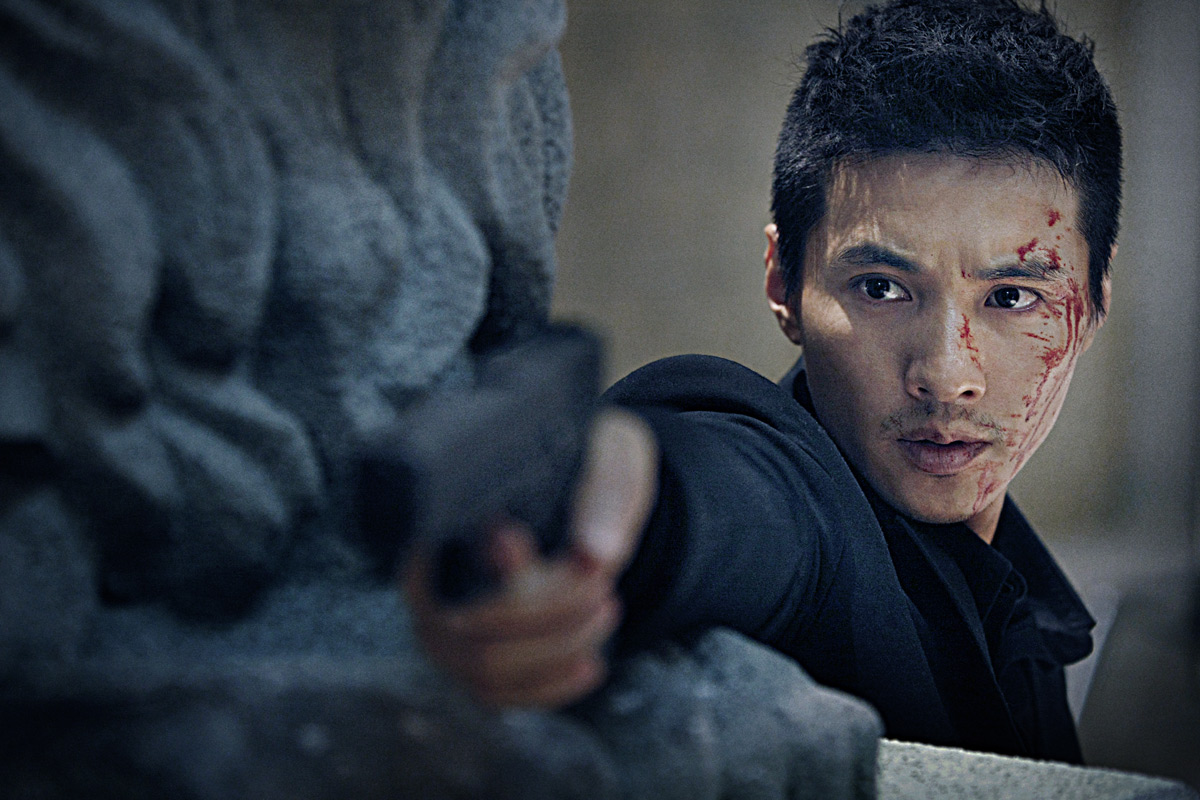
I would be remised not to include at least one South Korean film on my year end list.  While I failed to watch as many as I would have liked, this accidental inclusion during my Kung Fu marathon was by far my favorite contemporary work from a country that still pushes the boundaries of cinematic possibility.

Review Here

6. Gold Diggers of 1933 (1933)


There is a agreed argument that Singin' in the Rain is the key text in the genre of the musical.  This is certainly true, but this Busby Berkeley choreographed film that has become a point of feminist critique is pretty damn close to its equal.

Review Here

5. Existenz (1999)


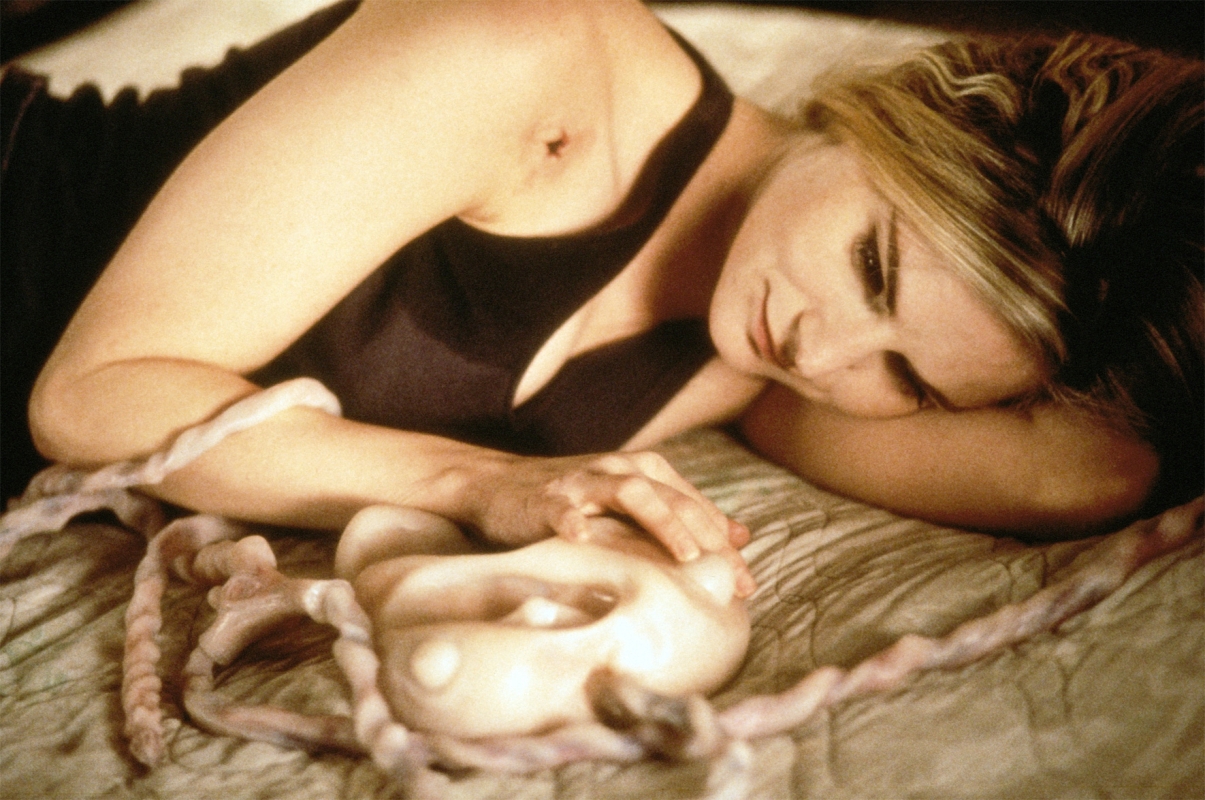
While this is probably not a universally adored Cronenberg film, it has, nonetheless, proven to be the single most important alteration in my understanding of cinematic possibilities and by extension my own continually evolving research interests.

I some how failed to actually blog about this film!

4. How the West Was Won (1962)


I watched a lot of westerns in May.  Most of them were brilliant.  While this is not the single most realized western, the use of Cinerama made it my favorite by far and it is essentially all the best parts of various westerns combined into a single epic film.

Review Here

3. Mind Game (2004)


I watched this film twice this year, it is still an enigma.  Furthermore, I watched quite a bit of animation, but this by far stretched my understandings of its conventions to their greatest point.

Review Hhttp://cinemalacrum.blogspot.com/2013/07/fear-takes-shape-we-are-willing-to-give.htmlere

2. The 36th Chamber of Shaolin (1978)


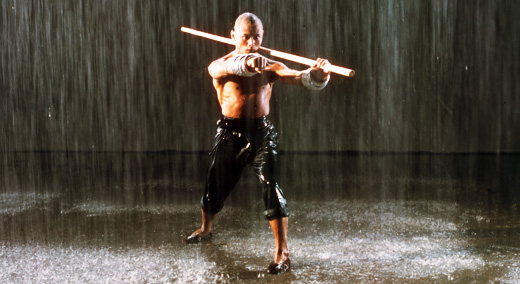
If I were told two years ago that I might seriously add a kung-fu film to my top ten films of all time, I would have scoffed off the possibility, but then I saw this film.  Body identity and Buddhist learning oversee what might well be one of the most stunningly shot action films ever made.

Review Here

1. A Matter of Life and Death (1946)


A absolutely moving film, this Powell and Pressburger film is a perfect navigation of color and black and white filmmaking that simply has to be seen to be believed.  While it does not receive the praise and adoration of The Red Shoes it is easily the greatest of the directing duo's works.

Review Here

Honorable Mention

On Her Majesty's Secret Service (1969)
The Illustrated Man (1969)
Fantastic Planet (1973)
Possession (1981)
Sunshine (2007)

30.8.13

Sweep The Leg: The Karate Kid (1984)

Sweep the mother fucking leg!  I could have pulled a ton of quotes from this film and incorporated them into the title, because I had not really realized how much of the iconic catch phrases of the 80's were lifted from this film, perhaps one of the most eighties of all films.  Between its language, style and general penchant for the excessive, The Karate Kid is everything I have come to expect from a classic genre film, particularly one that incorporates a distinct coming of age narrative.  It is also yet another reminder that when it comes to films involving kung fu and/or ninjas that are also set in the eighties, it is easiest to distinguish the good guys from those who are bad, in that the villains always possess motorcycles, while seeming to lack any piece of clothing that includes sleeves.  Also, The Karate Kid is the rare movie that manages to exude such a self-awareness about its eventual datedness and place as immediate nostalgia that some of the more pseudo-racist and narratively problematic through lines are present, but capable of being overlooked.  In fact, I would be willing to place The Karate Kid as one of the moments of before/after in 80's cinema, a time where simplicity, earnestness and stylistic over-exuberance trump cultural critique and the lavish as a means of social critique.  Indeed, compare this and a work like Top Gun with later works from the same decade like Robocop or Pretty in Pink and you will realize a sharp contrast in seriousness of subject matter, even in regards to genre works or coming of age tales.  While I know that a lot of this can be chalked up to simple escapist cinema and a changing landscape in the rise of independent cinema, but I would also extend the consideration that much of The Karate Kid narrative feeds into the hyper-idealisim of a Reagan era America where even the most impoverished of persons can pull themselves up by their boot straps and contest the greatest of foes, despite being cheated and denied equal class access.  Indeed, The Karate Kid depicts a world where its main character gets fortunate break after fortunate break, thus allowing him to move outside of his class othering at such an instantaneous rate that it would appears as though Reagan's misguided assumption about trickling down economic benefits did indeed reach one of the lowest rungs.  This idea failed in reality, but certainly seemed quite plausible in the narrative of The Karate Kid.


The Karate Kid begins with Daniel Larusso (Ralph Macchio) and his mother Lucille (Randee Heller) making the long trek from New Jersey to California, Lucille believing that by taking herself and her son to a completely new space that they will both be able to prosper in the wake of what the film suggests to be an unfortunate past with her spouse.  Daniel is incredibly reluctant to embrace the new space, particularly since California is decidedly different from his close-knit New Jersey block, although, he lucks out in getting invited to a beach party on his first day in the town.  It is during this party that he meets Ali Mills (Elisabeth Shue) a wealthy girl who seems to take a liking to Daniel for his earnest, down-to-earth attitude.  Yet, it is also during this night that he meets a group of biker kids whose ties to the infamous Cobra Kai dojo have made them into maniacal karate experts whose ruthless attitudes make fighting them a less than stellar affair.  The Cobra Kai's leader is Johnny Lawrence (William Zabka) whose previous relationship with Ali, causes him to immediately dislike Daniel and attack him in a push to establish his authority.  After being beaten up, Daniel returns home, and in an attempt to hide his bruises from Lucille instead gives away his secret, causing her to express concern, although she cannot exact the effort she would like considering that she is busy working to make their lives in California sustainable.  At this point, Daniel meets the apartment complex's maintenance manager Mr. Miyagi (Pat Morita) who admits to knowing karate, although he is hesitant to teach it to Daniel who he thinks only want to use it to pick fights, however, Miyagi does take Daniel under his wing, seeing that he is lacking a consistent parental figure.  During the night of a dance at his school, Daniel is attacked by a group of students from the Cobra Kai school, at which point Miyagi defends the young man and in the process realizes the seriousness of his situation and after confronting the dojo leader, suggest that Daniel and Johnny meet in the the regional martial arts tournament.  At this point Daniel's training is more intense and his relationship with Ali evolves, after a minor setback.  On the day of the tournament, Daniel's training pays off, although he learns in the process that it often takes overcoming cheating, physical and mental adversity and occasionally changing a course of action to complete a task successfully.


I should preface this paragraph by saying that I fully understand that The Karate Kid is made for a particular audience of youth and that it serves primarily an escapist function.  Yet I also want to note that intended audience/level of cultural popularity has never stopped me from over analyzing a film before, nor will it now.  Indeed, after I finish this post I intend to wildly throw some theory to a rather popular contemporary film trilogy in hopes of publication.  However, I digress.  I want, to posit that The Karate Kid is very much a film that suggest that class is something that can be transcended by the graciousness of those with privilege passing their wealth downward to those without.  Indeed, Daniel and his mom are clearly to be of a working class status in the opening moments of the film, when they arrive to California and are located in a run down apartment complex that boasts a pool barely containing any water, which of what is available is grossly stagnant.  Furthermore, Lucille must play into the gimmick of moving up through lower level management by "taking classes" as a means to succeed economically, when much of this requires her to sacrifice the possibility of making money, because she must spend what ever extra earning she makes to pursue these endeavors.  The signifier for Daniel's poverty then becomes his bike, which is mocked and destroyed by Johnny and his friends whose privilege drives them to destroy his poverty merely out of humor and out of a jealously that he could attain one of their points of status in Ali.  The really bizarre thing about the film, and the way in which it affirms a Reagan idea of trickle down economics is that when Daniel is in the presence of Ali he is suddenly in possession of money, most notably in the lunch scene where he retrieves enough money to pay for both of their meals, despite being clearly lacking in earlier moments.  Furthermore, Mr. Miyagi, while primarily a sensei to Daniel, seems to also be a point where money/property passes towards Daniel, in his case fixing his bike signifier to be less poor looking and eventually replacing it with a classic car.  These gifts are an implausible thing to most people of a lower class space, but this is one of the faults of trickle down economics, is that such occurrences are suggested to be quite frequent. It is worth acknowledging Miyagi's identity as other, but that is not the reading I am going for so it shall not be elaborated upon.  Daniel's class thus becomes less and less evident to the point that once he arrives at the tournament he is destined to win, attaining a golden trophy, perhaps a signifier of wealth, or a false idol intended to provide him a delusion of access to that which his lower class status will probably never officially attain.

Key Scene:  SWEEP THE LEG!

This is a fine film considering its dated 80's nature.  However, when approaching it be aware that its dated features also come with some problematic depictions of Mr. Miyagi as an Oriental body.  Other than that feel free to buy this, although renting is the route I would go.

29.8.13

Don't Ruin Your Reputation For Petty Gains: The Five Venoms (1978)

I decided to jam one last Shaw Brothers film onto my month of kung fu films, because, after all, they are the premier names in the realm of the martial arts work, indeed carrying the same weight Sirk does with the melodrama, Powell and Pressburger do with Technicolor and Ford does with the Western.  All of the aforementioned directors had moments in their career where they took considerable risks cinematically, choices that existed within their genre/style associations, while also twisting them in new and unique ways.  While they were often met with hesitation they also produced captivating and new ways in which to understand a previously cemented gorup of works.  I would argue that in The Five Venoms the Shaw Brothers approach the genre, for which they well established in at this point and decided to push it to grand proportions.  The Five Venoms is not a simple film, indeed the plot is considerably intricate despite its rather straightforward title, so much so that I will admit much of my recollection of the details of this film are heavily a result of scouring plot synopsis online prior to writing this blog post.  This audacious approach does pay off, considering that it is still incredibly watchable even if I found some, if not entire portions, narratively confusing and linearly uncertain.  I wholly embrace the work, because the Shaw Brothers dare to take a genre film and extend it to the grandest of proportions, indeed I would argue that The Five Venoms is the martial arts equivalent of something like Seven Samurai, where a work that had previously existed only in the realm of genre, moves into being grand, almost art house cinema.  Each moment of the winding and heavy plot of The Five Venoms plays into a larger consideration of loyalty, collective identity and deception that could make the most glorious of shogun samurai period pieces seem minor in breadth.  While I would be hard-pressed to consider this one of my favorite works of the marathon, I will concede to it being one of the more historically important.  It blows viewers over with information and narrative that extends through an undeclared amount of temporal space, never once back tracking (aside from affirming match cuts) to drive a message home.  The Five Venoms demands to be viewed with full attention and to be revisited many times.


The Five Venoms begins with the dying master of the infamous Poison clan explaining to its remaining student Yan Tieh (Chiang Sheng) that the previous five seniors of the dojo have come to make a less than positive name amongst themselves, although the master is rather certain that the infamy is resting on the actions of one or two of the former members.  Explaining to Yan that the five seniors have no identifiable names or traits, given their donning of masks, he goes about explaining the various techniques of the seniors in a hope that Yan will be able to incite them into betraying their secret identities through exposing their styles.  The five venoms of the title represent the animals with which each senior appropriates their style, which are the following: Centipede, Snake, Scorpion, Gecko and Toad.  The last one the Toad proving particularly interesting since nearly all of his skill is predicated upon his being seemingly invincible.  Yan Tieh, however, is not skilled enough in any of the styles to take on the members of the respective dojo, thus leading the master to suggest that he befriend one of the members that is not tied to the exploitation and use their skills to overcome their opponent. The remainder of the movie involves Yan Tieh moving through the city outside of the dojo and uncovering the layers of deception that involve the members of the former Poison clan discover in the process that it is specifically Snake and Scorpion who are of the highest point of trouble making in terms of ruthlessness.  As such, Yan Tieh moves to befriend both Gecko and Toad, realizing that Centipede is also tied to the criminal activity.  Yet, given the layers of communication occurring and the various skills and extensions of power possessed by the members, both good and bad, Toad is eventually killed through the brutal use of The Coat of a Thousand Needles.  After affirming Gecko's identity, Yan Tieh proceeds to create a plan of attack for the taking on of Snake and Scorpion, one that requires training and eventually flawless execution, but just as the Poison clan master predicted, Yan Tieh is able to fell the villainous members and end any further extension of a negative name upon the Poison clan.


I have mentioned in degrees of passing through the previous posts, particularly when discussing Riki-Oh: The Story of Ricky, the idea that one of the tropes within kung fu cinema appears to be the idea of body on display to be performed and performed upon.  I know this is what I just discussed concerning Mirageman, but here one can see it evolving in relation to the classical work of Shaw Brothers, relatively speaking of course.  I mean to say that there are multiple ways in which the body is put on display as well as theoretically considered.  Take for example Toad, he is the point of such masculine perfection as to be a battering ram that is incapable of overcoming, unless one is to be aware of his single weakness, which is place, not unintentionally in his eyes.  As an insurmountable force, he is apt not to listen to reason or budge, therefore the body and mind are distinctly separated in this context.  Similarly  this body on spectacle as a direct contradiction to the power of the mind, occurs with both Snake and Scorpion who are inclined to betray their identities, because both styles of martial arts require them to project their bodies in significant and highly personalized ways, therefore their body as power, requires them to reject the mental strains of stealth and secrecy.  It is indeed no small directorial choice to make Gecko a fighting style that predicates itself upon patience before striking, whereas Centipede and his intense "one thousand hands" attack is both sporadic and a barrage, but also so flailing and wild as to leave his mind exposed to the strikes of Gecko and Yan Tieh.  Indeed, it seems as though the film draws a clear line between issues of the over performed body, specifically that of the masculine and its ties to corruption and a willingness to do illegal, if not outright evil acts.  The narrative thus becomes a commentary on the importance of a well-rounded mind to match a physical prowess, because not only does it allow one to make consciously sound decisions, it also affords one the means to overpower those who might otherwise win off of brutish means alone.

Key Scene:  Opening montage is great, indeed, it might be its excellence that made getting into the slower pacing of the remainder of the film a tad more difficult.

This is worth renting before buy, not that it is outright bad, indeed it is quite good.  It might, however, prove a bit confusing upon a first viewing.

27.8.13

There's A Storm Coming, Can You Feel It?: Fatal Fury: The Motion Picture (1994)

Storms! Gary! A ton of women who are often overexposed, these seem to be the major themes of Fatal Fury: The Motion Picture.  Aside from that it is about as cookie cutter as the anime movies come, particularly ones that are clearly cut with the intention of being screened on television.  I added Fatal Fury: The Motion Picture to the month of kung fu film viewing, because I felt that to exclude the clear influence of the genre on the anime film would have been illogical and Chop Kick Panda's inclusion was more so a dare than anything else.  I, however, should have known better than to even consider that this would be remotely worth my time, because as my appearance on Drive By Nerding to discuss Video Game Adapations showed, it is rarely a successful thing for a video game to make the crossover to narrative film, almost entirely a result of cashing in on the possibility of financial gain by name recognition alone.  The trouble with Fatal Fury: The Motion Picture, however, is that it seems to be trying its best to take itself seriously, including some early establishing character arcs that while initially promising fail to go any place worth note, particularly the forced love stories and even worse the suggestion of some familial bond that can transcend the very divide of good and evil.  That is not to say that the film is particularly terrible, but, instead; to suggest that what could have been a more taut and well-considered narrative on space and identity, particularly given the expansive possibilities of anime as an art and film medium, manages to be nothing more than extensions of the video game realm, meant only for gaze and the thrill of violence and destruction and very little if any acknowledgement of what is really occurring in moments of such violence.  I will admit that my most recent exposures in regards to animation have been heavily lifted from the absurd or heavily non-linear, especially with a recent revisitation of Satoshi Kon's Paprika, but even acknowledging that I cannot help but feel as though Fatal Fury: The Motion Picture missed an opportunity to really consider what it means to identify oneself in regards to a larger national structure, in favor of resting a bit too heavily on hackneyed tropes of gender and power.


Fatal Fury: The Motion Picture begins with a thief exploring ruins in Egypt in a quest to discover a piece of armor, which is purportedly part of a larger set of armor called the Armor of Mars.  The man Cheng Sinzan hopes to use this armor for purposes of powerful corruption, only to be stopped by a group of bandits led by the mysterious Laocorn, a man who already possesses pieces of the armor, thus granting him a considerable degree of power over the other individuals he encounters.  Needless to say, this act leads to a riff in the sense of good in the world, which leads noted fighter and all-around stand-up guy Terry to acknowledge a storm coming.  The film then cuts to a muay thai kickboxing match involving the wiley Joe, a friend of Terry's and the first compatriot we meet in the group.  Along with Joe come Terry's brother Andy whose sexual identity is left surprisingly ambiguous, much to the frustrations of Mai a voluptuous ninja who is constantly seeking out a means to bed the aloof Andy.  During a night of recreational arcade gaming, Terry comes into contact with a young woman named Sulia after she is attacked by a group of brutish masked men.  Knowing it is the right thing to help those in need, Terry agrees to help Sulia find out more information about her mysterious attackers, in hopes that he can also win over her affections.  Recruiting the help of his friends, the group then seeks out a cave that has more information about the armor worn by the brutes, only to discover sprawling hieroglyphics relating to the origin of the Armor of Mars.  It is at this point that Sulia reveals her identity to be related to the lineage of the Armor of Mars and, more importantly, her ties to her brother Laocorn, who is on his own quest to attain the pieces of the armor.  Realizing the dangers imminent in Laocorn's attaining of all of the pieces of the armor, the group splits up and begin to scour the various ancient ruins where the last pieces are suspected to be.  During this quest the various groups achieve new levels of self-discovery, particularly Terry who learns to let go of his previous loss and open up to Sulia for the possibility of a new relationship.  Yet there endeavors prove nearly futile when they arrive at the last location and discover Laocorn assembling the armor, however, the result of that act are grander than even Laocorn could have imagined.


There are some moments of possibility in this film where one might argue that the film navigates boundaries and since I am not ready to dismiss this film, I find it best to approach the film with such a framework in mind.  The clear boundaries emerge in a film like this through the travel narrative, in so much as the the various pieces of the armor are scattered about all the spaces of antiquity in which traversing means a very physical movement over a space.  As such, it is important to consider the privilege and power of the group as they seamlessly bob in and out of lands that are thousands of miles apart, dropping their obligations, if any, to do so.  Considering that it is lifting from Fatal Fury the game, which does focus on people moving about space, such a choice is not highly problematic, but the whim on which they move about cannot be overlooked.  Similarly, it is the layers of the modern upon the space that are also worth considering, especially since the group is moving through the ancient world.  In many case the high rises, or ruins of attempted modern civilization cover the archaic world in which Terry and others must move within.  To a degree, one could certainly argue that Fatal Fury: The Motion Picture, in its choice to place the narrative within spaces of antiquity that have confronted modernity, that boundaries not only take on a length aspect of crossing, but one of depth as well, reinforced by the multiple inclusions of caves and catacombs.  These are considerably tangible versions of space, however, and one must also consider the ways in which space can be a bodily function, especially in anime where characters looks and physicality are far more indicative of Western influence than Eastern, yet in the narrative it is made painstakingly clear that all of the individuals are of some form of Asian descent, right down to Terry who looks about as American as Hulk Hogan in his heyday.  To consider the animation choice beyond its video game adaptation, one could certainly suggest that the creators hoped to transcend body boundaries by creating Asian identities in non-Asian bodies, but this is likely not the case, instead; reaffirming the privileged place of western ideals of everything from ancient history to beauty.

Key Scene:  The arcade scene is probably the highlight of the film, if only for the one moment in the fight sequence, where things go almost entirely into cel-shade animation.

Watch Akira instead.  This is really not worth your time unless you want to be a completist on bad video game adaptations.

24.8.13

Very Good! But Brick Don't Hit Back: Bloodsport (1988)

I tried to make every film I watched during this marathon come from a place of new experience or deeply entrenched in the vague memories of my youth.  However, when I looked over my list yesterday, I realized that I had managed to completely skip a viewing day, leading to a panicked attempt to quickly find something to add and watch.  Fortunately, I had made a list of possible alternatives, one of which being a personal favorite of mine, 1988's Bloodsport.  I am very much aware that Bloodsport is not a piece of well-respected cinema, nor is it a particularly problem free film from a narrative standpoint, but it is very much a film I have a deep nostalgic bond to and believe to be one of the greater martial arts based films to ever be released.  Released at the height of the phenomenon that was Jean-Claude Van Damme, Bloodsport is what the film version of Street Fighter should have been, as well as being a rather wonderful expose into the world of mixed martial arts tournaments, well before MMA pay-per-view events were the thing do for any muscle-bound bro wearing a Tapped Out shirt.  It would be one thing if Bloodsport just incorporated a bunch of fight scenes, interspersed with really over-the-top montage sequences (which it does in spades), however, it manages to extend the genre, which at that time had reached a lull, and reinvigorate it with a heavy degree of eighties cool.  Between the occasional use POV shots and other experimental camera angles and what goes between being the cheesiest of soundtracks to absolutely thrilling instrumentals, director Newt Arnold makes it expressly clear that Bloodsport exists within its own space, full of stained brutality, much like the ring that figures so prominently into this film.  Considering my nostalgia towards this film, it is probably worth acknowledging that I was far too young to have watched this film once, not to mention repeatedly, consuming the bloodied jaws and broken bones that emerge throughout this film.  I guess I turned out fine as a result though and I certainly could have been far worse had I watched the far more violent Robocop on a more regular basis.  Bloodsport is good to me, because Bloodsport possesses a personal degree of escapism, it is not a great film to most, but it is perfect by my standards.


Bloodsport begins with Frank Dux (Jean-Claude Van Damme) going on leave from his job in the Air Force, only to be stopped by one of his colleagues who claim that his captain wants to see him, after being informed that he is planning on fighting in the deadly full contact Kumite fighting bout.  Knowing that to talk with his superior would mean being unable to compete in the tournament, he leaves by deceiving a lower ranking officer, traveling to train with his master and "second father" Senzo Tanaka (Roy Chiao).  After learning the last series of techniques to become the ultimate fighter, Dux then travels to the seclusive Kowloon Walled City in Hong Kong, where officials have agreed to hold the dangerous tournament.  Aware of the implications of losing one of their most distinguished soldiers the American government hires two agents to track him down in Helmer (Norman Burton) and Rawlins (Forest Whitaker).  Prior to the tournament Dux befriends American fighter and beer-chugging gargantuan Jackson (Donald Gibb) and the two cheer one another along in the tournament.  It is during the first day of fighting that they are made aware of Kumite favorite and general madman Chong Li (Bolo Yeung) whose infamous nature involves killing a man in the ring.  Chong Li clearly takes to disliking Dux and calls him out directly during the tournament.  Between a day of fights, Dux meets American reporter Janice (Leah Ayres) who hopes to break into the tournament by influencing one of the fighters.  Despite wooing Janice and sleeping with her, Dux still explains that he cannot allow her into the tournament, but given her journalistic guile she still manages to find a way.  It is during this day of fighting that Chong Li is pitted against Jackson, beating him down and delivering a near fatal blow to his head, causing Dux to storm the mat in an attempt to exact revenge.  Yet remembering the no fighting outside of the Kumite matches rule, he holds back, promising revenge in a later round.  This promise is given credence when the two meet in the final match of the tournament, where the two go kick for kick, until Dux exposes Chong Li's weakness in the gut.  Chong Li, in rage, attempts to cheat by blinding Dux, who taps into his training by Tanaka and still defeats his opponent, claiming vengeance for Jackson and becoming the first Westerner to win the Kumite tournament.


Again, I am fully aware of the film in all its absurd glory, primarily as a film that suggest that it is some great feat for the Western figure to overtake the Eastern figure, particularly in a physical manner.  Post-colonial theory was still making a name for itself in the late 1980's and would have complete rejected such a narrative of "overcoming the odds" in the context of Dux's privileged status.  Indeed both he and Jackson move about the film with their Western status being a point of pride and power, very literally for Jackson.  At least in the case of Dux he is using the techniques of Eastern philosophy and martial arts to engage with the tournament, so his Western presence is only in a physical sense, as opposed to moral or social one.  The closing moments are rather intriguing particularly considering that the narrative suggest the real life Frank Dux created his own fighting style, assumedly a hybrid of Western and Eastern styles by its name alone Dux-Ryu.  Over the years the legitimacy of such claims has been called into question, but culturally the figure of Dux in Bloodsport is rather prevalent, therefore, making its existence in the cultural space of film absolutely noteworthy.  Another element of this film is the clearly homosocial bond between Dux and Jackson, one that comes dangerously close to taking on a very real sexual element, particularly in the closing scenes of the film, where Dux kisses the recovering Jackson on the cheek, moving his desire from a purely fraternal sense to a physical one.  It may seem like a innocent act, but Dux lingers and it is noticeable and quite possibly not accidental.  I would actually rank the relationship between Dux and Jackson on a level right below that of the wildly homoerotic love triangle that is Maverick, Goose and Iceman in Top Gun, which was from the same era.  I am sure there is a text out there considering these relationships in a variety of action films from the the mid to late 1980s and I would not be surprised if the reading directly ties such occurrences to the hyper-conservative world of Reagan America.  Bloodsport, also does interesting things with racial bodies and spectacle, although it seems to remove the Western body from involvement in the diagetic spectatorial gaze, however, there is always the cinematic gaze to consider, which is an entire critical beast all its own.

Key Scene: As wildly cheesy as it may be, the montage before Dux's final fight is awesome.  Mostly over-the-top the moment he imagines Chong Li's reflection in the subway is one of the most haunting moments in the entire film.

I love this film and so should everyone else.  Nab yourself a copy of the bluray and just ignore that it is double featured with Time Cop.

23.8.13

Do You Understand The Words That Are Coming Out Of My Mouth: Rush Hour (1998)

It might be easy to declare Rush Hour the biggest stretch in the entirety of my kung fu marathon in that it declares itself rather openly to be an action film and has cemented itself as one of the contemporary classics in the field of buddy cop flicks.  However, it does include Jackie Chan as one of it its stars, there is a good bit of fighting throughout and it is so heavily drawing from the Hong Kong action cinema of the decade, which, in turn, draws upon kung fu films that it is almost possible to argue that this is the most obvious inclusion for the marathon.  I am sure prior to watching this film last night that I had seen Rush Hour in its entirety, but it would easily have been fifteen years ago at this point, when it was originally released so any sort of memories I had from the film had, undoubtedly, been influenced by its references in popular culture.  The most obvious of these being the line that I used in the title of this post.  Given that I am wildly critical about every piece of film I consume these days, including the lowest of art, I went into Rush Hour assuming that it would be particularly offensive in the way it portrays Asian, particularly Chinese, culture, exploiting it for its most basic elements and appropriating them to create a narrative deemed producer friendly.  Much to my surprise, Rush Hour manages to take its Chinese presence very seriously, using locations in Chinatown as they turly exist, as opposed to creating simulacra of the spaces to make them, again, more producer friendly.  Praising this element of the film does not mean that it is a work void of problems.  Where the narrative takes careful trides to avoid stereotypical imagery of Chinese people, it manages to undermine the notion of racial performance by writing Chris Tucker's character as an over-performance of the stereotypes of African-American masculinity, only to have Tucker play into these depictions through many of his acting choices.  This is, easily the most frustrating element of the film, but it does not run throughout, making particular moments of the movie exude excellent action choreography and relatively watchable cinematography for a late-nineties action flick.


Rush Hour begins in a Hong Kong setting, focusing on the skills of Chinese Special Investigator Lee (Jackie Chan), whose persistence and dedication to his job has stifled the criminal activities of infamous syndicate Sang (Ken Leung).  His job earns him the gratitude of China's consulate to the United States Han (Tzi Ma).  This respect, affords, him a chance to come to America when Han's daughter is kidnapped by Sang and his lackeys for ransom.  Meanwhile, Carter (Chris Tucker) is an undercover cop with the LAPD, whose reputation for wild field choices and general garrulous behavior lead to him being threatened with suspension if he does not get his act together.  When the FBI is placed on the case to find and save Han's daughter they are hesitant to involve Lee in their investigation, assuming he will be dead weight.  Upon his arrival, a frustrated LAPD chief assigns Carter to be the aid to Lee, taking him around Chinatown and distracting him from actually becoming involved in the investigation.  Feigning a lack of English skills, Lee quickly realizes that Carter is tricking him and escapes, arriving at the FBI safe point hoping to speak directly with Han.  After fighting off guards who assume he is one of Sang's men, it is revealed that the FBI had attempted to distract Lee, as well as Carter, to the frustration of both, as well as Han who feels betrayed by the FBI.  Still, the FBI assures Han that it is in his best interests to allow only their organization to handle the case.  Yet, when Carter and Lee realize they posses far more information about the case than anyone at the FBI they take it upon themselves to hunt down the persons involved in the kidnapping, eventually recruiting the help of another officer on the LAPD force Johnson (Elizabeth Pena).  After a failed attempt to rescue Han's daughter at the hideout of Sang and his men, the threats on the girl rise, as does the ransom demand, culminating at a huge Chinese art exhibit, where it is discovered that Han's daughter is hidden in a van with a vest of C4 strapped to her chest.  Furthermore, it is realized that the person funding the entire kidnapping ordeal was much closer to Han than any person could have imagined.  Nonetheless, Carter and Lee are successful, earning Lee a spot on his countries secret service.  Carter is begrudgingly offered a place on the FBI, to which he refuses, choosing, instead; to travel with Lee to China.


I want to get out the racial performance element before talking about one of the more positive aspects of this film.  There is a ton of dialogue which is delivered by Tucker that requires him to heighten his voice and play into a shucking and shuffling that would be more indicative of a minstrel show of years gone by, which, while not a sole occurrence in Hollywood at the time, nor in contemporary films, when it does emerge it is a particular point of frustration, because it is played for comedy and often consumed by audiences of multiple races.  Indeed, Spike Lee's incisive and scathing consideration of the African-American male body in entertainment that was Bamboozled dealt with this issue to its most extreme form, with the intent of noting that while it may not appear in the extremes of new age blackface the performance element was still present.  It is films like Rush Hour that Lee is clearly considering.  In an extension beyond the hyper critical in a negative, I want to critically approach the film for its use of language as a metaphor for learning friendship and bonding.  Both Lee and Carter are initially hesitant to embrace one another because of clear stereotypes they have about one another's cultures that extend beyond not only their nation, but race as well.  Indeed, they both assume a degree of a language barrier, wherein, Carter assumes that Lee cannot speak any English and takes it upon himself to yell repeatedly in hopes that some sort of rage will get Lee to understand.  Carter still entrenched in his single-minded attitude cannot fathom the possibility of learning a language to speak to Lee who he neither respects or admires.  It is, indeed, Lee who makes the first step toward a friendship by revealing his ability to speak decent English, a fact that causes Carter to begin losing his hermit shell and opening up to Lee as a friend and partner.  Interestingly it is when they realize that language affords them a shared experience through stories of their fathers that the two really seem to bond, other cultural elements such as music and food help, but not to the degree that this interaction does, pushing Carter from a space where he would ignore the safety of his partner for self-advancement, to sacrificing his body and safety for the survival of Lee.  This comes full circle in the final moments of the film, when Carter himself speaks Chinese, showing his willingness to fully embrace Lee as a friend.

Key Scene:  While there are some great moments in this film, it possesses what might be the best of the credits blooper reals, adding a surprising layer to the language reading in the film.

You have likely seen this film, in which case it is not really worth revisiting, however, it is a cultural staple and catching up with it, despite its problems, helps make one more versed in the beast that is a "popular" collective memory.

22.8.13

Even A Buddhist Must Conquer Evil: The 36th Chamber Of Shaolin (1978)

I can mark the occasions on my hand where watching a film that turned out to be more than I expected, even when going into it knowing it had a great reputation.  The film proves to exist in such a vacuum of cinematic perfection and narrative engagement as to radically alter my relatively entrenched set of "top ten film," which for the longest time consisted entirely of obvious classics.  Prior to yesterday, the only two films that proved to be a new degree of perfection were relatively recent cinematic offerings in 2011's Take Shelter and 2007's Secret Sunshine.  These films were so jarringly perfect as to rattle my understanding of cinema and cause me to alter how I had formulated a list of what I already thought consisted of largely perfect, if not near perfect moments in film.  I have in the course of the past year managed to catch up with a large amount of my cinematic blind spots, many of which were quite amazing, works like Rio Bravo and Born Yesterday were phenomenal, but also have a sense of classicism about them that allows me to understand their place in cinema, as well as temper my willingness to subvert my top ten list.  It is when I go into a film not expecting it to be wildly entertaining, profound and personally moving that I tend to have transcendental experiences.  My viewing of The 36th Chamber of Shaolin was one such occurrence.  A film that made the list on the kungu marathon entirely based on a recommendation by RZA on a website in which he listed his favorite kung fu films.  I had already viewed some of his recommendations earlier in the marathon and those he favored were quite enjoyable, however, this film exists in a class all its own, using a highly kinetic style that manages to temper itself throughout by including flares of the melodramatic, but with a decidedly Eastern touch.  I know it is tough to make a case for film, let alone a genre work, to be considered high art, but in terms of The 36th Chamber of Shaolin it is nothing short of cinematic mastery, both proving what is possible in the limits of a genre film, while also considering the larger ability of film to move people on a deep, almost spiritual level.  All of this loquacious rambling comes to one simpler idea, The 36th Chamber of Shaolin is a cool movie.


The 36th Chamber of Shaolin is a story that has surprisingly seen alterations in the form of early works in this marathon, indeed, Shaolin Temple is almost the same film on paper, focusing on a figure who is attempting to fight of the presence of imposing outside forces on his village.  In The 36th Chamber of Shaolin the figure is San Te (Chia Hui Liu) and the oppressive force is the Tartans, also known historically as the Mongols.  San Te is a young man who after attempting to defend his family from an aggressive attack by the Tartans is wounded and stows away in a shipment of lettuce.  This food is by chance delivered to the Shaolin temple, where it is revealed almost immediately that San Te has been transported.  Initially hesitant of his entrance into their sacred space, the head Abbot suggests that they take in the young man and train him in the ways of Shaolin, although they make certain that his training is as intensive, if not more, than his fellow disciples.  Initially San Te is wildly ambitious and hopes to begin in the 1st chamber of the Shaolin, only to discover that not only is he incapable of comprehending the enigmatic phrases of the highest monks, but that he also cannot grasp how a monk sitting down manages to knock him off his feet and across a foyer.  Accepting his need to start from the beginning, San Te works from the 35th chamber, which is a test of jumping over a set of floating logs before eating, to higher levels that teach him endurance, patience and awareness to the surroundings.  Indeed, San Te is initially quite confused as to why it takes him so long to learn even the fist and foot attacks of Shaolin, but as the various abbott's note, it is training that comes to a collective perfection, that is the backbone of Shaolin style.  After a run of success, San Te is appointed a position of leadership, much to the concern of another abbott, who demands that he can only earn his place after defeating him in a fight, after a few unsuccessful attempts with a bladed staff, San Te discover a new weapon by accidentally destroying a bamboo shoot.  This weapon affords him a win and the chance to choice a chamber with which he would like to oversee.  Not wanting to overstep his bounds, San Te suggest that he create a 36th chamber that is intended to train the citizens in basic Shaolin techniques, an idea that is dismissed and eventually leads to his being banished until he can exact a punishment involving obtaining devotions.  It is during his time outside that he comes to realize he can not only find a ton of willing participants for his new chamber, but that he can finally face the man who killed his father and countless other family and friends.  Using the self-defense based non-attacks of the style, San Te is still able to cause the man to kill himself with his own sword blade, a successful battle that is then followed by his return to the temple with rows of new monks, assumedly part o the new chamber he has created.


This film has tons of through lines involving commentaries on how to lead a proper life, many of which pull directly from the Buddhist religion where this film expressly borrows its narrative ideas.  The first and perhaps the most important narrative element seems to be an identification and embracing of humility.  San Te begins the film as a wild young man whose long hair and desire to exact justice lead to his being near-fataly wounded by the Tartan leader.  This, however, does not end his humility, because it is an act by a terrible person who used guile to assure the violence.  It is not until he is stifled by a resting abbott that San Te begins to even consider that he might need to put his privilege into check.  Indeed the 35th chamber of the Shaolin temple exists purely to teach this issue to its students, reinforcing the problems of assuming entitlement.  In this chamber their ability to eat is predicated upon possessing an unusual skill.  San Te cheats at first and attempts to ignore the rules to eat, because he has  not the humility to understand that eating is a privilege he had been afforded prior.  Once he learns this key element to transcendence, other elements become attainable.  Moving upward he learns the value of persistence and an understanding that while it is ideal to help other people in their movement towards their enlightenment it is necessary for them to experience their own trial and errors.  In more unusual moments throughout his training, San Te must understand the beauty and aid of learning a rhythm and methodology in relation to larger endeavors.  Indeed, fighting is not really an element of the Shaolin way, but instead learning to harness literal weight and metaphorical rage, into means to avoid death for those involved. One of the more hilarious scenes in the film involves San Te moving through the "head" chamber which is where he must repeatedly head butt sacks full of rocks and finish by offering a devotion to Buddha.  This may seem self-destructive but the overarching suggestion that such an approach takes on the attitude that one must literally be headstrong while also using their head to be intelligently sound is one of the major lessons he is able to extend to his prospective students when he is on force sabbatical from the temple.  In a bit of brilliance he comes to understand that training for Shaolin results in lessons that occur both in the confines of the chamber, as well as in daily engagements, suggesting that his newly added 36th chamber was not unprecedented, but indeed quite normal to the way the teachings of Shaolin evolve and extend beyond small, inclusive groups.

Key Scene:  It is tough to pick any singular chamber, because they are all so wonderful.  I personally liked the candle on the fulcrum sequence, but any of the moments could have been the key scene.

This is the best thing I have seen on bluray.  Hands down.  The added commentary by The RZA, which is highly informed and inquisitive is merely and extra incentive to get the film.

21.8.13

Reconsidering My Cinematic Childhood: 3 Ninjas (1992)

Due to time, I am starting a new segment on the blog, what follows will be a bit of an explanation/diatribe of sorts.  In the case of this post it will still fall within the kung fu marathon:

As I become more familiar with my use and presence on Letterboxd, I am decided that making really quirky lists is proving to be a great way of wasting my seemingly minimal amount of free time, but since it requires little effort and far less dedication that writing out a blog post, I justify the act in that it is still allowing me to consider film, even if in a wildly joking manner.  For example, I have a running list of films in titled "movies that make the 80's look like the coolest and grossest place to live simultaneously" which considers a breadth of movies from the era that are wildly over-the-top, but highly engaging, including wonderfully terrible movies like Miami Connection and more well-established classics that are still kind of awful, such as Top Gun.  Another list has come to my mind as a result of this kung fu marathon, when I watched 3 Ninjas.  The title for this Letterboxd list will be something along the lines of "movies from my childhood that have not aged well," because 3 Ninjas is certainly a prime example of this dilemma.  My brother and I used to repeatedly watch this film and hope to obtain the, what we thought at the time were, kabuki masks worn by the brothers.  Revisiting it for this marathon, made it rather apparent that it not only failed to maintain even the slightest degree of nostalgia that I have obtained for movies that are far from perfect, a work like Space Jam being perhaps the best example.  3 Ninjas cannot even maintain the aforementioned nostalgia factor because the movie is both very dated and indeed not even well made.  It is clearly a work that was rushed through production, evident through sporadic editing and filming that make the presence of stunt doubles so blatant and a narrative with the flimsiest of character arcs and an understanding of fashion that extends to about a solid three months of 1992.


This segment will involve me attempting to reflect on what I might have picked up on as a child that would have made me adore this movie and then I will juxtapose it with the reality, or new opinion I might have formed with a more matured cultural palette, as well as a much broader awareness of the art of cinema, both in function and theory.  First, I seem to recall being really fond of the films presence of the Japanese grandfather, played by Victor Wong.  Something about his sagely presence seemed hip and desirable.  Now, I realize how exploitative the figure was, as well as how stereotypical the figure proved to be, particularly in contrast to the whiteness of the kids around him.  In fact, assuming that he was supposed to be their grandfather, the possibility of the three children having any amount of Asian heritage seems genetically unlikely, thus leading to another point of reconsideration as I look back on this film.  When I was younger, I am certain that some of my joy in this film came from its brevity.  Clocking in at under an hour and thirty minutes, the film is paced at a frantic speed, jumping between scenes inexplicably and incorporating characters, none of which seem to go anywhere.  I am aware that this could have been a result of the producers demanding the filmmaker cut away scenes to make it watchable, for children, like myself at the time, whose attention spans would have popped off by the hour thirty marker.  Yet, what they chose to keep makes as little sense at what is clearly missing, as though whoever did get tasked with editing was doing so out of spite.  For the third consideration, I will get a bit Freudian and admit that one of the elements that might have drawn me to the film was the tenuous relationship between the father and sons, of absence and indifference.  Thematically it is something that still strikes a cord with me when executed brilliantly, as is the case with Puffy Chair, or to a lesser degree in The Great Santini.  Here, however, it is just done with little concern for the psychological effects or the nature of such a distancing relationship on a family structure.  Like the rest of the film it is dealt with hastily and unconvincingly.


As you can tell by this revisitation, I am less than thrilled about this film.  While I do not foresee this being a super frequent variant on the regular blog postings, it is something that I hope to try here and there.  Inclusions in the future are likely to be films like Small Soldiers, Gordy and A Walk to Remember, which I reacted to with great enjoyment at a younger, pre-cinephile age that might not hold up with a more critical lens.  However, on this quest, I do hope to occasionally find a work that has become even more profound with age, unfortunately, that was not the case with 3 Ninjas.

20.8.13

Virtue Is Often Found Among The Lowly: Once Upon A Time In China (1991)

It seems that at this point in the cinematic narrative there is a Once Upon A Time film for pretty much every important country in the world, as well as a handful of less well established global spaces.  However, even considering this I have managed to not catch up with some of the icons of this particularly titled choice.  Indeed, prior to viewing Once Upon A Time in China, I had only seen the smooze-fest that was Once Upon a Time in Tibet and the pensive, yet haunting film from later year, Once Upon a Time in Anatolia.  The West, America and, until last night, China had failed to make the cut.  Considering that the film situates itself in the years of the Qing dynasty and stars Jet Li, who continues to amaze me as a performer, it seemed like a more than appropriate film to include in my month of martial arts films.  Indeed, there are few films with more of a sense of grandeur and depth than the Chinese period piece, particularly in an age of digital and CGI cinema, which affords a film an ability to take on an ethereal and otherworldly quality.  What is amazing when considering Once Upon A Time in China is that there are moments in this film that are just as thrilling and captivating as the best moments of Crouching Tiger, Hidden Dragon.  Hell, the opening dragon dance sequence and the thirty or so odd minute fight sequence that bookend this film are some of the best of the marathon thus far.  These are all wonderful things about the film and would be more than enough to carry them along as a fun historical film that borrows from the genre trappings, but Once Upon A Time in China goes farther than being a simple matter of spectacle and indeed offers a film that comes to the forefront in a consideration and critique of the imperialist activities of the United States and Britain and how this particular invasion of Western Culture upon the varied regions of China extended to create inner-national animosity, while pushing a country into modernity in an uncomfortable and disjointed manner. Yet, considering that it is, at its heart, a film about the heroism of China and its people, this imperialism is acknowledge and deconstructed in a manner that could only work in a post-colonial mindset.


As noted earlier, the film focuses on the experiences of people living under the troubling imperialist shadow of Britain and America during the Qing dynasty.  However, the film looks specifically at the actions and experiences of Wong Fei-Hung (Jet Li), a noted folk hero of China and master of martial arts.  Wong is attempting to keep his disciples and his town in general during the contentious occupation of the various colonial bodies, hoping that by doing so they will eventually remove themselves from occupation of the area, and afford China a means to grow further independently.  However, Wong becomes aware of the major effects Westernization seem to be having on his country when he sees a romantic interest from his youth Siu-kawn (Rosamund Kwan), whom he refers to formally as "13th Aunt."  Siu-kwan has not only begun to speak English frequently, she has also appropriated the hairstyles and dress of Western culture, even seeming to possess the features of "traditional" western beauty as well.  Overarching Wong's struggles to prove himself to Siu-kwan are the very real issues of violent colonial bodies attempting to enact their will upon the Chinese people.  In many ways the imperial bodies, particularly the British men show little concern for their misuse of the people in the space, attacking and beating them as they see fit, all the while invading their spaces to replace structures with icons of Western decadence, the incorporation of a French restaurant being one wild example.  Indeed, one can even see the less abrasive figures of priests in the narrative as being problems, because although they do care for the people, one even sacrificing his body to save Wong, it is done so with the understanding that he is an authority figure.  As such, the narrative begins to look at how Wong, as an individual fighting against the emergence of imperial power in China relates to his fellow Chinese men, wherein his friends and students like Bucktooth So (Jacky Cheung) and Porky Wing (Kent Cheng) share his ideals, but have appropriated a certain degree of Western influence, Bucktooth even speaking relatively fluent English or suits instead of Chinese formalwear.  Yet, when it is discovered that a group of imperialist figures, as well as Chinese men are involved in high scale human trafficking, Wong and his school change their opinion on their indirect involvement in the imperialist discussion, becoming attuned to the real oppression occurring realizing that fighting is a necessity when the "influence" of an outside force oversteps its presence.


It is precisely this overstepping of boundaries that makes Once Upon A Time in China a brilliant text in a post-colonial discourse.  While there are many wonderful media outputs in the realm of colonial critiques, many spend time completely reviling its existence while somehow suggesting that it is a memory that can be removed from a nation space.  As many post-colonial theorist note, however, bodies in these spaces are irreversibly affected by the oppression and can not exist in a state of mind that is "before" the colonial presence.  Indeed, once the imperialist body has acted itself upon a space, it is near impossible for a person of even generations later to not be affected by its aftermath.  A film like Once Upon A Time in China manages to realize this idea.  The characters, seem to accept that since colonial occupation has occurred to believe that a case in which it will disappear could follow is absolutely foolish.  Instead, the characters, particularly Bucktooth and Siu-kwan choose to learn the elements of the imperialist force that will only benefit them, particularly the extension of a new language.  The style and other elements which occur are more cultural hybridity than oppression, although a case could be made that given their covering of the colonized body it takes on a degree of oppression.  The narrative, however, rejects this by showing characters who are indeed intent on only exploiting the Chinese bodies, or completely ignoring their presence in a situation, as is the case when the British and American soldiers begin a shootout completely dismissive of the Chinese royalty in the midst of the battle.  Considering this reading, Wong becomes a figure of unadulterated nativeness, his opening dance inside the Dragon kite affirm his nearly mythic attachment to his nation's traditions, yet, as much as he struggles to keep the affects of imperialism from invading upon his world, he accepts the inevitability when those around him slowly appropriate English words and clothing into their daily engagements.  One is led to believe that in the closing moments of the film when he is wearing a suit that he is doing so by choice, because in the process he still possesses the skills of ancient martial arts and an unwavering concern for what is best for his people and his nation as a whole.

Key Scene:  The dancing dragon scene is truly something of cinematic wonder, that sets up a work of lofty ambition, which, for the most part, delivers.

A great film to seek out for rental and yet another Jet Li film to possess marvelous cinematography.

19.8.13

He Who Controls The Rebound Controls The Game: Kung Fu Dunk (2008)

The J-Drama/K-Drama scene is something I am not familiar with, despite having a deep admiration and love for all things contemporary and East Asian.  It is not that I do not think that I would at the very least enjoy the absurd plots of Korean kids dealing with high school romances in the supernatural or find something evocative and captivating in period piece Japanese miniseries, I love both of these narratives in their filmic form, but am fully aware that an endeavor of the sort in regards to drama would suck way more time out of my day than I already do with watching movies.  Therefore, I occasionally try to nab a film that looks expressly like it is a result of Asian television more so that film and considering that Kung Fu Dunk fit within the framework of my month of martial arts films, it figured like a perfect opportunity to kill the veritable two birds.  Of course, Kung Fu Dunk is a Chinese film, but its existence is quite similar to that of the aforementioned J/K Drama works, in so much, as it is a highly stylized and overly melodramatic film that does not delve too deeply into serious social issues, although Kung Fu Dunk does venture into some rather interesting territory.  It is necessary, first off, to note that this film is nowhere near that of Shaolin Soccer, but in a humorous tip of the hat makes that rather clear from the onset.  Instead, Kung Fu Dunk exists in a space similar to that of a high school comedy that might appear in the world of The Disney Channel, right down to the archetypal characters and the absurdists adult figures.  Indeed, I could not help but draw constant comparisons between the film's main star and the indomitable media presence that is Justin Bieber.  Kung Fu Dunk is a textbook mid-grade film whose offering is nothing revolutionary, but is also not unwatchable, instead existing as a series of thoughts ideas and action sequences that were thought up by producers to create something that could be produced quickly, relatively inexpensively and turn around a quick dollar.  Considering this frame of mind, Kung Fu Dunk is fun, but never exceptional.  Indeed, it lacks the stakes or threat of narrative danger necessary to a truly good film, particularly in the martial arts and even sports drama.  The characters are likable, but not memorable.  If anything is to be outright praised about this film, it is what I can only assume to be the entire sequence that stands in as a shot-for-shot remake of a highlight reel from the games played by the 1992 USA Dream Team.


Kung Fu Dunk begins by focusing on the early life of an orphan named Fang Shijie (Jay Chou) who is taken in by a vagrant kung fu artist known for his attempts to master a technique that will alter time.  However, messing with such a dangerous technique results in the man's death and Fang is then relocated to another dojo, where he is reviled by the headmaster and used as a literal punching bag.  During an evening when he wants to escape the woes of the dojo life, Fang wanders about a park in the city, tossing cans carelessly into a trash can, with surprising precision.  This catches the eye of a hustler named Wangli (Eric Tsang) who realizes the potential Fang could have in hustling at a local bar.  During the night he takes Fang to the club and begins using his skills to win dart games, much to the frustration of the bar owner, who sends his goons to attack, all of which are fended off by the versatile Fang.  However, this bar owner is also a dear friend of the dojo master, who punishes Fang and then exiles him from the dojo.  Fan desperate returns to Wangli who comes up with the idea of using Fang's skills on the basketball court, combining his precision with the orphan narrative to create the most ideal of underdog stories.  Arriving at First University, the idealist Fang is confronted with a group of basketball players who while skilled deal with a variety of problems, whether it be the injury of their star player, or the crippling alcoholism of the team's captain Ting Wei (Bolin Chen).  Matters are made worse for Fang when his long time crush Li-Li (Charlene Choi) proves to be the sister of Ting, providing an initial anxiety to Fang as he attempts to prove his skills on the court.  While Fang is excellent at making shots, he is not as skilled at the basics of basketball and delves heavily into his training, eventually earning the respect of his teammates, although he has yet to find his family.  The First University team eventually makes it to the finals where they are forced to face Fire Ball, a team infamous for their foul play and financial backing, one that is the same as the owner of the bar with whom Fang and Wangli are at odds.  However, despite the unending cheating on the part of Fire Ball and its backers, Fang uses a long lost skill to assure a win, earning admiration from all involved and even a chance meeting with his father.


Mind you a condensed that narrative a bit, but there are also a lot of side stories going on in the film that never really come to fruition.  I am rather certain that the narrative was much longer in its inception and was wildly cut to fit a shorter film, thus assuring the limited attention span of the young adult audience for which it is likely intended.  Indeed, the film makes great strides to show how aware it is of Western youth culture, between the absurd outfits worn by the characters, to the decadent engagements of the young people as they move about the spaces of clubs drinking and dancing as though the former has no lasting repercussions, even for Ting who is depicted as being a heavy alcoholic, shaking with anxiety on any occasion where he is not guzzling alcohol out of a flask.  Other elements, like Fang's attachment to his lost family and coming to learn familial bonds through friendship, also emerge, but what I found most fascinating is the manner with which the film dealt with cheating, almost as if to put forth a larger narrative about the nature of exploitation and its unfortunate past in Chinese history.  The figure of the club/Fire Ball owner is that of a man who wills his way in everything, even hiring the referees to run afoul when it proves that Fang and his teammates might win a game.  The narrative seems to suggest that China acknowledges its problematic exploitative past through figures like the club owner, as well as Fang's father, who even dons an outfit that seems indicative of feudal Chinese power.  In the past, no amount of diligence or unified efforts could have afforded those without access to those with and even when underdogs did emerge, the person in power would stifle their movement in very real and jarring manners.  In Kung Fu Dunk it is with a baseball bat, whereas in Chinese history one thinks of the man standing up against a tank, one of the most iconic images in a post-television world.  In the end, however, the film does embrace a notion of companionship through trust and team bonding, reminding viewers that while dunking is cool it rarely wins a game.  This narrative is highly invested in a communist based ideology of unity for a common success, but entrenched within individual endeavor, it manages to avoid the trouble of blind robotic devotion and embrace the singular identity in the process.  Ideally there would be more of this in the film, but, again, it is a narrative mess that was likely the result of heavy script editing.

Key Scene:  Again the scene that might have doubled as 1992 USA Dream Team highlights is pretty wild

Honestly there is nothing really excellent about this film that makes it worth watching.  If you are bored it might be worth taking a look at, but Shaolin Soccer is a far better film for kung fu martial arts, and pretty much every Korean film about high school is better than Kung Fu Dunk.

18.8.13

Must You Hide Behind The Image Of Another Man: Legend Of The Seven Golden Vampires (1974)

There are no shortage of genre hybrid films in the history of cinema, and given a push towards the digital/indie market in a more contemporary setting these, along with anthology films seem to be taking the market by surprise.  Many of these films are decidedly revisionist and while highly enjoyable also possess a degree of detached irony or situate themselves as a critique of one genre through the inclusion of the other.  I have no problem with this, but it takes a considerable amount of the cinematic zeal out of it when one becomes aware of the layers of commentary going on within the directors offering.  I, as such, assumed that genre hybrid films were always to be a thing I would pursue if in a particular mood or hoping for something completely off-the-wall, returning to Singing Cowboy films being a constant.  Yet, when creating my list for the kung fu marathon, I was recommended by a stalwart cinephile and purveyor of all things excellent to check out, amongst other things Legend of the Seven Golden Vampires.  Admittedly the name alone was enough to pique my interest, although I also assumed that it would be a film entirely entrenched within some of the more badly executed Chinese films of the seventies, ones that implode within their own excessiveness.  However, when I began watching the film and was given "A Hammer/Shaw Brothers Production" to read, I went crazy.  When one considers the genre of horror films, Hammer is the grandfather of all things gloriously macabre, whereas, an argument that the Golden Age of kung fu cinema began and ended with the work released by the producing brothers.  At first, it appears as though Legend of the Seven Golden Vampires will be nothing more than a cleverly edited film that is two distinctly different stories using the Hammer and Shaw names as a marketing ploy, but this fear is quickly squashed when the icons and bodies famous to the Gothic horror begin to interact with those of the Shaw Brother world, breaking visual boundaries through the space of genre, while also doing a surprising amount to ease racial and language based tensions during a time when foreign cinema, particularly that of the art house style, where reading subtitles was one of many concerns.  This intersection of crossover foreignness, even if decidedly Westernized represents a moment in cinema that is near impossible.  The fact that Legend of the Seven Golden Vampires  even exists is a feat all its own, the realization that it is also a great movie is simply a wonderful added benefit.


Legend of the Seven Golden Vampires, begins with a flashback to Transylvania in the early 19th century, as a shaman from China seeks out the castle where the infamous Dracula (John Forbes-Robertson) resides.  Finding him asleep in a mausoleum, the shaman is quickly horrified to discover not only that Dracula desires to come back to live, but that he also intends to use his body as a vessel, thus changing his appearance bend then affording himself the opportunity to find new bodies to feed off of in China.  After this prologue, viewers are introduced to Lawrence Van Helsing (Peter Cushing) who has taken up residence as a professor at a Chinese university, claiming that Dracula's influences have stretched to the Far East and have led to a set of vampires ruining the Chinese countryside.  Many of the students flippantly dismiss Van Helsing with the exception of Hsi Ching (David Chiang) who claims not only to have proof that the Seven Golden Vampires Van Helsing discusses exist, but that he and his brothers have been sworn to protect their villagers from the constant attacks of the undead monsters.  Requiring proof of this, Van Helsing travels with Hsi, and brings along his son  Lelyand Van Helsing (Robin Stewart) and a wealthy baroness named Vanessa Buren (Julie Edge) to finance the  trip.  The group eventually meet up with Hsi's siblings which include a variety of martial arts experts, including his sister Mai Kwei (Shih Szu) with whom Lelyand takes to liking.  While Van Helsing is driven by ambition to complete his mission, he is also aware of the dangers befalling anybody hoping to fight one, let alone, seven vampires.  The skills of Hsi and his siblings, nonetheless, proves high and they take out the vampires one by one, watching them melt away after being destroyed, Lelyand even throws his fists about in a pub fighting inspired version of martial arts, although he seems constantly concerned with his ability to protect his new love interest Mai.  Ultimately though, the villain still remains to be Dracula and as such it is Van Helsing who must confront him, demanding that he return to his original body before fighting him, eventually stabbing him with a spike and causing the count to decay in front of his eyes.  Exhausted, both physically and mentally, Van Helsing sighs, hopefully, having forever rid the world of Dracula's evil presence.


So what makes this work as a hybrid?  It is tricky to decide whether or not it is the nations varied influences that make this film work, or what they pull from the respective genres, but it seems simplest to suggest that it is a combination of both.  For example, the film clearly lifts its ambiance and costuming from the world of Hammer, the makeup of all involved carries that faded pastel look that made Hammer iconic, whether it be the sickly green of Dracula's face or the bright, yet florid blood that covers anybody dying or injured.  Furthermore, even when in pagodas the sense of the setting possesses the decadence, indicative of a Hammer film, right down to the seemingly inescapable amount of cobwebs covering the walls.  This is one element, the film seems more invested in the Shaw Brothers martial arts stylings when considering the editing and production of the film.  For example, there are a heavy amount of zoom-in and pan outs throughout the film, one notable one involving a beheaded frog, that capture the frenetic nature of the action of kung fu cinema, which are far less present in the slow-pacing moodiness of a Hammer film.  The two put together become nearly transcendental, playing off of one another much like a great improvisational jazz set.  Culturally the films seem to be a exercise in well-thought out symbiosis.  Take the dialogue interactions throughout the narrative.  Scenes between the British characters have the rat-a-tat-tat of choppy, loquacious British demeanor, while scenes involving the Chinese character, take on the drawn out waxing poetics of honor, family and identity that are very present within the genre.  At times, the two come together and you can witness the Chinese character playing with language in ways that would be more indicative of a Hammer film, whereas, Van Helsing at times will draw out his speech and ideas to represent the narrative leanings of a quest to become a master, in his case of killing Dracula.  These are only a few examples, issues of religion and fraternal bonds also emerge, wherein the two cultures ideas are initially separated, only to converge in the most thrilling of ways.

Key Scene:  When the fight starts involving vampire deaths, the movie's hybridity takes on a new level.  Never has a drawn out melting vampire shot felt so frantic.

The DVD is a bit pricy, but trust me this is more than worth the investment.