Showing posts with label my favorite films. Show all posts

2.1.14

Top Ten Thursday: The Best Film Discoveries of 2013

It has been a considerable time since i have committed to making a top ten thursday list.  Indeed, if it was not the last time that I did a best film discoveries of the year it was pretty damn close.  While I am still tenuously navigating the space between being certain I have found all my favorite films released in 2013 and being certain the list cannot change, I figured now was an appropriate time to attempt to deliver the list accordingly of my most favored films that were not released in 2013, but were first time encounters this year.  While I was able to catch up with some rather glaring shame spots in my filmic viewing (Who's Afraid of Virginia Woolf, Rio Bravo, My Neighbor Totoro) I decided to exclude those form the list, because I was fairly certain I would adore the films.  The list here is compromised of films that so utterly startled me as to make me considerably change my favorite films of all time list in very drastic and real ways.  These films have in varying forms altered my understanding of cinema, my academic research endeavors, or frankly were just so enjoyable as to rekindle the love for medium of film in a fresh and rewarding way.  In the past year I did a ton of marathons and even managed to tackle viewing a hundred movies in a single month.  The resulting list is barely a reflection of the options I had, but were certainly the most captivating outcomes.

10. Terrorvision (1986)


Between being what might be the zaniest film ever produced and being the most underrated film of the decade Terrorvision deserves all the cult adoration it has achieved.  Thanks to Shout Factory this overlooked horror/comedy/sci-fi study of the nuclear family in the misguided decadence of the 80's can be enjoyed by all in the highest of definitions.

Review Here

9. To Be or Not To Be (1942)


Ernst Lubitsch appeared a lot in my film viewing this year and while most of it was in regards to his silent work, this comedy that doubles as a scatting critique of Nazism managed to pull me into its narrative despite being viewed on a computer screen.  Indeed, this along with other works like The Doll and I Don't Want To Be a Man have led to me thinking that Lubitsch might be a single director research interest for me.

Review Here

8. Born Yesterday (1950)


This film was my first knowing introduction to the comedic genius of Judy Holliday and by far the most rewarding experience I had with a George Cukor film this past year.  The fact that it also happens to be a insightful consideration of gender relations in 1950 is equally engaging.

Review Here

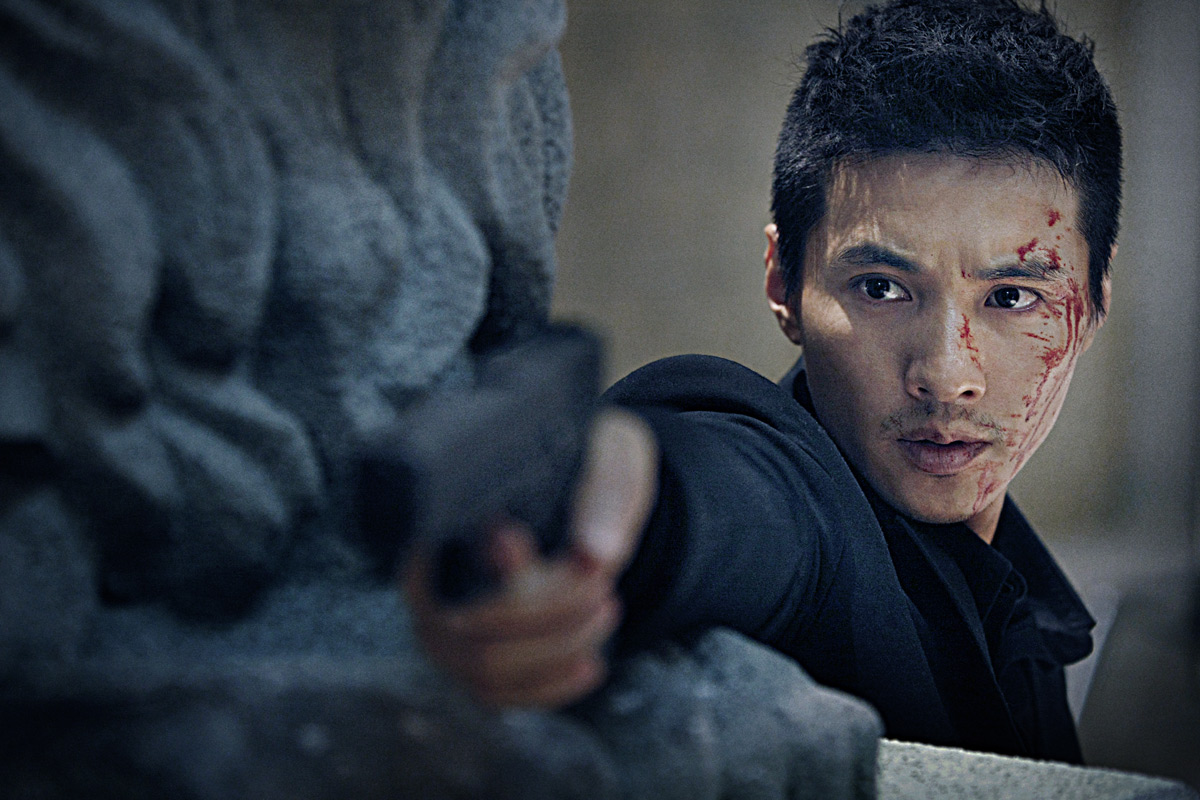
7. The Man from Nowhere (2010)


I would be remised not to include at least one South Korean film on my year end list.  While I failed to watch as many as I would have liked, this accidental inclusion during my Kung Fu marathon was by far my favorite contemporary work from a country that still pushes the boundaries of cinematic possibility.

Review Here

6. Gold Diggers of 1933 (1933)


There is a agreed argument that Singin' in the Rain is the key text in the genre of the musical.  This is certainly true, but this Busby Berkeley choreographed film that has become a point of feminist critique is pretty damn close to its equal.

Review Here

5. Existenz (1999)


While this is probably not a universally adored Cronenberg film, it has, nonetheless, proven to be the single most important alteration in my understanding of cinematic possibilities and by extension my own continually evolving research interests.

I some how failed to actually blog about this film!

4. How the West Was Won (1962)


I watched a lot of westerns in May.  Most of them were brilliant.  While this is not the single most realized western, the use of Cinerama made it my favorite by far and it is essentially all the best parts of various westerns combined into a single epic film.

Review Here

3. Mind Game (2004)


I watched this film twice this year, it is still an enigma.  Furthermore, I watched quite a bit of animation, but this by far stretched my understandings of its conventions to their greatest point.

Review Hhttp://cinemalacrum.blogspot.com/2013/07/fear-takes-shape-we-are-willing-to-give.htmlere

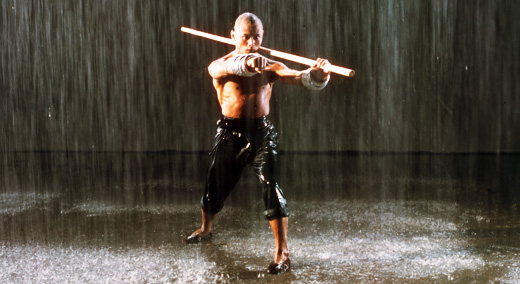
2. The 36th Chamber of Shaolin (1978)


If I were told two years ago that I might seriously add a kung-fu film to my top ten films of all time, I would have scoffed off the possibility, but then I saw this film.  Body identity and Buddhist learning oversee what might well be one of the most stunningly shot action films ever made.

Review Here

1. A Matter of Life and Death (1946)


A absolutely moving film, this Powell and Pressburger film is a perfect navigation of color and black and white filmmaking that simply has to be seen to be believed.  While it does not receive the praise and adoration of The Red Shoes it is easily the greatest of the directing duo's works.

Review Here

Honorable Mention

On Her Majesty's Secret Service (1969)
The Illustrated Man (1969)
Fantastic Planet (1973)
Possession (1981)
Sunshine (2007)

24.8.13

Very Good! But Brick Don't Hit Back: Bloodsport (1988)

I tried to make every film I watched during this marathon come from a place of new experience or deeply entrenched in the vague memories of my youth.  However, when I looked over my list yesterday, I realized that I had managed to completely skip a viewing day, leading to a panicked attempt to quickly find something to add and watch.  Fortunately, I had made a list of possible alternatives, one of which being a personal favorite of mine, 1988's Bloodsport.  I am very much aware that Bloodsport is not a piece of well-respected cinema, nor is it a particularly problem free film from a narrative standpoint, but it is very much a film I have a deep nostalgic bond to and believe to be one of the greater martial arts based films to ever be released.  Released at the height of the phenomenon that was Jean-Claude Van Damme, Bloodsport is what the film version of Street Fighter should have been, as well as being a rather wonderful expose into the world of mixed martial arts tournaments, well before MMA pay-per-view events were the thing do for any muscle-bound bro wearing a Tapped Out shirt.  It would be one thing if Bloodsport just incorporated a bunch of fight scenes, interspersed with really over-the-top montage sequences (which it does in spades), however, it manages to extend the genre, which at that time had reached a lull, and reinvigorate it with a heavy degree of eighties cool.  Between the occasional use POV shots and other experimental camera angles and what goes between being the cheesiest of soundtracks to absolutely thrilling instrumentals, director Newt Arnold makes it expressly clear that Bloodsport exists within its own space, full of stained brutality, much like the ring that figures so prominently into this film.  Considering my nostalgia towards this film, it is probably worth acknowledging that I was far too young to have watched this film once, not to mention repeatedly, consuming the bloodied jaws and broken bones that emerge throughout this film.  I guess I turned out fine as a result though and I certainly could have been far worse had I watched the far more violent Robocop on a more regular basis.  Bloodsport is good to me, because Bloodsport possesses a personal degree of escapism, it is not a great film to most, but it is perfect by my standards.


Bloodsport begins with Frank Dux (Jean-Claude Van Damme) going on leave from his job in the Air Force, only to be stopped by one of his colleagues who claim that his captain wants to see him, after being informed that he is planning on fighting in the deadly full contact Kumite fighting bout.  Knowing that to talk with his superior would mean being unable to compete in the tournament, he leaves by deceiving a lower ranking officer, traveling to train with his master and "second father" Senzo Tanaka (Roy Chiao).  After learning the last series of techniques to become the ultimate fighter, Dux then travels to the seclusive Kowloon Walled City in Hong Kong, where officials have agreed to hold the dangerous tournament.  Aware of the implications of losing one of their most distinguished soldiers the American government hires two agents to track him down in Helmer (Norman Burton) and Rawlins (Forest Whitaker).  Prior to the tournament Dux befriends American fighter and beer-chugging gargantuan Jackson (Donald Gibb) and the two cheer one another along in the tournament.  It is during the first day of fighting that they are made aware of Kumite favorite and general madman Chong Li (Bolo Yeung) whose infamous nature involves killing a man in the ring.  Chong Li clearly takes to disliking Dux and calls him out directly during the tournament.  Between a day of fights, Dux meets American reporter Janice (Leah Ayres) who hopes to break into the tournament by influencing one of the fighters.  Despite wooing Janice and sleeping with her, Dux still explains that he cannot allow her into the tournament, but given her journalistic guile she still manages to find a way.  It is during this day of fighting that Chong Li is pitted against Jackson, beating him down and delivering a near fatal blow to his head, causing Dux to storm the mat in an attempt to exact revenge.  Yet remembering the no fighting outside of the Kumite matches rule, he holds back, promising revenge in a later round.  This promise is given credence when the two meet in the final match of the tournament, where the two go kick for kick, until Dux exposes Chong Li's weakness in the gut.  Chong Li, in rage, attempts to cheat by blinding Dux, who taps into his training by Tanaka and still defeats his opponent, claiming vengeance for Jackson and becoming the first Westerner to win the Kumite tournament.


Again, I am fully aware of the film in all its absurd glory, primarily as a film that suggest that it is some great feat for the Western figure to overtake the Eastern figure, particularly in a physical manner.  Post-colonial theory was still making a name for itself in the late 1980's and would have complete rejected such a narrative of "overcoming the odds" in the context of Dux's privileged status.  Indeed both he and Jackson move about the film with their Western status being a point of pride and power, very literally for Jackson.  At least in the case of Dux he is using the techniques of Eastern philosophy and martial arts to engage with the tournament, so his Western presence is only in a physical sense, as opposed to moral or social one.  The closing moments are rather intriguing particularly considering that the narrative suggest the real life Frank Dux created his own fighting style, assumedly a hybrid of Western and Eastern styles by its name alone Dux-Ryu.  Over the years the legitimacy of such claims has been called into question, but culturally the figure of Dux in Bloodsport is rather prevalent, therefore, making its existence in the cultural space of film absolutely noteworthy.  Another element of this film is the clearly homosocial bond between Dux and Jackson, one that comes dangerously close to taking on a very real sexual element, particularly in the closing scenes of the film, where Dux kisses the recovering Jackson on the cheek, moving his desire from a purely fraternal sense to a physical one.  It may seem like a innocent act, but Dux lingers and it is noticeable and quite possibly not accidental.  I would actually rank the relationship between Dux and Jackson on a level right below that of the wildly homoerotic love triangle that is Maverick, Goose and Iceman in Top Gun, which was from the same era.  I am sure there is a text out there considering these relationships in a variety of action films from the the mid to late 1980s and I would not be surprised if the reading directly ties such occurrences to the hyper-conservative world of Reagan America.  Bloodsport, also does interesting things with racial bodies and spectacle, although it seems to remove the Western body from involvement in the diagetic spectatorial gaze, however, there is always the cinematic gaze to consider, which is an entire critical beast all its own.

Key Scene: As wildly cheesy as it may be, the montage before Dux's final fight is awesome.  Mostly over-the-top the moment he imagines Chong Li's reflection in the subway is one of the most haunting moments in the entire film.

I love this film and so should everyone else.  Nab yourself a copy of the bluray and just ignore that it is double featured with Time Cop.

22.8.13

Even A Buddhist Must Conquer Evil: The 36th Chamber Of Shaolin (1978)

I can mark the occasions on my hand where watching a film that turned out to be more than I expected, even when going into it knowing it had a great reputation.  The film proves to exist in such a vacuum of cinematic perfection and narrative engagement as to radically alter my relatively entrenched set of "top ten film," which for the longest time consisted entirely of obvious classics.  Prior to yesterday, the only two films that proved to be a new degree of perfection were relatively recent cinematic offerings in 2011's Take Shelter and 2007's Secret Sunshine.  These films were so jarringly perfect as to rattle my understanding of cinema and cause me to alter how I had formulated a list of what I already thought consisted of largely perfect, if not near perfect moments in film.  I have in the course of the past year managed to catch up with a large amount of my cinematic blind spots, many of which were quite amazing, works like Rio Bravo and Born Yesterday were phenomenal, but also have a sense of classicism about them that allows me to understand their place in cinema, as well as temper my willingness to subvert my top ten list.  It is when I go into a film not expecting it to be wildly entertaining, profound and personally moving that I tend to have transcendental experiences.  My viewing of The 36th Chamber of Shaolin was one such occurrence.  A film that made the list on the kungu marathon entirely based on a recommendation by RZA on a website in which he listed his favorite kung fu films.  I had already viewed some of his recommendations earlier in the marathon and those he favored were quite enjoyable, however, this film exists in a class all its own, using a highly kinetic style that manages to temper itself throughout by including flares of the melodramatic, but with a decidedly Eastern touch.  I know it is tough to make a case for film, let alone a genre work, to be considered high art, but in terms of The 36th Chamber of Shaolin it is nothing short of cinematic mastery, both proving what is possible in the limits of a genre film, while also considering the larger ability of film to move people on a deep, almost spiritual level.  All of this loquacious rambling comes to one simpler idea, The 36th Chamber of Shaolin is a cool movie.


The 36th Chamber of Shaolin is a story that has surprisingly seen alterations in the form of early works in this marathon, indeed, Shaolin Temple is almost the same film on paper, focusing on a figure who is attempting to fight of the presence of imposing outside forces on his village.  In The 36th Chamber of Shaolin the figure is San Te (Chia Hui Liu) and the oppressive force is the Tartans, also known historically as the Mongols.  San Te is a young man who after attempting to defend his family from an aggressive attack by the Tartans is wounded and stows away in a shipment of lettuce.  This food is by chance delivered to the Shaolin temple, where it is revealed almost immediately that San Te has been transported.  Initially hesitant of his entrance into their sacred space, the head Abbot suggests that they take in the young man and train him in the ways of Shaolin, although they make certain that his training is as intensive, if not more, than his fellow disciples.  Initially San Te is wildly ambitious and hopes to begin in the 1st chamber of the Shaolin, only to discover that not only is he incapable of comprehending the enigmatic phrases of the highest monks, but that he also cannot grasp how a monk sitting down manages to knock him off his feet and across a foyer.  Accepting his need to start from the beginning, San Te works from the 35th chamber, which is a test of jumping over a set of floating logs before eating, to higher levels that teach him endurance, patience and awareness to the surroundings.  Indeed, San Te is initially quite confused as to why it takes him so long to learn even the fist and foot attacks of Shaolin, but as the various abbott's note, it is training that comes to a collective perfection, that is the backbone of Shaolin style.  After a run of success, San Te is appointed a position of leadership, much to the concern of another abbott, who demands that he can only earn his place after defeating him in a fight, after a few unsuccessful attempts with a bladed staff, San Te discover a new weapon by accidentally destroying a bamboo shoot.  This weapon affords him a win and the chance to choice a chamber with which he would like to oversee.  Not wanting to overstep his bounds, San Te suggest that he create a 36th chamber that is intended to train the citizens in basic Shaolin techniques, an idea that is dismissed and eventually leads to his being banished until he can exact a punishment involving obtaining devotions.  It is during his time outside that he comes to realize he can not only find a ton of willing participants for his new chamber, but that he can finally face the man who killed his father and countless other family and friends.  Using the self-defense based non-attacks of the style, San Te is still able to cause the man to kill himself with his own sword blade, a successful battle that is then followed by his return to the temple with rows of new monks, assumedly part o the new chamber he has created.


This film has tons of through lines involving commentaries on how to lead a proper life, many of which pull directly from the Buddhist religion where this film expressly borrows its narrative ideas.  The first and perhaps the most important narrative element seems to be an identification and embracing of humility.  San Te begins the film as a wild young man whose long hair and desire to exact justice lead to his being near-fataly wounded by the Tartan leader.  This, however, does not end his humility, because it is an act by a terrible person who used guile to assure the violence.  It is not until he is stifled by a resting abbott that San Te begins to even consider that he might need to put his privilege into check.  Indeed the 35th chamber of the Shaolin temple exists purely to teach this issue to its students, reinforcing the problems of assuming entitlement.  In this chamber their ability to eat is predicated upon possessing an unusual skill.  San Te cheats at first and attempts to ignore the rules to eat, because he has  not the humility to understand that eating is a privilege he had been afforded prior.  Once he learns this key element to transcendence, other elements become attainable.  Moving upward he learns the value of persistence and an understanding that while it is ideal to help other people in their movement towards their enlightenment it is necessary for them to experience their own trial and errors.  In more unusual moments throughout his training, San Te must understand the beauty and aid of learning a rhythm and methodology in relation to larger endeavors.  Indeed, fighting is not really an element of the Shaolin way, but instead learning to harness literal weight and metaphorical rage, into means to avoid death for those involved. One of the more hilarious scenes in the film involves San Te moving through the "head" chamber which is where he must repeatedly head butt sacks full of rocks and finish by offering a devotion to Buddha.  This may seem self-destructive but the overarching suggestion that such an approach takes on the attitude that one must literally be headstrong while also using their head to be intelligently sound is one of the major lessons he is able to extend to his prospective students when he is on force sabbatical from the temple.  In a bit of brilliance he comes to understand that training for Shaolin results in lessons that occur both in the confines of the chamber, as well as in daily engagements, suggesting that his newly added 36th chamber was not unprecedented, but indeed quite normal to the way the teachings of Shaolin evolve and extend beyond small, inclusive groups.

Key Scene:  It is tough to pick any singular chamber, because they are all so wonderful.  I personally liked the candle on the fulcrum sequence, but any of the moments could have been the key scene.

This is the best thing I have seen on bluray.  Hands down.  The added commentary by The RZA, which is highly informed and inquisitive is merely and extra incentive to get the film.

3.1.13

Top Ten Thursdays: Best Film Discoveries of 2012

Oh it has been a long time coming, I cannot recall the last time I actually compiled a top ten list and here I find myself attempting to throw one together in the last hours of the day.  I figured that since I did a similar list last year and plan to hold off for a few more weeks before discussing my favorite films of 2012, it would be an opportune time to discuss some of the works for years earlier that proved to be revelations to me and worth repeating.  As was the case last time, they must be things that I had not seen prior to this year and nothing that came out this year, although I cannot think of something that would break this list, although I have seen some stellar cinematic offerings.  Hopefully the key to this will be brevity, because I have at some point written blogs about all the films I have chosen and will post links to them with each.  Looking back makes me realize that I watch a whole heap of films last year, many of which were indeed quite good, although a good few of them were downright terrible, needless to say, it is not an easy list to compile and only drives me to see more great films as this year winds onward. Viva la cinema...or something like that.

10. An American Werewolf In London (1981)

Leave it to a rather raunchy and satirical horror comedy to break into the top ten, but I cannot get this movie out of my head, something is just too damn perfect about it, not to mention it having the greatest closing song in film history.

Review Here


9. The Straight Story (1999)

I will blame this on having just finished season one of Twin Peaks, yet The Straight Story was not the only first time with a Lynch film viewing this year, it just proved to be something far grander than I could have possibly imagined.

Review Here


8. Stardust Memories (1980)

I have found my definitive Allen film, although I look forward to digging through more of his back catalogue this year, I can only hope I turn on a few more people to the genius of his hidden gem.

Review Here


7. Harold and Maude (1971)

This viewing had been a long time coming and boy did it live up to the hype.  A deserved cult classic, Harold and Maude exudes magic and clearly serves as a stepping stone for Anderson and others, not to mention a single artist soundtrack on par with The Graduate.

Review Here


6. Pather Panchali (1995)

I broke down and bought a less than stellar bootleg of this film because it gets referenced and praised so damn often, despite being clearly ripped from a VHS recording, the cinematic zeal of Ray pops of the screen, here's to this finally being the year Criterion gets it out on bluray.

Review Here


5. Lonesome (1928)

Safety Last was so close to making the list, but I had to give way to the film that has allowed me to completely reconsider the art of silent film, even if this is "technically" an early talkie.  Not to mention I cannot get the words to "Always" out of my head.

Review Here


4. Close-Up (1990)

No film better captures the vision of my blog than this revelation by Kiarostami, I can only hope to obtain a copy for my personal collection sometime this year.

Review Here


3. The Poughkeepsie Tapes (2007)

I am convinced that I am chairing a single person committee to save this film from obscurity, but, seriously, just writing about this dark horror film gives me chills.

Review Here


2. Take Shelter (2011)


Easily my biggest oversight on my best films of 2011, this film beats out everything else that came out in 2011 and could stand to become one of my favorite films of all time.


Review Here


1. Secret Sunshine (2007)

This is the year that I found my focus and plan for academic study, all centering on South Korean cinema, fortunately, Secret Sunshine and a transcendent performance by Jeon Do-yeon came along to not only reaffirm my decision, but my faith in film as a whole.  If it were not for Do The Right Thing and Cool Hand Luke, this would easily be my favorite film ever released.

Review Here


Honorable Mention

Safety Last (1923)
Gentlemen Prefer Blondes (1953)
Zazie Dans Le Metro (1960)
Woman In The Dunes (1964)
Earth Girls Are Easy (1988)
Away We Go (2009)