While I had seen a few David Cronenberg films well before I had decided to "get into him" as a filmmaker, it was around June of last year that I finally encountered him as a director proper and slowly notched his oeuvre off of my needs to be seen list. Considering that yesterday was his birthday and that I had A Dangerous Method delivered the other day via Netflix, it seemed far to serendipitous an opportunity not to take. I am aware that there has been a sort of tapering off of the love for Cronenberg by his fandom as his films have move far away from their more gore inspired roots to something that at first glance seems to be cerebral and less physically affective. I can see the confusion for certain, but I am also wholly aware that body gore and affect do not need a visual component to work wonders. Indeed, it is with almost perfect precision that Cronenberg is able to take the deeply psychological and disturbing elements of the interior and make them work on the body without really showing the gore he has become synonymous with the director. Sure there are some deeply graphic scenes and the film is disconcerting, but this is Cronenberg moving in a new direction, after all as of yesterday the man is seventy one years old! To make The Fly or Scanners is simply not his world anymore, like most directors (Tarantino excluded) maturity brings forth a new look at the world and a far more introspective execution in his films. Hell, even Michael Bay seems to be moving in this direction and it should be no surprise that it occurs with the master of gore. If one is looking for film to affect them on a deep level, then Cronenberg is continuing to succeed in a way few are and were he not being overcome by the likes of Paul Thomas Anderson and David Fincher, I would be prepared to argue that he is one of the most important directors working today, but at seventy one to be mentioned in the same breath as the former filmmakers is a success all its own.
A Dangerous Method focuses on the work and life of Carl Jung (Michael Fassbender) as he continues to establish himself in the field of psychoanalysis, despite having to do so under the rather intense and broad shadow of Sigmund Freud (Viggo Mortensen). Although, Jung knows that this is a near impossibility when he is provided with the patient and prospective psychoanalyst Sabrina Spielrein (Keira Knightley) things change drastically. A frantic and disheveled woman, Spielrein, nonetheless, proves a counterpoint to so many of Freud theories, completely throwing the theorists understanding of abject desire and erotic fixation out the window. Jung begins pouring his entire studies into working with Spielrein, while also guiding her along in her endeavors. This act comes at the frustration and anxiety of Jung's wife Emma (Sarah Gordon) who is busy attempting to provide the doctor with a son, the only way in which to assure that his name will continue to possess legitimacy and avoid the existential fear of losing one's name. Yet, this seems to be of the most minor concern to Jung, who finds the navigation between patient learning and desire for Spielrein to become less and less clear, particularly when she begins making advances towards him, seeing his role as authority figure and teacher, overlapping with her own problematic relationship with her father. It is not until Jung is given another psychoanalyst turned mentally ill patient in Otto Gross (Vincent Cassell) that things change. Gross argues that Jung must engage in relationships with his patients in order to assure that he will become happy and better achieve a relationship. Blinded by his already repressed desire, Jung takes Gross's ill-offered advice to heart and begins a relationship with Spielrein, one that puts his familial relations at odds and eventually leads to his contentious and troubling confrontations with Freud. Finally, believing he has become friends with Freud, Jung offers up his dreams for interpretation, hoping to receive the same in return. When this does not happen, Jung questions the entire structure of authority, although this happens far too late to solve things with either Spielrein or his family, instead, Jung pours everything into work and solitary studies.
If one were to extract the psychosexual element at play in this film, it would read as pretty much another period piece of desire, lust and repression in a time of hyper-conservative conformity. There have been other films about the era of psychoanalysis, but the limitations of censorship often cause them to be confused and lost in safe narrative construction. Cronenberg, as most know, has always pushed the boundaries and buttons of censors, using giant bugs and non-linear narrative to make one of the greatest examinations of repressed sexual identities in modern cinema. Here, he is dealing with the perverse and in no small way he does so with it expressly meaning to shock. Under the guise of the cold medical rhetoric, Cronenberg is able to talk about the most uncomfortable of human functions in banal terms. When the psychoanalysts talk of the various fixations, many of which involve relieving oneself, the overlay of Jung consuming things makes a clear connection that human bodies are subject to exchanges that are in a constant ebb and flow. It is not so much an act of pleasure in the context of this film as it is replacing voids that are physically lost. Cronenberg takes the guise of excretion and argues that it is in these basic human desires that psychoanalysis seems to be replicating a mental understanding of something physical. It is heady academic theory and at this point has become more a point of literary consideration than anything certifiable, indeed, most psychologist just teach it as a point of historical curiosity. Where Cronenberg seems to relish most in regards to narrative is within a consideration of authority, it is in this space that he seems to find the body at a loss, a surprising moment for Cronenberg, who had prior tied the body to the world of television and video games. In the space of this narrative the body is a thing that can only be punished by authority, because rewards are seemingly less physical and far more cerebral. The basest of human desires often coming in as, again, fillers for hopes of approval. In the vague and dreary endings that have come to signify the filmmakers works, desolation and ennui fill characters who are blindly hoping for something far grander, but still linger on the failure and limitations of the body.
Key Scene: I was initially hesitant to embrace Knightley's performance as it seemed to be very Oscar-baity, however, one scene involving her recollecting a dream to Jung where she is in the foreground and he in the background. It is deeply intense and cinematically engaging.
I rented this, but intend to buy it soon. However, it is a different kind of Cronenberg than most expect, so I would suggest doing the same before pulling the trigger on a purchase.
Showing posts with label David Cronenberg. Show all posts
2.1.14
Top Ten Thursday: The Best Film Discoveries of 2013
It has been a considerable time since i have committed to making a top ten thursday list. Indeed, if it was not the last time that I did a best film discoveries of the year it was pretty damn close. While I am still tenuously navigating the space between being certain I have found all my favorite films released in 2013 and being certain the list cannot change, I figured now was an appropriate time to attempt to deliver the list accordingly of my most favored films that were not released in 2013, but were first time encounters this year. While I was able to catch up with some rather glaring shame spots in my filmic viewing (Who's Afraid of Virginia Woolf, Rio Bravo, My Neighbor Totoro) I decided to exclude those form the list, because I was fairly certain I would adore the films. The list here is compromised of films that so utterly startled me as to make me considerably change my favorite films of all time list in very drastic and real ways. These films have in varying forms altered my understanding of cinema, my academic research endeavors, or frankly were just so enjoyable as to rekindle the love for medium of film in a fresh and rewarding way. In the past year I did a ton of marathons and even managed to tackle viewing a hundred movies in a single month. The resulting list is barely a reflection of the options I had, but were certainly the most captivating outcomes.
10. Terrorvision (1986)
Between being what might be the zaniest film ever produced and being the most underrated film of the decade Terrorvision deserves all the cult adoration it has achieved. Thanks to Shout Factory this overlooked horror/comedy/sci-fi study of the nuclear family in the misguided decadence of the 80's can be enjoyed by all in the highest of definitions.
Review Here
9. To Be or Not To Be (1942)
Ernst Lubitsch appeared a lot in my film viewing this year and while most of it was in regards to his silent work, this comedy that doubles as a scatting critique of Nazism managed to pull me into its narrative despite being viewed on a computer screen. Indeed, this along with other works like The Doll and I Don't Want To Be a Man have led to me thinking that Lubitsch might be a single director research interest for me.
Review Here
8. Born Yesterday (1950)
This film was my first knowing introduction to the comedic genius of Judy Holliday and by far the most rewarding experience I had with a George Cukor film this past year. The fact that it also happens to be a insightful consideration of gender relations in 1950 is equally engaging.
Review Here
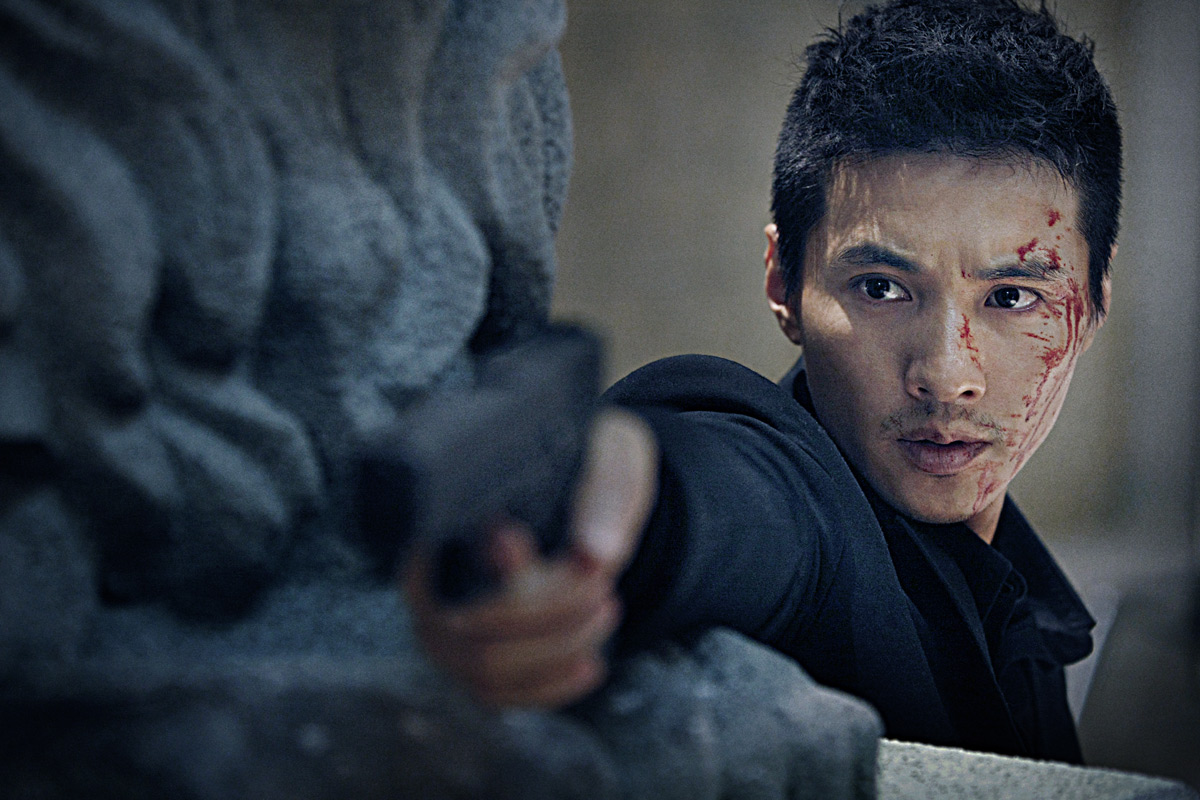
7. The Man from Nowhere (2010)
I would be remised not to include at least one South Korean film on my year end list. While I failed to watch as many as I would have liked, this accidental inclusion during my Kung Fu marathon was by far my favorite contemporary work from a country that still pushes the boundaries of cinematic possibility.
Review Here
6. Gold Diggers of 1933 (1933)
There is a agreed argument that Singin' in the Rain is the key text in the genre of the musical. This is certainly true, but this Busby Berkeley choreographed film that has become a point of feminist critique is pretty damn close to its equal.
Review Here
5. Existenz (1999)
While this is probably not a universally adored Cronenberg film, it has, nonetheless, proven to be the single most important alteration in my understanding of cinematic possibilities and by extension my own continually evolving research interests.
I some how failed to actually blog about this film!
4. How the West Was Won (1962)
I watched a lot of westerns in May. Most of them were brilliant. While this is not the single most realized western, the use of Cinerama made it my favorite by far and it is essentially all the best parts of various westerns combined into a single epic film.
Review Here
3. Mind Game (2004)
I watched this film twice this year, it is still an enigma. Furthermore, I watched quite a bit of animation, but this by far stretched my understandings of its conventions to their greatest point.
Review Hhttp://cinemalacrum.blogspot.com/2013/07/fear-takes-shape-we-are-willing-to-give.htmlere
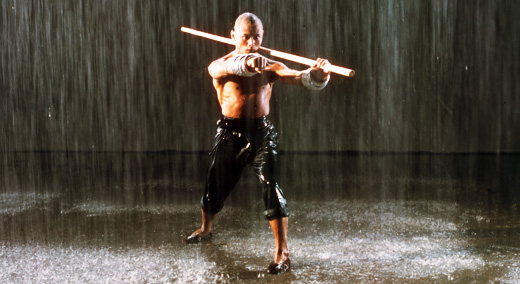
2. The 36th Chamber of Shaolin (1978)
If I were told two years ago that I might seriously add a kung-fu film to my top ten films of all time, I would have scoffed off the possibility, but then I saw this film. Body identity and Buddhist learning oversee what might well be one of the most stunningly shot action films ever made.
Review Here
1. A Matter of Life and Death (1946)
A absolutely moving film, this Powell and Pressburger film is a perfect navigation of color and black and white filmmaking that simply has to be seen to be believed. While it does not receive the praise and adoration of The Red Shoes it is easily the greatest of the directing duo's works.
Review Here
Honorable Mention
On Her Majesty's Secret Service (1969)
The Illustrated Man (1969)
Fantastic Planet (1973)
Possession (1981)
Sunshine (2007)
10. Terrorvision (1986)
Between being what might be the zaniest film ever produced and being the most underrated film of the decade Terrorvision deserves all the cult adoration it has achieved. Thanks to Shout Factory this overlooked horror/comedy/sci-fi study of the nuclear family in the misguided decadence of the 80's can be enjoyed by all in the highest of definitions.
Review Here
9. To Be or Not To Be (1942)
Ernst Lubitsch appeared a lot in my film viewing this year and while most of it was in regards to his silent work, this comedy that doubles as a scatting critique of Nazism managed to pull me into its narrative despite being viewed on a computer screen. Indeed, this along with other works like The Doll and I Don't Want To Be a Man have led to me thinking that Lubitsch might be a single director research interest for me.
Review Here
8. Born Yesterday (1950)
This film was my first knowing introduction to the comedic genius of Judy Holliday and by far the most rewarding experience I had with a George Cukor film this past year. The fact that it also happens to be a insightful consideration of gender relations in 1950 is equally engaging.
Review Here
7. The Man from Nowhere (2010)
I would be remised not to include at least one South Korean film on my year end list. While I failed to watch as many as I would have liked, this accidental inclusion during my Kung Fu marathon was by far my favorite contemporary work from a country that still pushes the boundaries of cinematic possibility.
Review Here
6. Gold Diggers of 1933 (1933)
There is a agreed argument that Singin' in the Rain is the key text in the genre of the musical. This is certainly true, but this Busby Berkeley choreographed film that has become a point of feminist critique is pretty damn close to its equal.
Review Here
5. Existenz (1999)
While this is probably not a universally adored Cronenberg film, it has, nonetheless, proven to be the single most important alteration in my understanding of cinematic possibilities and by extension my own continually evolving research interests.
I some how failed to actually blog about this film!
4. How the West Was Won (1962)
I watched a lot of westerns in May. Most of them were brilliant. While this is not the single most realized western, the use of Cinerama made it my favorite by far and it is essentially all the best parts of various westerns combined into a single epic film.
Review Here
3. Mind Game (2004)
I watched this film twice this year, it is still an enigma. Furthermore, I watched quite a bit of animation, but this by far stretched my understandings of its conventions to their greatest point.
Review Hhttp://cinemalacrum.blogspot.com/2013/07/fear-takes-shape-we-are-willing-to-give.htmlere
2. The 36th Chamber of Shaolin (1978)
If I were told two years ago that I might seriously add a kung-fu film to my top ten films of all time, I would have scoffed off the possibility, but then I saw this film. Body identity and Buddhist learning oversee what might well be one of the most stunningly shot action films ever made.
Review Here
1. A Matter of Life and Death (1946)
A absolutely moving film, this Powell and Pressburger film is a perfect navigation of color and black and white filmmaking that simply has to be seen to be believed. While it does not receive the praise and adoration of The Red Shoes it is easily the greatest of the directing duo's works.
Review Here
Honorable Mention
On Her Majesty's Secret Service (1969)
The Illustrated Man (1969)
Fantastic Planet (1973)
Possession (1981)
Sunshine (2007)
2.11.13
Holes Are Interesting, There Are Books About Holes: Cosmopolis (2012)
I am astounded by the amount of negative feedback mounted agains this, David Cronenberg's most recent filmic offering. Well...actually I am not entirely astounded, but more so begrudgingly understanding in the derisive attitudes directed towards the piece. Existing in an ethereal space that is both within the confines of the alienating cinematic stylings made famous by the Canadian auteur, while also managing to deconstruct the very relationship technology and space has to film output, Cosmopolis is far from Cronenberg's most viscerally engaging work. Beginning and ending with some decidedly upbeat music from composer Howard Shore, one would almost immediately dismiss it as a work by the director whose use of the body as a space of cinematic violence has become a trope of sorts within his career, causing one to immediately compare other works that incorporate such themes and imagery as being always in contention with his, usually superior, offerings. Suffice it to say, Videodrome, Existenz and many other Cronenberg works proved to be well ahead of their times, the two former pieces proving as, if not more, enigmatic as was the case during their original release. While I would not go so far as to suggest that this is on par with those two films, I do think people are under-appreciating the winding, if decidedly monotonous styles of this film, which for all intents and purposes is focused on one young man's limo ride through a city. Yet, Cronenberg who is ever prescient in his cinematic endeavors seems to use this car as a larger metaphor for the individual attachment to society by way of technological detachment. Existing in a space of the heightened simulacra on a level of starkness compared only to Cronenberg's own work, or perhaps the more jarring work of Lars Von Trier, Cosmopolis constantly demands that the viewer move beyond what is portrayed in the foreground of a scene, to scrape away at the layers of depth within a moving image, at times even needed to dig deeper to find something in the very skin of the film itself. Cosmopolis is about penetration, both in a literal and metaphorical sense and while it may seem as though Cronenberg is a filmmaker whose movies are primarily for his own enjoyment, it is rather obvious that he expects viewers to engage with the films on a tangible and textual level wherein simple observation bears few results if not absolute indifference, but a focused eye and mind can see something both poignantly disturbing and decidedly prophetic.
Cosmopolis centers on the day of Eric Packer (Robert Pattinson) a son of a wealthy mogul, who has had his own success in the stock trade, thus spending much of his time simply cruising about the city and trying to get laid, either by his former fiancee or by many of the various women he encounters. When told by his security guard that he ought to consider limiting his travels in lieu of an upcoming visit by the president, Eric stubbornly refuses and demands that he be taken across town to receive a haircut. Along the ride, Eric meets with various acquaintances, whether it be tech gurus like Michael Chin (Philip Nozuka) and Shiner (Jay Baruchel) or people with whom Eric has had past sexual relationships, often re-consummating the relationships as occurs with Didi Fancher (Juliette Binoche) and Kendra Hayes (Patricia McKenzie). Ultimately, however, Eric seems most intent on recreating a relationship, purely one of sexual means with his ex-fiance Elise Shifrin (Sarah Gadon) who is decidedly uninterested in his advances. When a local religious leader and spirited social activist dies, a moment of civil unrest arises, all while Eric idly passes the time in his car, drinking, pontificating and at one point even receiving a prostate exam. Eventually, the constant burden of having to worry about his security guard Torval (Kevin Durand) being extremely cautious with his whereabouts leads to Eric tricking him into deactivating the lock on his gun and killing the guard. This shift allows Eric to move more freely about the city even enabling to finally get his haircut although it requires the opening of a barber well past business hours, a moment wherein the barber and Eric's driver share in stories of their past days as taxi drivers. This moment proves to be the last of Eric's encounters, before he finally meets up with Benno Levin (Paul Giamatti) a hermit and hypochondriac that has purportedly spent the entirety of the day trying to kill Eric. When in his sights, Benno fails to kill Eric, but instead of fleeing Eric climbs the stairs to his apartment and enters into his house, only to be confronted by Benno, the two sharing in a perplexing and winding confrontation before Eric assumedly succumbs to his fate, sitting facing the camera as Benno utters a few words, the screen fading to black before any shot is fired.
I want to reemphasize the way in which this film is seemingly working on a layer below the tangible, wherein, the to use a term in corporeal cinema, the skin of the cinema has been penetrated. There are moments in Eric's limo where it would seem like the CGI is being executed in a very poor manner, making it quite clear that the outside is different from the interior, I would argue that this is not poor filmmaking, but a directorial choice on the part of Cronenberg to show Eric's movement from complete technology based detachment to the real which moves towards complete attachment to it in the closing moments of the film when the now less certain Eric enters the space of Benno's gross and filthy apartment, complete, no less with a mound of broken computer monitors. It would seem to be in this bookended nature of the film that Cronenberg is tackling the issues of how a social understanding of the world fueled almost entirely by that which is attainable through social outlets. The movement in and out of individuals within the space of Eric's vehicle represent the transitory and desultory nature of communication in this age, right down to what appears to be a cinematic recreation of a booty call. Eric cannot seem to understand the physical barriers confronting his ability to travel the town during the presence of the president, because his world does not exist outside of the car and, therefore, he cannot physically understand such a thing as a barrier, a metaphor that perfectly extends to the seemingly unlimited amount of access he is afforded purely as a result of wealth. Indeed, he is shown rather early in the film attempting to buy the Rothko Chapel, a space purportedly made for the community, which Eric hopes to possess for himself through financial means. This acquisition without physically viewing an item takes on yet another layer of online identity as Eric can now consume the world from the comfort of his car computer, never being forced to deal with a grounded understanding of things. Even events of heightened intensity are dealt with in a detached manner, watching a riot occur from the safety of his walled in car/computer, much as was the case with watching the Occupy Movement or in more violent examples the uprisings in the Middle East. It is fitting that when he does finally leave his car and computer space it is to get a hair cut an act of physical destruction that leads to the further, assumed physical destruction of his body in the closing moments of the film. The computer has allowed a person access to pretty much anything they could desire on Maslow's hierarchy of needs, yet the feeling of destruction and, ultimately, death must be felt in the flesh and in the real.
Key Scene: It should be no surprise that the best scene in this film involves Eric receiving a prostate exam while talking to another woman. Aside from Robert Pattinson knocking this scene out of the park in acting terms, it also takes on a wonderful layer of metaphor and psychosexual politics.
This is watch instantly on Netflix, however, it is worth obtaining on bluray, the lack of popularity has led to it dropping in price considerably, which both a shame and a benefit to those looking to obtain a copy of the film.
2.8.13
He Tied His Own Tendons!: Riki-Oh: The Story Of Ricky (1991)
Knowing that I would go through the entire month of kung-fu films missing some gems if I did not take suggestions from friends as to what I should watch, I decided to call out for suggestions via Facebook and the results were quite notable, many people offering a list of film while others gave a single affirmation as to what one work should be viewed. I have a friend, who is very into comic books and all things comic related that also happens to have an excellent taste in film, although we find ourselves disagreeing about a lot of films, he, nonetheless, is a person who I find to be worthy of acknowledging when given a suggestion. I am glad I adhered to his recommendation of Riki-Oh: The Story of Ricky, because it is a wild, wild film that exists in a cinematic world entirely of its own accord. In fact, I have often wondered what a kung-fu film directed by David Cronenberg might look like and I now have my answer with this film, which takes body gore and horror to a place way beyond even The Fly. The gore in this movie is excessive to be certain, but in its sort of over-the-top grandeur it becomes a statement on the nature of violence in action cinema, particularly when considering death and physical attacks upon the body. Whether this is purposeful on the part of director Ngai Choi Lam is up for debate, but the product does exist and it can be dissected as such, indeed a viewer is offered plenty of flesh, intestine and blood with which to do so. While this is only the second film is a thirty one film marathon I am wondering the the trope of body as vessel with which morality works through will come to be a larger theme within the genre, because it was certainly passively discussed in Enter the Dragon, and is pretty much the main focal point in this film. Again, like Enter the Dragon, Riki-Oh also considers the various bodies that can occupy a challenging physicality, whether it be physically disabled persons or an individual whose gender is ambiguous. The crazier thing about Riki-Oh is that this is only one of many social commentaries or narrative through-lines in the film, all of which seem so well-executed and realized as to be separate films working in some wonderful synchronicity. It is a film to which I was quite surprised and am grateful to have been suggested.
Riki-Oh begins somewhat in media res with the introduction of a prison that has with the turn of the 21st century become privatized, meaning that large capitalist figures can use the institution as they see fit, exploit workers or affording favors to whomever they please. The prison in this film is one such place and when recent murder convict Ricky (Siu-Wong Fan) enters the world, he is quickly deemed a threat with his ability to destroy the bodies of other with his intense martial arts. This destruction is so honed in fact that Ricky can punch through bodies, while also using his own physical form as a human shield, literally deflecting the attacks of other whether they be by fist or gun. Nonetheless, given that Ricky's jailing is a result of having killed a mob boss, he becomes a threat to the various crime lords working within the prison, many of which are martial arts experts in their own rights. Ricky is a force that is unstoppable however, beginning immediately he becomes a protector to the persons in the prison, treating them as human beings, while looking at the warden and his group of lackeys as terrible entities bent on destruction. Ricky begins a series of attacks that first deal with the lowest of the wardens bosses Oscar fending of an attempted strangling by the disemboweled mobster. Yet, while Ricky is nearly invincible the impossibility of fighting three experts in various forms of martial arts leads to his being tied up by the warden and buried alive for a week, the warden promising that should he survive he will be given his freedom without question. Yet when Ricky does exactly this, despite all expectations, the warden refuses him the right leading to a complete breakdown of the authority system by not only the other prisoners but Ricky who takes it upon himself to destroy all in his path, whether it be the use of cement to beat the aptly named Tarzan or a chop so intense as to sever a man's head in half, leading finally to his battle with the warden, who it is revealed fights with the same technique as Ricky, one that feeds off of strength. As such, the warden evolves into a monstrous version of himself that initially gives Ricky challenge, but Ricky proves capable of the challenge and ends up shoving the monstrous warden into a meat grinder, thus destroying him completely. Ricky immediately returns to the prison yard and punches through the concrete wall, exclaiming that everyone is free as he walks off into what one can assume to be the sunset.
The description I just gave probably makes the movie sound crazy, and I fully understand that, because it is indeed an insane film, one full of gore laden fight scenes and a complete rejection of all physical and biological possibilities, but just because Riki-Oh exists in a state of filmic absurdism does not mean it is not still full of critical possibilities. There is a very well-executed Christ metaphor in this film, although it does get really on the nose in once scene, just as there are issues concerning body politics and morality. Yet, what has to be the absolute most fascinating element of this film is the way it deals with the notion of a prisoner. In fact, I earnestly wondered while watching this film if Angela Davis was aware of its existence, because despite its hyper violence and insane gimmick, it does ask viewers to reconsider their thoughts on the average prisoner. I say average, because it creates a very tangible and stark difference between the career criminals depicted as vicious and lacking in ethical thoughts, whether it be the money hungry warden and his various lackeys who seem to have no qualms murdering and maiming to assure their advancement and those people who have been placed in jail for a minor or misappropriated offense. The film introduces viewer to a man who was part of a traffic accident, in which he was allegedly not at fault, yet as others note he killed a police officer, therefore, resulting in his heavy sentence. This jailing leads to him being physically beaten by the higher-ups for no reason than it is part of the world. Similarly, Ricky is arrested for killing a local pimp, one that allegedly attempted to rape his girlfriend who dives to her death in order to avoid the defiling. While killing is always a murky ground the narrative does seem to posit that it was a level of criminality that was being completely ignored by the warden and others who were presumably friends with the crime boss. I give these descriptions, because the film seems to posit the criminality is often associated to people who are far from deserved of such negative monikers. Angela Davis has written extensively on this topic and is particularly critical of a legal system that over-punishes for minor crimes and looks away at serious offenses with large scale social impacts. The race and class elements are not necessarily dealt with in this film, but it is certainly a point of reference that could be drawn with the right lens. Ultimately, Riki-Oh seems keen on noting the grey areas of criminality, while also warning of the serious dangers and human rights infractions that could emerge from privatizing institutions.
Key Scene: With many wildly gory scenes to choose from, I guess I will have to go with the jaw-busting upper cut. I think I actually let out a gasp paired with the screaming of WHAT when it happened.
The DVD for this is not super expensive and while I really really enjoyed this movie, I would suggest a streaming option first, unless you love either kung-fu films or David Cronenberg, in which case buy this immediately.
5.6.13
Exterminate All Rational Thought: Naked Lunch (1991)
I am both regretting, as well as beginning to appreciate the #100filmsforJune marathon I have decided to undertake along with a ton of other members on Letterboxd. I am regretful because it is proving to be an incredibly daunting and time-consuming process, especially considering that I am trying to avoid repeat viewings per the stipulations of the marathon. However, it has thus far afforded me an opportunity to catch up with a few blind spots within my film literacy a problem that I hope will be noticeably altered by the end of the month. One such blind spot for me, as mentioned with my previous post concerning Sunshine, is that of underrated or overlooked science fiction films, which made a viewing such as Naked Lunch excellent, primarily because it falls within the confines of lesser known science fiction, while also affording me the very welcomed opportunity to fill in a gap on my desired viewing list with the psychosexual madness of yet another Cronenberg film. While I would not say that Cronenberg hits every work out of the park, I do find most of his choices engaging and, at times, deeply profound. Works like Videodrome and Existenz have become staples of consumerist fears and the detachment of the body in regards to an omnipresent, artificial entity that can fulfill even the most base of human needs and desires. As should be little surprise, Cronenberg takes lens in Naked Lunch and spins a web of insanity relating to some absurd hybrid of drug culture and repressed heterosexuality. What comes out of his cauldron of visions is a film that is parts Terry Gilliam and Ken Russell, engaging the very fabric of human life and its fractured psyche during a state of dependence that parallels nicely with the narrative of Linklater's A Scanner Darkly which provides for yet another layer of fitting parallels, in that both manage to perfectly adapt rather dense and challenging texts from equally prolific authors into a world all their own, using similar metaphors and messages to paint their facsimile of society in such a way that it is entirely implausible to the point of viewers finding safe detachment, while also being incredibly prescient and a cause for very real feels of discontent and dismay.
Naked Lunch is set inconceivably in fifties era New York and follows the life of exterminator Bill Lee (Peter Weller), a rather interesting job in the context of this world considering that both bugs, as well as particular pesticides prove to be highly addictive drugs, so much so that his girlfriend Joan (Judy Davis) is a strung out addict to bug powder herself, often stealing large quantities from Bill's work supply to get her fix, which, in turn, leads to his being fired from his job. Later that evening in an attempt to get people out of his house, Bill and Joan do a William Tell routine that involves him shooting a glass off of Joan's head, only for it to go awry and result in her being shot. During an arrest related to his assumed murder Bill begins his own hallucinations as a result of repeated work around bug powder, where in he sees a large insect who informs him that he is to be a secret agent in a alternate world known as Inter Zone where he will serve as a writer for the various alien-like bugs that inhabit the world. During his work for a particular bug, one named Clark Nova, after the typewriter which it manifests itself though, Bill is told that he is to find one Dr. Benway (Roy Scheider), an endeavor that leads him to meeting doppleganger of his deceased wife. As this navigation towards Dr. Benway continues, Bill comes to realize that the entirity of Inter Zone, as well as its extended alternate universe Annexia are riddle with drug addicted individuals, many of which actively engage in gay relationships, and that a larger narcotics trade orbits around the trafficking of a particular bug based drug known as "black meat." Of course, getting to the center of the issues is far from simple, particularly since Bill himself is navigating various drug induced trips, yet after a constant shifting of mind states, he eventually comes to realize that it is indeed Dr. Benway who is the veritable kingpin of the narcotics pushing and in an attempt to flee to Annexia, he, as well as the doppleganger of Joan, is stopped by border police, also dopplegangers of previous characters themselves who demand that Bill prove he is a writer. After pulling a pen out of his pocket as evidence, Bill, for no obvious reason, recreates the William Tell accident from earlier, thus bring the acid trip of a film full circle and Bill no closer to a sort of meaning and happiness he so clearly seeks throughout.
Much like other Cronenberg films, the narrative and its visual stylings seem to have a particular fascination with flesh, penetration and the seemingly inextricable connection between the mind and body as it relates to identity and survival. This cinematic theme within Cronenberg's films furthermore always seems to have a psychosexual layer added as well, one of invasion and intrusion that is made all the more grotesque by the perfectly disgusting creatures that Cronenberg's crew makes for his films. While I know I am not going to do any justice to this thematically, I feel it necessary to talk about the particularly unusual way in which the psychosexual elements relate to homosexuality between males. Much like Barton Fink, the film has a drifting writer character to seems to be struggling with something larger than himself that is forcefully and unsuccessfully being repressed only to blow apart in troubling and destructive ways. I would argue that both the character of Barton, as well as Bill are dealing with their respective oppressed sexualities, ones that are necessariliy oppressed for fear of violence and desertion from society. In Cronenberg's film, this repression means that Bill must shack up with a drug addicted woman who he "accidentally" kills not out of malice, but out of a desperate hope to escape to something desirable, an escape he and the other openly gay characters of the film seem to pursue via wild hallucinogenics. The escape only proves mildly beneficial for Bill, in that he is arguably surrounded by other gay males, although the price is pretty severe because the various drugs essentially allow for his feuding id and superego to go unchecked resulting in some bizarre drug induced visions. Of course the image that will be easy to pick up to the non-Freudian thinking viewer will undoubtedly be that of the various writers and other figures suckling at the flaccid stem of the white bug hoping to receive the liquid that emerges upon the completion of "good writing," which, of course, extends to include a good sexual performance as well. Bill while madly struggling to repress his feelings cannot help but desire this secretion, much as he cannot change his desire for other men. Of course, there is also the bug whose back, and apparent form of communication very much resemble the anus, suggesting a point of sexual pleasure, as well as verbal interaction whose implications both within the context of sexuality and Freudian psychology are many and multifaceted.
Key Scene: The bug farm scene and the revelation of Dr. Benway's disguise are a fitting way to bring this narrative to a near close and defy all the logic in the film, which was minimal to begin with.
This is an excellent film and Criterion has recently put out a bluray, I would strongly encourage obtaining a copy when finances allow you to do so.
Naked Lunch is set inconceivably in fifties era New York and follows the life of exterminator Bill Lee (Peter Weller), a rather interesting job in the context of this world considering that both bugs, as well as particular pesticides prove to be highly addictive drugs, so much so that his girlfriend Joan (Judy Davis) is a strung out addict to bug powder herself, often stealing large quantities from Bill's work supply to get her fix, which, in turn, leads to his being fired from his job. Later that evening in an attempt to get people out of his house, Bill and Joan do a William Tell routine that involves him shooting a glass off of Joan's head, only for it to go awry and result in her being shot. During an arrest related to his assumed murder Bill begins his own hallucinations as a result of repeated work around bug powder, where in he sees a large insect who informs him that he is to be a secret agent in a alternate world known as Inter Zone where he will serve as a writer for the various alien-like bugs that inhabit the world. During his work for a particular bug, one named Clark Nova, after the typewriter which it manifests itself though, Bill is told that he is to find one Dr. Benway (Roy Scheider), an endeavor that leads him to meeting doppleganger of his deceased wife. As this navigation towards Dr. Benway continues, Bill comes to realize that the entirity of Inter Zone, as well as its extended alternate universe Annexia are riddle with drug addicted individuals, many of which actively engage in gay relationships, and that a larger narcotics trade orbits around the trafficking of a particular bug based drug known as "black meat." Of course, getting to the center of the issues is far from simple, particularly since Bill himself is navigating various drug induced trips, yet after a constant shifting of mind states, he eventually comes to realize that it is indeed Dr. Benway who is the veritable kingpin of the narcotics pushing and in an attempt to flee to Annexia, he, as well as the doppleganger of Joan, is stopped by border police, also dopplegangers of previous characters themselves who demand that Bill prove he is a writer. After pulling a pen out of his pocket as evidence, Bill, for no obvious reason, recreates the William Tell accident from earlier, thus bring the acid trip of a film full circle and Bill no closer to a sort of meaning and happiness he so clearly seeks throughout.
Much like other Cronenberg films, the narrative and its visual stylings seem to have a particular fascination with flesh, penetration and the seemingly inextricable connection between the mind and body as it relates to identity and survival. This cinematic theme within Cronenberg's films furthermore always seems to have a psychosexual layer added as well, one of invasion and intrusion that is made all the more grotesque by the perfectly disgusting creatures that Cronenberg's crew makes for his films. While I know I am not going to do any justice to this thematically, I feel it necessary to talk about the particularly unusual way in which the psychosexual elements relate to homosexuality between males. Much like Barton Fink, the film has a drifting writer character to seems to be struggling with something larger than himself that is forcefully and unsuccessfully being repressed only to blow apart in troubling and destructive ways. I would argue that both the character of Barton, as well as Bill are dealing with their respective oppressed sexualities, ones that are necessariliy oppressed for fear of violence and desertion from society. In Cronenberg's film, this repression means that Bill must shack up with a drug addicted woman who he "accidentally" kills not out of malice, but out of a desperate hope to escape to something desirable, an escape he and the other openly gay characters of the film seem to pursue via wild hallucinogenics. The escape only proves mildly beneficial for Bill, in that he is arguably surrounded by other gay males, although the price is pretty severe because the various drugs essentially allow for his feuding id and superego to go unchecked resulting in some bizarre drug induced visions. Of course the image that will be easy to pick up to the non-Freudian thinking viewer will undoubtedly be that of the various writers and other figures suckling at the flaccid stem of the white bug hoping to receive the liquid that emerges upon the completion of "good writing," which, of course, extends to include a good sexual performance as well. Bill while madly struggling to repress his feelings cannot help but desire this secretion, much as he cannot change his desire for other men. Of course, there is also the bug whose back, and apparent form of communication very much resemble the anus, suggesting a point of sexual pleasure, as well as verbal interaction whose implications both within the context of sexuality and Freudian psychology are many and multifaceted.Key Scene: The bug farm scene and the revelation of Dr. Benway's disguise are a fitting way to bring this narrative to a near close and defy all the logic in the film, which was minimal to begin with.
This is an excellent film and Criterion has recently put out a bluray, I would strongly encourage obtaining a copy when finances allow you to do so.
Labels:
auteur,
claymation,
David Cronenberg,
drug movie,
homoeroticism,
literary adaptation,
nineties,
Peter Weller,
psychoanalysis,
psychosexual politics,
Roy Scheider,
sexuality,
special effects
Subscribe to:
Posts (Atom)