8.1.14

He's Got His Boots On The Wrong Feet: The Longest Day (1962)

I am a sucker for the big budget Hollywood spectacle film, particularly when Steven Soderbergh is afforded the chance to direct some of the biggest stars in a crime heist movie on three different occasions.  It is not every day, however, that I can actually sit down and enjoy these works, particularly since many of them are rather lengthy endeavors, necessitating a fair amount of screen time for the various performers.  When I do though the rewards are rather clear, the last example being How the West Was Won, a film so absolutely engaging and expansive, both narratively and literally in its use of Cinerama a work so captivating that it catapulted directly to the top of my favorite westerns of all time in the process.  To achieve the same sort of feat with a war film would seem a bit more daunting, particularly since it is predicated on depicting rather graphic elements, particularly when said film is set in and around the storming of the beaches of Normandy.  While my theory can really never be tested, I would like to formally posit that the deciding factor in the success of such grand Hollywood narratives, rife with all-star casts might be the figure of John Wayne, present in the aforementioned How the West Was Won, he too is featured prominently in 1962's The Longest Day, a work that is also made possible by the directorial efforts.  While the film seems to sell Wayne as the major figure, it also consists of a variety of other notable Hollywood leading men, such as Robert Mitchum, Henry Fonda and even features Sean Connery, who was then just becoming a star for his role as James Bond.  These cameos were all absolutely delightful, but the absolute piéce-de-résitence comes in the form of a rather brief appearance by Rod Steiger, who is by far one of my most adored of actors, mostly for his sleezy and slimy roles, although he plays it straight here.  This is a tangent I know, but it is worth noting.  The Longest Day at a runtime of just under three hours succeeds at telling a story of the scale of the days leading up to and immediate aftermath of D-Day, looking at all person involved, both allied and enemy, never forgetting to accept that such a depiction can only succeed if it is capable of showing both the higher up strategy and the on-the-ground grit.  The Longest Day is what a war film should aim to achieve and it is all the more successful if you happen to have Mitchum and Wayne in your corner.


The Longest Day focuses on the invasion of Normandy, agreed by most historians to be the big moment of change in a lengthy and hard fought war.  As such, narrative plot would seem rather redundant as it is a well-known historical event, particularly in regards to its tragedy.  Yet, what The Longest Day does is not provide viewers with an absolutely linear narrative of the events, but three interlocking experiences of American, British and German forces during the events.  The American experiences focuses specifically on the planning of the beach storming, with figures like Lieutenant Colonel Benjamin Vandervoot (John Wayne) and Brigadier General Norman Cota (Robert Mitchum) prepping their men for what will, undoubtedly, be a very grueling and life threatening mission.  Vandervoot takes a very technological approach, whereas Cota seems quite ready to dig his feet in and push alongside his men.  Meanwhile other figures emerge from the American forces, whether it be the waxing poetics of a wary Destroyer Commander (Rod Steiger) or the adamant demands of Brigadier General Theodore Roosevelt, Jr. (Henry Fonda) that he live up to his father's reputation.  The British forces center on their own technological endeavors, particularly creating dummies to airdrop and distract German soldiers, their key figures include the somewhat existential Flying Officer David Campbell (Richard Burton) and the wise cracking Scottish soldier Private Flanagan (Sean Connery).  Indeed, this is all juxtaposed with the frantic worrying of the German soldiers whose own insistence on their superior status is put into question when they realize that they are not only incapable of verifying when the American storming might happen, but that they are equally ill-equipped to stifle the French Resistance occurring in the areas with which they have occupied.  This is not to say that they do not fight with poise, indeed, they kill many Allied troops, some before they even land on the ground, causing much frustration for Vandervoot and while it is certainly a hard-won victory, the Allied forces do secure Normandy, the closing moments depicting Cota as he drives off in a moment of celebration, the camera panning out to the various soldiers working away at rebuilding the area, however, suggests that this victory is only a minimal achievement.


War films are all about depicting the emotional toil and physical strain of the endeavor.  For some directors this means a venue to explore the futility and fragility of the human psyche in such a space, perhaps most evident in Kubrick's war films, certainly Full Metal Jacket and Paths of Glory (and to a lesser extent Fear and Desire).  Other directors see it as a moment to praise those who take their burden with great dignity and pride, most obvious in Saving Private Ryan, but it could be argued that it works this way in Oliver Stone's Platoon as well.  The Longest Day manages to traipse, ever so carefully, between both worlds, noting that it is not simply a matter of depicting valiant individuals, because during war it is a matter of destroying the enemy and many individuals on both sides of the fight are merely there out of forced necessity.  This was certainly true for Nazi inscription of soldiers, but the zeitgeist at play in World War II America caused such a fervent patriotism that to not join the war effort was tantamount to treason.  As such, The Longest Day captures the humanity of war for all those involved, save for a few sly and ill-willed Nazi officers.  Accepting the death that is necessary in such a narrative, The Longest Day manages to both deal with images of the dead in a very stoic and dignified manner while also not overselling the image in any degree of exploitative nature.  It is a careful navigating between both worlds, but one that pays off successfully when it is later referenced if only in very indirect terms in the closing moments of the film as the soldiers, fresh off of their storming of the beach, drag themselves up the hills working in a near zombie-like fashion never allowed a moments rest.  Furthermore, while the film does situate the narrative around central figures like Wayne's Vandervoot and Mitchum's Cota, it does not glorify their presence as anything more or less important than the lowly ranking cooks and infantrymen.  Indeed, this film paints the picture of the barracks with such a loving stroke as to capture both the glee in the homosocial bond and the constant threat of death that leads to an anxious dialogue and bonding between each member of the crew.  Despite its decidedly masculine orientation, this film depicts World War II with poise and dignity in a way only twenty years detachment from its occurrence could ever hope to achieve.

Key Scene:  The soldiers hanging from power lines is about as stark a war image as you can get without actually encountering actual footage.  What makes the scene work, however, is Wayne's reaction, one that is so sincere as to suggest he is looking at the real thing.

I snagged this bluray up as a result of the downfall of Blockbuster.  Considering that others, undoubtedly, invaded the store and did the same it should show up on Amazon in the coming days.  I suggest you grab a copy immediately!

7.1.14

Strange That The Mind Will Forget So Much: How Green Was My Valley (1941)

Poor How Green Was My Valley might have the single worst rap in the history of cinema.  Standing in as the film that beat out Citizen Kane at the Oscars many people dismiss it purely on the assumption that because it is a Oscar win that the film is somehow less legitimate, a feeling that is mounted tenfold against the work that beat out what was for quite some time the greatest film in ever made.  While Citizen Kane is the superior film and easily out delivers this film by lightyears, How Green Was My Valley was part of a rather respectable year of filmmaking one that saw the two films already noted competing against the likes of Sergeant York and The Maltese Falcon, for the latter its own place within the canon of cinema is equally well-established and could just have easily won.  Mind you Sergeant York is no film to be ignored either.  I say all this in a roundabout way as to claim that How Green Was My Valley is quite good, indeed, it evokes the likes of a ton of different European auteurs, notably Bergman, Bresson and De Sica, while also having a nod or two to the expressionist era as would be in line with Welles work of the same year.  All this is working within the same space and is orchestrated by John Ford, a filmmaker whose career is well-documented and incredibly storied, but also happens to be more closely tied to his prolific work within the Western.  In all its sentimental, coming-of-age glory, How Green Was My Valley could well have been a stand alone classic that was mention in the same breath as Citizen Kane, were it not to suffer the fate of coming out the same year and also winning a rather arbitrary Best Picture Oscar.  Those who have seen How Green Was My Valley know that it is nothing short of cinematic perfection itself, not necessarily reinventing the language of film in the way its competitor did, but certainly showing that when fully realized the methodology at play within this type of filmmaking could result in pure moviegoing glee and fulfillment, taking strides to recreate both the most abject moments of existence, alongside the moments when happiness is alive and well.  Amidst a non-American setting and a poignant religious allegory, How Green Was My Valley is what one should seek out when hoping to better understand Classic Hollywood.  Citizen Kane is the divergence of genius, whereas this film is the working within the confines to its most realized.


How Green Was My Valley focuses via an trans-temporal narrative on the memories and experiences of Huw Morgan (voiced by Irving Pichel and acted by Roddy McDowall) the youngest boy of the Morgan family, whose entire male line is tied to the mining community of their remote Welsh village.  Headed by the religiously stern, but absolutely loving father Gwilym (Donald Crips) the Morgans strive to be respectable members of the community, all predicated on their children Ianto (John Loder), Ivor (Patric Knowles), Davy (Richard Frasser) and Angharad (Maureen O'Hara) all following in line.  Indeed, all the Morgan boys work at the mine, making considerable money for the family, much of which Gwilym allows them to spend freely, yet when workers from other areas arrive, willing to work for next to nothing, economic prosperity begins to dwindle and the sons begin traveling as far as America to find work.  Huw who is far too young to work stays at home with his mother Beth (Sara Allgood) and helps keep watch over the house.  Tragically, however, a horse accident leaves Huw crippled indefinitely, causing him to understand the world from the space of his window sill bed.  During this time the various sons return and young Angharad becomes the object of romantic pining for local priest Gruffydd (Walter Pidgeon). Gruffydd is a far cry from the more conservative clergymen that have occupied the town in the past, both willing to party and drink with the workers, as well as openly sharing in their sentiments when it comes to creating unions and opposing the harsh and swift overpowering of their town by greedy mine owners.  Given Huw's injury his time to enter the mines is prolonged, instead being sent to school, where he becomes rough and tumble in the face of becoming the object of ridicule for persons who find his working class status despicable, most notably his own teacher.  Yet, with the help of family friends he becomes a powerful boxer and eventually does decide to work in the mines himself.  It is during his work in the mine that his father becomes trapped in the rocks, becoming so severely injured as to die in the mines.  This, however, does not occur before one last bonding between the two, one that is remember fondly and trans-temporally between the young Huw and his narrating future self.


How Green Was My Valley shares a lot in common with one of the first films I reviewed here on the blog Summer of '42, in so much as both offer a distinct focus on how to tell the coming of age tale.  In both films cinematic elements like light melodramic music and notably soft lighting, allow for the idyllic to take precedence in the visual cinematic space.  Indeed, both main characters, Huw and Hermie in Summer of '42 are delightfully humorous characters, Huw attaching fondly to his family while Hermie clings ideally to his friends, all of which is overlaid by the longing remembrances of a disembodied narrator.  Neither film is content to stage itself completely in the ideal depiction of the past, because these are stories of world-weary adults looking back on the past, their ability to recontextualize previous occurrences meaning that innocent and irrelevant events take on completely different occurrences when remembered.  Take for example, the first encounter with Gruffydd, it is situated within the church and is suggested to be the moment wherein Huw's sister Angharad becomes enamored with the priest.  In an impossibly high-angled shot one would assume it to be Huw's point of vision, which is somewhat true because he is looking at Angharad look at Gruffydd, only further repurposed when one realizes that it is Huw looking back on this moment of discovery.  Yet, what makes Ford's creation of this dreamlike remembrance particularly thrilling is the acknowledgement that certain past events cannot be detached from their emotive elements.  This is realized in its most joyful manner when Huw learns to walk again with the aid of Gruffydd, the scene playing out in a valley with a heavy amount of lighting as if to create an angelic quality over the entire event.  In contrast, indeed, comes the discovery of his father in his last moments alive, the shadows and claustrophobic nature of the mine are creepy and the older Huw clearly looks back on this moment with all the anxiety that would have reflected the initial encounter, as it is undoubtedly a past occurrence that is still loaded with much negativity.  With all this in mind, there is still the closing shot, which seems to suggest not a memory, but a future space, one that has a distinctly astral quality about it.

Key Scene:  If you Google this film, you will get the image of Huw right after he has learned to walk again and this is deservedly so, it is absolutely beautiful cinematography.

While I watched this on DVD, I can only imagine that the bluray is exponentially more stunning.  You should pick it up and let me know how gorgeous it looks.

6.1.14

He Keeps Me In A Bubble, So I Swam Away From Home: Ponyo (2008)

Yesterday was the birthday of the great Japanese animation pioneer and director Hiyao Miyazaki.  While I had encountered much of his work prior to beginning this blog, he has been featured rather prominently here in the past few years, particularly when I was finally able to catch up with My Neighbor Totoro, a film agreed by many to be his masterpiece, as well as one of the greatest moments in animation.  While my personal preferences lean towards Howl's Moving Castle, all of his films succeed at an exceptional level, wherein others fail to even scrape the surface.  I have watched a lot of anime films, most are trash, many are decent, but few are exceptional.  Ponyo, Miyazaki's take on the classic Hans Christian Andersen tale The Little Mermaid is one such work of exceptional stature. Miyazaki's more contemporary work is noted by its reliance on incredibly crisp visuals that expand and exploit the latest technology in both two dimensional sketching and three dimensional rendering. Ponyo while no less stunning visually is a bit of a digression for the director as it involves him using very simple animation with an equally moving and fantastical effect.  While one could make a case for Miyazaki's films working on various levels regardless of the age of the viewer or the individual sensibilities of the person encountering the film, given the nature of this work pulling from the fairly tale nature of Andersen's work, it does take on a rather childlike sense of awe without being juxtaposed by an adult reality, which occurs very jarringly in My Neighbor Totoro and proves a through line for all of Howl's Moving Castle.  Ponyo is one of the many films to be upgraded to bluray by Studio Ghibli, now a subsidiary of Disney and it is absolutely stunning.  The kaleidoscopic nature of the film, doubled by its already magical setting, much of which resides underwater, is a draw to any person appreciative of true art.  With the onslaught of CGI-only animated films comes at audience these days, it is heartbreaking to realize that Miyazaki has all but retired from the field, fortunately, his adoration is well-documented and varied, affording him a point of awareness given to few directors, let alone animators.


Ponyo, as the title might suggest does focus on a character named Ponyo, by the way of a young boy named Sosuke who lives with his mother and father on a cliff in a small pier village, wherein most of the residents work at sea.  This includes, Sosuke's father who remains absent from the narrative for much of the film, much to the frustration of his mother, who spends a considerable amount of her own time working at the local retirement home.  Prior to leaving for another day at school, Sosuke discovers a small, unique looking goldfish in the shore next to his home, capturing it an placing it in a bucket of water near his house.  Panicked and in a rush to get to school, Sosuke brings the goldfish with him on his ride to work, his mother noting its gorgeous nature.  Deciding that he wants to keep the goldfish, he names it Ponyo and hides it in the bushes outside his nursery.  Ponyo, however, is not a simple goldfish, but is actually Brunhilde, one of the many fish children of Fujimoto and Granmamare two deities of the sea.  When Sosuke leaves Ponyo alone, she is retrieved by an infuriated Fujimoto who tells her that she has no business messing with humans.  Yet, in an attempt to help Sosuke, Ponyo consumed some of his blood, which causes Ponyo to take a semi-human form.  During her escape to return to Sosuke, Ponyo accidentally knocks a potion into the center of Fujimoto's underwater home, unleashing a wild storm that ravishes Sosuke's town.  During this storm, Ponyo arrives at the home much to Sosuke and his mother's surprise.  Nonetheless, she takes what she believes to be a young girl into their home and await news on the safety of Sosuke's father.  Sosuke's mother eventually leaves to check on the safety of the nursing home, only to have her remain away for a considerable length of time.  As such, Sosuke and Ponyo mount their own rescue mission, one that leads to the awareness of Ponyo's non-human status, all leading to a meeting with Fujimoto in his underwater lair, wherein he and Granmamare test the loyalty and love of Sosuke for Ponyo.  When it is verified much to the happiness of all involved the two are allowed to live together and in the same moment it is revealed that Sosuke's father has return safely from his dire time at sea.


There are many ways to talk about a film like Ponyo, one of which would be to consider its validity as an adaptation, which is solid, because it is Miyazaki.  There is also the narrative surrounding human identities and how to navigate understanding that which is performing humanism, but is not technically human.  This is a new research interest of mine and will certainly lead me to return to this film in my academic studies in the future, yet I do not want to take that route here.  Knowing that the familial component is key to many of Miyazaki's films, Howl's Moving Castle, From Up On Poppy Hill and The Secret World of Arrietty, I too want to extend it to consider the narrative of Ponyo.  I think that it is particularly a ripe discussion point in this film, because it is heavily invested in the absence of Sosuke's father, something that leads his mother to drink on at least one occasion.  It is not to suggest that Sosuke's father does not care, but that economic situations necessitate that he must remain detached from the familial space only to assure the safety of such a construct.  The catch-22 at play is rather blatant, but, nonetheless, indicative of the illogical nature of capitalist consumption and idealism that has rooted itself in an unusual way within Japan and was particularly intriguing in and around the time of this film.  As such, one can certainly read the character of Ponyo as the family's own anxiety regarding the possibility of a future child, one that is met with adoration by the young Sosuke, but with understandable hesitation by Sosuke's mother.  In the film, Sosuke says something along the lines of it being part of reality that she must accept and the absence of his father only makes it that much more of an internal struggle.  Little should be made of the love relationship between Sosuke and Ponyo, because it is not one of a romantic nature, but more so of kindred spirits.  Indeed, keeping this economic anxiety in mind, the scenes involving Ponyo consuming are quite interesting, Sosuke's mother now having to provide food (specifically ham) for more than one young mouth, other economic issues like the lack of candles too take on larger narrative elements.  By adding the fact that Sosuke's mother works at a nursing home, which is, for many, another layer of economic anxiety makes this possible reading of economic anxiety that much more fascinating.

Key Scene:  The scale and intensity of the storm scene, is a particularly dark moment in an otherwise vibrant film, but it plays out poetically and perhaps best evidences the magical realist elements so key to this era of Miyazaki's work.

This bluray is stunning, indeed, all the Studio Ghibli blurays are stunning.  If I were to mount any downside to this particular release, it is the lack of a Japanese audio track, but that is probably only bothersome to a handful of people.  As such, purchasing it is well worth your time.

5.1.14

This Kid Is Flat Out Magic: Speed Racer (2008)

I will preface this review by noting that I once dressed as Speed Racer for a costume during career day in high school.  This will assuredly make my reactions to all things relating to the franchise particularly notable, especially something like a live action remake of the film.  I will admit that I was wholly aware of this film when it came out in 2008, but purposefully avoided seeing it because at the time I did not want my nostalgia, and frankly, still rooted adoration for the film negated in any serious way.  I had been told, prior to getting into the film that this was not good by the general film going public who were assumedly expecting something in line with The Wachowski's other works prior, such as The Matrix and V for Vendetta.  I admit that Speed Racer, in its seizure-inducing visual styles and seismic like pacing, is a far cry from the previously mentioned films, but when it comes to a directing duo such as Andy and Lana Wachowski repetition is simply not a thing of interest.  Speed Racer was critiqued for not appropriating the franchise and was dismissed as being all thriller with absolutely no filler.  I find both of these accusations to be indicative on individual critical lenses that cannot accept that the film is managing to do both of these things in such a synchronized way as to completely move beyond a space of live action remake to a complete revisioning of the world of Speed Racer.  Between a noted choice to create a cyberspace for the world, one that incorporates CGI graphics with a very early pixelated look and the after effects added to many of the motions undertaken by the character it is a noted shame that Speed Racer did not receive a greater degree of praise for its absolutely thrilling use of special effects.  The Wachoswki's clearly took their source material to heart and managed to create something that was both true to the material as well as infused with their own cinematic points of interest, the delightful uses of kung fu in the film being a great example of just this occurrence.  Indeed, Speed Racer the film is not the cartoon, because as a live action film it cannot perfectly recreate that which does not exist in the real.  Between the vibrant colors, purposefully measured acting of the performers and a keen eye for narrative scope, Speed Racer gets as close to the cartoon as possible without relying on cel animation to exist.


Speed Racer focuses on the title character of Speed (Emile Hirsch) who is a member of the independent racing family The Racer's.  While Speed has become the new hope for racing in the family he is living under the shadow of his late older brother Rex (Scott Porter) who died in a car crash much to the sadness of his father Pops (John Goodman) and Mom (Susan Sarandon).  Nonetheless, Speed proves from a young age that he is simply tied to racing, therefore, spending his days becoming better at the sport, letting it even invade his dreams.  Supporting Speed are the other members of his family Sprite (Paulie Litt) and a pet monkey Chim Chim (Willy and Kenzie), alongside Sparky (Kick Curry) the Racer's mechanic and Speed's girlfriend Trixie (Christina Ricci).  When Speed makes a name for himself during a big race, he becomes the object of affection for various racing companies, including the corporate power figure Royalton (Roger Allam).  Despite being offered lavish goods and the highest training, Speed refuses to join the Royalton racing team, thus leading to him becoming a target of the other drivers who are part of a fixing scheme that is affecting the professional racing circuit.  Approached by the enigmatic and stoic Racer X (Matthew Fox) in unison with Inspector Detector (Benno Fürmann) Speed is asked to help create a team that will directly counter the corruption in the sport.  Although initially hesitant, Speed agrees to join when another racer Taejo Togokahn (Rain) also joins forces with him and X.  Unfortunatley, during the race it is revealed that Taejo is under the strings of a larger corporate scam, leaving Speed no choice but to enter into a highly contestable race and prove that he is not only the best racer in the circuit, but that he can achieve victory without playing into the scheme of fixed matches.  After the affirmation of Racer X, who Speed believes to be his deceased brother, Speed takes on the greatest racers in the industry and even manages to catch one of them in the process of cheating.  In victory, Speed ushers in a new era of racing where skill and compassion trump deception and wealth.


If this were any other filmmakers work, I would be inclined to read the narrative on a very cursory level, completely overlooking the possibility of gender politics, ethics and even religion at play in the film.  The Wachowski's however, are not any other filmmakers, and whether it be their masterpiece The Matrix, or their more contentious recent film with Tom Twyker Cloud Atlas it is certain that they take narrative to be something that works on layers and pulls from various sources to create its details.  Speed Racer is a lengthy movie considering its subject matter and potential intended audience, but it is very much in this length that the film can be discussed for its use, or lack thereof, of linear narrative to create identity and empathy in a film.  It would be simple to read this as a film about Speed Racer coming into his place as the future of a name in racing and it is very much that, however, the layers of performing the part of prodigal son, unwilling patriarch and thing of spectacle all emerge within the fantastical frenzy of the film.  The way figures move throughout the film in a layered, free floating manner suggests that as much as the narrative is decidedly predicated upon the decisions and actions of Speed, it is also in unison and constant engagement with the other figures in his life, both those incredibly close to him like Trixie and those almost wholly detached, such as the announcers whose voices and visages emerge in as almost a high a frequency as the main characters.  This all coalesces to suggest that every motion or action is in regards to a layer of contingent events that if altered even in the slightest could change the entirety of the narrative.  For example, Racer X knows that by revealing his identity to Speed in a very real sense could prove the very change that would minimally alter his ability to win the Grand Prix.  In a more cinematic and metaphorical level, Speed while still a good sport, nonetheless, has to learn that the best way to win a raise is not to be straightforward from beginning to end, but does require navigating outside the boundaries of the track, because these spaces are of equal importance to his advancement.  It is when he must use the Mach 5 to climb the side of the mountain, in the process skipping a section of the track, that he moves into a new space.  The Speed that is capable of unquestioned victory learns that linearity is futile, when those around are willing to help and hinder such progression, even if in an accidental manner.

Key Scene:  The outdoor kung fu fight is an excellent aside, in a film that is for all intents and purposes about race car driving.

This film is without a doubt one of the most underrated films of the past decade, alongside the other Wachowski work Cloud Atlas.  It pops of the screen and demands a bluray purchase unlike any other film.

4.1.14

You're So Stressed Out, Do You Want Some Pot?: Crank (2006)

I know that whoever might come across this blog would seem to find my taking the time to even blog about Crank a bit curious.  A film that appears to be a completely action oriented film starring Jason Statham that could very well have been shot entirely as a result of a couple of guys drinking way too much Red Bull before doing an equal amount of cocaine.  Crank is a movie that on paper would be everything I despise about the movie industry, because it appears to be filtering out normative fare about cool white guys running amuck in a city with little or no consequence to their own bodies or those around them.  Crank, however, proves almost immediately to be the singular exception to this rule, becoming something much more in lines with Tom Twyker's Run Lola Run or the maddening cinematic sporadical nature of a Terry Gilliam film.  Crank emerges off of the screen as some sort of larvae that had been festering in the open wounds of the post-modern cinematic structure, wherein the likes of referential filmmaking and only the most moderate of attempts to merge new filming technologies with narrative were being explored.  Here, in the frantic pace of 88 minutes the directorial team of Neveldine/Taylor offer up a cocktail of special effects, music and every other possible element that is as lethal to the eye sockets of the viewer as the drug with which the film borrows its title.  It is not to say that this sort of execution should be the singular approach to action filmmaking, because if done so with even the slightest of a misstep it becomes nauseating, foolish and frankly a bit grating.  Crank, however, manages to take the concept of the frenetic filmic possibilities of post-modernism and move the camera within the diegetic space in clever ways, both breaking the fourth wall and the very understanding of temporal progress in cinema to result in something that is far more enticing that it is disconcerting.  Crank has the feel of being a rather fun experimental film project that has been stretched to its absolute limitations, always at the point of cracking, but never losing its tension.  Indeed, if there is anything to find fault in with Crank it is the fanboys who have appropriated the film as their point of reference without doubly understanding the moral implications at play in the film or how the function as part of a larger commentary on the nature of dilmmic language and action cinema.  Crank is a gift, one that is both acknowledged by a large audience, but also quite overlooked by many for its layered critical possibilities.


Crank focuses on the character of Chev Chelios (Jason Statham) a hired hand for various criminal organizations in Los Angeles who happens to awake one morning to find himself in a dizzied frenzy and barely able to walk.  It is not until he approaches his television and discovers a DVD explaining his situation that things become much clearer.  Chev's former boss has exacted one of his henchmen, Verona (Jose Pablo Cantillo) to see to Chev's death, but given the warped sense of how to go about murdering a hired hand, Verona chooses to inject him with a cocktail of various drugs that put his body into a state of slow nerve and arterial arrest.  Panicking, the maniacal Chev attempts to contact his girlfriend Eve (Amy Smart) with no success, leading to his turning to his 'doctor' and medicinal advisor Doc Miles (Dwight Yoakam).  It is explained that the drug's affects can be slightly altered if Chev is capable of keeping up his heart rate and adrenaline to their highest points, as it will keep him functioning and prevent his body from shutting down.  At first completely concerned with sustaining his own well-being Chev begins a rampage about Los Angeles that includes him obtaining and snorting crack on a bathroom floor before getting into a fistfight and even driving through a packed mall in order to evade police in pursuit.  In between, all of this Chev continues to load himself up with various drugs and sources of caffeine, all the while attempting to contact Eve, while also obtaining information regarding Verona and his lackey through his friend and informant Kaylo (Efren Ramirez).  When Chev is finally able to catch up to Eve, her generally blasaie attitude, paired with her constant pot smoking lead her to be rather oblivious to the going-ons, although when she sees Chev's body falling apart she is willing to sacrifice both mind and body (in a very obvious way) to assure his safety.  Eventually, Doc Miles is able to meet with Chev and help control the substance running rampant through his body, but it proves only a means to slow down the decay, thus causing Chev to execute in his last hours alive the most wild and aggressive of revenge acts, all culminating with him falling as his body slows to its final beats.


This movie is a lot of things in a matter of very little narrative space.  It is rather clear that the filmmakers had a great time creating the film and by extension Statham seems to clearly enjoy the general off-the-wall nature of his characters' rampaging.  What is lost in the visceral styling of the film and the latent coolness of such a unchecked push through rage is a larger look at the male power figure in the action film and the ways in which he too is capable of going on rampages in the name of his own self-interests, even if not quite as intense as is on display in Crank.  This male action figure as body that can overcome all obstacles has its most classic connection to the iconic works in the James Bond franchise, primarily those tied to Sean Connery.  What makes Crank so absolutely scathing in this regard is the noted emphasis on Chev's own survival being predicated on filling his body with chemically vile materials, all the while breaking and plowing through everything in his path in rode to save himself.  Indeed, his relations to the other characters around him are also stretched by his own fight or flight mentally, here drawn out to a very literal level.  In a way, Chev is a Bond or, in fact, another Statham action character, but here the sense of good versus evil becomes far murkier, when indeed his only willingness not to flee for his safety and the though of taking Eve with him is challenged by the realization that even if he continues to rampage and destroy accordingly he will only do so in a futile sense.  This awakening all plays back on his ultimate decision not to go through with an assassination, which led to his being injected with the Crank in the first place.  Wherein a previous masculine action hero is playing into the execution of military orders or the saving of his daughter from an unseen kidnapper, Chev is solely doing things for his own fruition, taking and giving to others as it enables him to further on his desires.  This would all make for a great film, but what takes the film to the next level is the moment when Chev must encounter his own mortality in the death bed of a patient at the hospital.  The existential implications in this, one of two paused and slowed down moments in the film is highly evocative, as it is not until he is plummeting to his own death where the futility of his own actions and the larger masculine hero as harbinger of unchecked power crash to the ground, here very literally.

Key Scene:  It is tough to pick out of something that is so heavily invested in a strung out narrative, but one can see many of the elements at work well in the mall chase scene through its entire fruition.  Also the subtitles scene is pretty great.

Crank is rather easy to come by on bluray and must be seen in HD.  I was glad to become aware of this film through a blog some time ago of underrated bluray releases.  I cannot emphasize the deserved place of this film on that list.

3.1.14

Fortune Is Allied To The Brave: Clash Of The Titans (1981)

I am riding the wave of repetitive blog posts in the New Year!  While it was not a goal of mine to compose a single blog for every day of the year,  as conferences and school will, undoubtedly, get in the way, I am currently afforded plenty of free time and know that there is little excuse as to not make an earnest endeavor to tackle this possibility.  I am also plowing through movies at a fast rate and figured that reflecting on at least one a day would be beneficial.  As such, viewing Clash of the Titans yesterday proved to be the most promising blog post, not because it was in any way the best viewing experience of the day, but more so because it offered me the best chance to navigate a theoretical framework, this one inspired by existentialism, a near and dear philosophical framework of mine that I have become far too detached from in recent years.  Clash of the Titans is a film that has become adored some three decades later not for it being a particularly key narrative offering in the fantasy genre--the middle portion actually drags quite a bit--but has been noted for its interesting use of claymation in a moment when special effects were still moving into the world of CGI, but not completely feasible.  Works like this and Repo Man attempted audacious things with lesser special effects forms and in both cases excel at this incredibly.  What manages to make Clash of the Titans that much more enjoyable is the variety of noted performers who offer their services to the narrative, whether they be the likes of Maggie Smith who would have still been establishing herself as an actress, or the more prolific performances by the great Laurence Olivier and star of the most adored of Twilight Zone episodes Burgess Meredith.  Hell, this film even includes Ursula Andress in a non-Dr. No role which is also a nice thing to see, as she has become unfairly attached to that film.  Clash of the Titans, at first glance, would appear to be a very childish narrative with the special effects magic to reinforce such notions, yet as the narrative unfolds and ethical boundaries become crossed, it becomes rather evident that not only is this a tale with enough tragedy and happenstance to prove quite adult in its scope, it is also a film that considers whether or not the presence of a divine force is truly a blessing, or if the bizarre workings of the natural world are simply out to get even the most well-intentioned of persons.


The Clash of the Titans focus on the deliberations and defiances between the gods of antiquity as the plan to move for power with their respective mortal beings, some of which are through divine ordination their offsprings.  Zeus (Laurence Olivier) in particular is concerned with the well being of his own child Perseus (Harry Hamlin) who is but a small child who has been banished alongside his mother to a remote island to live out his days, an act undertaken by Thetis (Maggie Smith) who has allowed for her own earthy child Calibos (Neil McCarthy) to run wild and act in the most vile of manners.  As such, Zeus with his infinite power has turned the evil Calibos into a figure that properly reflects his own terrible actions.  In a vengeful act, Thetis relocates the young Perseus to a remote island where he is to fend for himself, while attempting to reclaim the kingdom an act which is predicated upon him achieving the affections of a young princess, as well as returning the head of Medusa to a city.  If Perseus fails to achieve this task, Zeus and Thetis come to an agreement that he will release the monstrous Kraken upon the land, much to the concern and confusion of Poseiden (Jack Gwillim).  While Thetis does her best to put up obstacles for Perseus, Zeus is able to recruit the help of the other goddesses in the temple, specifically, Athena (Susan Fleetwood), Aphrodite (Ursula Andress) and Hera (Claire Bloom).  In doing so, Perseus is provided with a set of weapons and devices that makes his navigation of the new lands slightly less challenging, although he still is forced to face off against a variety of mythological beasts, including giant scorpions and Cerebus, al leading to his eventual confrontations with both Calibos and Medusa.  Fortunately, Perseus is also afforded an earthly guide through the figure of Ammon (Burgess Meredith) a poet and oracle of sorts that helps Perseus to translate the messages from the gods and make the best use of the gifts he is given.  While it would appear as though Perseus simply lacks the necessary strength to overcome the powerful Kraken, a last minute boost from his animal companion Pegasus proves enough to succeed, thus making his status as a king amongst men certain, even pushing to a reality where he might achieve the status of a Titan himself.


I think the last time I discussed the notion of game theory here on the blog was in regards to the surprisingly enjoyable and decently executed The Cooler, wherein William H. Macy's character represents a figure who is some how divinely unlucky, predisposed to have the world against him, although it is later evidenced that his playing in a larger game of performances and backstabbing had something to do with this.   Nonetheless, game theory denotes a reality where contingency and chance play as much a role in the occurrences of a character as do their skill and prowess, often times luck, or the lack thereof making for the ultimate deciding factor.  Indeed, I would most comfortably apply the ideas of game theory to the likes of film noir where they are most fitting.  With this in mind I still think a case could be made for Clash of the Titans working within this framework in a notable and interesting way, if not outwardly evidenced in the way that Perseus and other figures within the narrative are literally the pawns of the gods rivalry, ones that can be molded, moved and revived merely by a waving of their respective hands.  This realization takes the paranoia latent in the game theory as it relates to something like a crime thriller and puts it into its most realized form as it is a game, and regardless of what Perseus, Calibos or any other earthly figures might attempt, it is still contingent upon the gods playing a larger game with their bodies.  Of course, that is not to say that the skill and precision of the earthy manifestations do not still play a factor.  While both Zeus and Thetis could do their best to give various advantages to their pawns a randomness is still at play.  Suffice it to say, the battle between Medusa and Perseus could have gone a variety of ways and from a statistical standpoint (something key to game theory) Perseus should have lost out, but his low victory percentage is raised ever so slightly by possessing a shield and sword as to make victory feasible.  This paired with his own self-growth made for a push to Titan like statistical probability, all overseen by the hands of Zeus, that allow for him to easily destroy the Kraken.  Game theory, by pure narrative necessity, might be at its most realized in Clash of the Titans.

Key Scene:  The Medusa battle, despite using a now well-dated special effects method is still incredibly cinematic and highly engaging.

This film is well worth your time, but probably is of keen interest to me from a theoretical standpoint, as such I strongly urge a rental first.

2.1.14

Top Ten Thursday: The Best Film Discoveries of 2013

It has been a considerable time since i have committed to making a top ten thursday list.  Indeed, if it was not the last time that I did a best film discoveries of the year it was pretty damn close.  While I am still tenuously navigating the space between being certain I have found all my favorite films released in 2013 and being certain the list cannot change, I figured now was an appropriate time to attempt to deliver the list accordingly of my most favored films that were not released in 2013, but were first time encounters this year.  While I was able to catch up with some rather glaring shame spots in my filmic viewing (Who's Afraid of Virginia Woolf, Rio Bravo, My Neighbor Totoro) I decided to exclude those form the list, because I was fairly certain I would adore the films.  The list here is compromised of films that so utterly startled me as to make me considerably change my favorite films of all time list in very drastic and real ways.  These films have in varying forms altered my understanding of cinema, my academic research endeavors, or frankly were just so enjoyable as to rekindle the love for medium of film in a fresh and rewarding way.  In the past year I did a ton of marathons and even managed to tackle viewing a hundred movies in a single month.  The resulting list is barely a reflection of the options I had, but were certainly the most captivating outcomes.

10. Terrorvision (1986)


Between being what might be the zaniest film ever produced and being the most underrated film of the decade Terrorvision deserves all the cult adoration it has achieved.  Thanks to Shout Factory this overlooked horror/comedy/sci-fi study of the nuclear family in the misguided decadence of the 80's can be enjoyed by all in the highest of definitions.

Review Here

9. To Be or Not To Be (1942)


Ernst Lubitsch appeared a lot in my film viewing this year and while most of it was in regards to his silent work, this comedy that doubles as a scatting critique of Nazism managed to pull me into its narrative despite being viewed on a computer screen.  Indeed, this along with other works like The Doll and I Don't Want To Be a Man have led to me thinking that Lubitsch might be a single director research interest for me.

Review Here

8. Born Yesterday (1950)


This film was my first knowing introduction to the comedic genius of Judy Holliday and by far the most rewarding experience I had with a George Cukor film this past year.  The fact that it also happens to be a insightful consideration of gender relations in 1950 is equally engaging.

Review Here

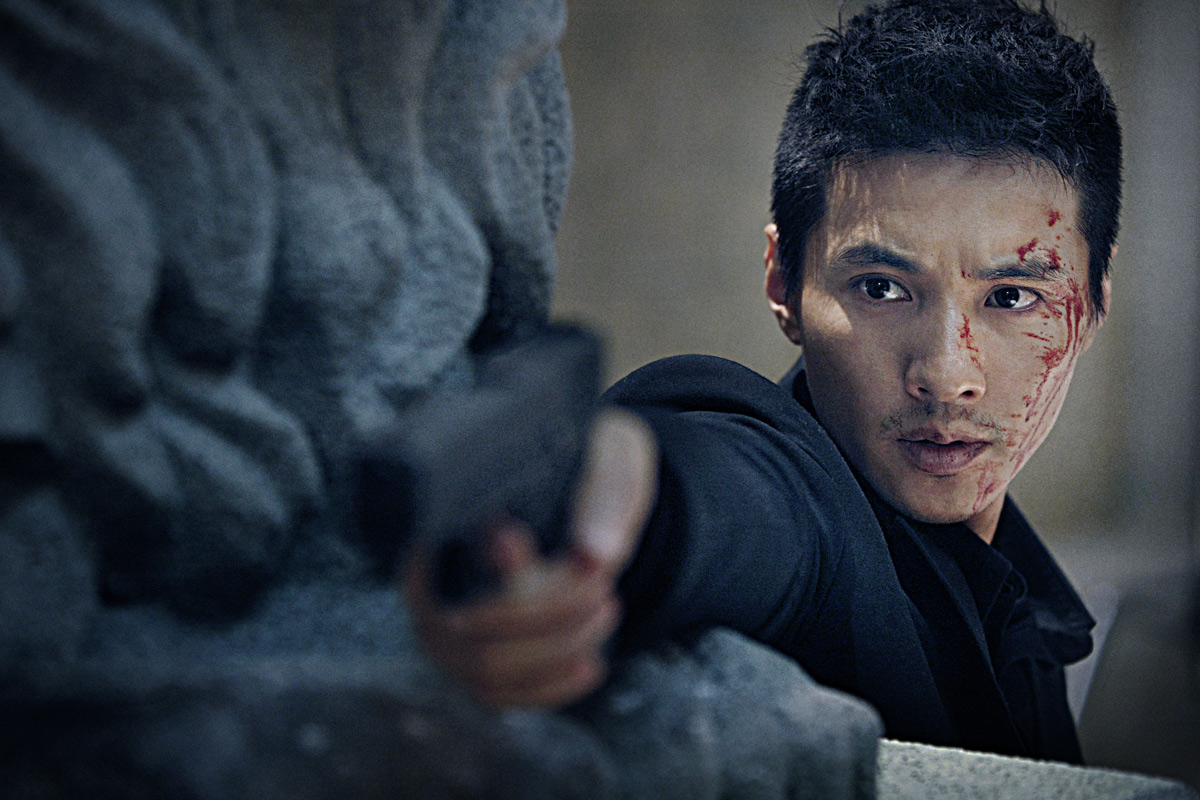
7. The Man from Nowhere (2010)


I would be remised not to include at least one South Korean film on my year end list.  While I failed to watch as many as I would have liked, this accidental inclusion during my Kung Fu marathon was by far my favorite contemporary work from a country that still pushes the boundaries of cinematic possibility.

Review Here

6. Gold Diggers of 1933 (1933)


There is a agreed argument that Singin' in the Rain is the key text in the genre of the musical.  This is certainly true, but this Busby Berkeley choreographed film that has become a point of feminist critique is pretty damn close to its equal.

Review Here

5. Existenz (1999)


While this is probably not a universally adored Cronenberg film, it has, nonetheless, proven to be the single most important alteration in my understanding of cinematic possibilities and by extension my own continually evolving research interests.

I some how failed to actually blog about this film!

4. How the West Was Won (1962)


I watched a lot of westerns in May.  Most of them were brilliant.  While this is not the single most realized western, the use of Cinerama made it my favorite by far and it is essentially all the best parts of various westerns combined into a single epic film.

Review Here

3. Mind Game (2004)


I watched this film twice this year, it is still an enigma.  Furthermore, I watched quite a bit of animation, but this by far stretched my understandings of its conventions to their greatest point.

Review Hhttp://cinemalacrum.blogspot.com/2013/07/fear-takes-shape-we-are-willing-to-give.htmlere

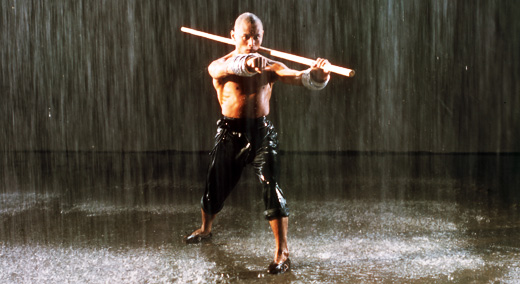
2. The 36th Chamber of Shaolin (1978)


If I were told two years ago that I might seriously add a kung-fu film to my top ten films of all time, I would have scoffed off the possibility, but then I saw this film.  Body identity and Buddhist learning oversee what might well be one of the most stunningly shot action films ever made.

Review Here

1. A Matter of Life and Death (1946)


A absolutely moving film, this Powell and Pressburger film is a perfect navigation of color and black and white filmmaking that simply has to be seen to be believed.  While it does not receive the praise and adoration of The Red Shoes it is easily the greatest of the directing duo's works.

Review Here

Honorable Mention

On Her Majesty's Secret Service (1969)
The Illustrated Man (1969)
Fantastic Planet (1973)
Possession (1981)
Sunshine (2007)